

When the Black Girl Sings by Bil Wright
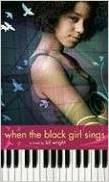 If When the Black Girl Sings by Bil Wright was a dish served at a fancy restaurant it would be described as “adoption woes over a bed of teenage angst served with a side of parental problems and an empty glass of communication.” Doesn’t sound like a favorite dish you would order time after time, but it does fill a definite need on the menu.
The main character, Lahni, is a 13 year old black girl who was adopted by white, heterosexual parents when she was a baby. Living with white parents in Connecticut, Lahni attends a private school, with only a handful of non-white students. She feels completely out of place, alone and unable to connect with friends. Adding to her troubles, her parents are getting a divorce and her father has a new “friend”. Then her mother suggests they try going to church, where Lahni meets and befriends the choir director and the church’s soloist who are both black. She is coerced by her music teacher, who sees promise in her, into joining a singing competition at her school. Lahni joins her church choir to help her prepare for the competition and in the end finds her voice.
I found at many times in this book I was frustrated with Lahni and her parents mainly because they seemed to be hopeless at communicating honestly with one another and others around them. After a particularly upsetting incident at school where a classmate calls Lahni an “African baby on a television special” her mom says, “Maybe she meant it as a compliment.” Or when Lahni’s dad finds her waiting outside the door listening to her parents scream at one another, he simply takes his suitcase and gets into the taxi. Lahni, following the role models set out for her, never talks with her parents (or anyone) about how it feels to be a black child adopted by a white family or about the troubles she has as the only black girl in her grade. Lahni keeps her best friend at bay, only telling her about her parents impending divorce at the very end and then again shuts her friend down when she asks questions. Lahni’s struggle with communication does not end with her inability to share her thoughts, but it seems she is not able to garner messages others are telling her as well. Her music teacher and choir director clearly express on multiple occasions their admiration for her singing, yet even to the end Lahni refuses to have confidence in her ability. That said, the teenage years are not perfect. Transracial adoption is not always heart-to-heart chats and a warm cup of cocoa. And I am NOT a black, teenage girl being raised by struggling white parents, so perhaps I just don’t get it. And perhaps there is some reader in Lahni’s exact situation who will want to take Lahni into her heart because she is singing the reader’s song.
At one point in the story, Lahni is being stalked by a white boy in school who calls himself Onyx 1. This boy focuses his affection on Lahni purely based on his desire to date a black girl. Later he gets in a knife fight with two black boys and he calls them “two black apes”. When Lahni hears this, she is so confused about how a person can want to date someone who is black, nickname themselves “black” and then use racial slurs. In typical teenage style, although scared of Onyx 1, she chooses to handle it on her own. Lahni never mentions it to her parents or to another adult until the end of the book after she is forced in a deserted parking lot to confront him. I dislike the fact that the author had Lahni deal with this issue on her own. Obviously, in fiction the author managed the confrontation to work out in Lahni’s favor but in real life confronting a stalker is truly dangerous. I want the message to young adult readers to clearly state, “ask for help from an adult if this happens to you.” I did however like that the author kept Onyx 1’s character as undesirable and Lahni told him to get lost. Too many times, plots include the “good girl” falling for a “bad boy” when she discovers his soft side.
This book has a light Christian theme to it, but it is not overwhelming. In the beginning Lahni attends church for the first time and by the end she performs “His Eye is on the Sparrow” and realizes she is not singing but she is in fact praying.
Recommendation: This book is suitable for readers age 13+.
Reviewer: Amanda Setty

Donovan’s Big Day by Leslea Newman
 A close examination of the cover of Lesléa Newman’s Donovan’s Big Day — which features two, shiny gold rings dangling overhead — hints that the story involves a wedding. If you miss that cue, you’ll probably spend half of the book wondering just what Donovan’s “very BIG day” is all about. (Which could actually be a lot of fun for young readers!) But if you’re a fan of Newman’s work, you already know it’s not a “typical” wedding. Newman is one of a handful of authors who pens children’s books featuring same-gender parents and how their families are just like every other family out there. And Donovan’s family, as well as his big day, is no different. (more…)

Good Dream, Bad Dream by Juan Calle and Serena Valentino
 Good Dream, Bad Dream turns a traditional meet-your-fears-head-on storyline into a global bilingual adventure. This book is about a boy, named Julio, who can’t get to sleep because he’s afraid monsters will terrorize his dreams. But his papa reassures him that every monster will meet its match when confronted with a bedtime superhero.
Every line of this children’s book features a different mythical hero from various cultures across the globe to fight a monster—a cunning companion for each devilish spirit, so to say. Grecian heroes defend the weak against Grecian monsters, African warriors fight African beasts, Mayan gods combat Mayan monsters, robots destroy evil aliens, and so on. To tell the tale, there’s even an accompanying bilingual Spanish translation to help teach young readers Spanish, or to make it easier for Spanish-speaking children to understand the storyline.
Seven talented artists came together to illustrate the vibrant, comic book stylized drawings in Good Dream, Bad Dream. The full-color pages offer visual cues into the characters of the various creatures and champions who make appearances in children’s’ minds all across the world. But on a negative note, those bright depictions may be too distracting for the child to clearly read the words on the page for themselves. So it would be best for the adult to read the story the first time, and to help the child follow along by trailing each sentence with their finger.
A former Kickstarter project, Good Dream, Bad Dream is available for purchase in October 2014.
Recommendation: Recommended (Just make sure you’re there to lend a hand if the child can’t make out the words on the distracting pages.) Ages 5-8.
Reviewer: Kaitlyn Wells

The Favorite Daughter by Allen Say
 Many of us with foreign or (to Americans) impossible-to-pronounce names will relate to Yuriko’s conflicts in The Favorite Daughter—people make fun of and butcher her name so she wants an Americanized one without cultural or linguistic baggage. There’s also an additional layer of complexity to Yuriko’s identity—she’s mixed (there are two photographs of the real Yuriko in the book: she has blonde hair and Asian facial features). In addition, since the book begins with “Yuriko came to stay with her father on Thursday that week,” this may be a divorced family as well. Allen Say navigates all of these complexities with grace, subtlety, humor, and most of all, love.
Yuriko is upset that her classmates tease her after she shares a baby picture at school, and the new art teacher mispronounces her name. At home, she tells her Japanese father she wants an American name, “Michelle”. He goes along with it, saying “Michelle” is his new daughter, even introducing her as such to the owner of a Japanese restaurant. When she acquiesces to letting the owner call her Yuriko, he gives her a bundle of disposable chopsticks as a gift.
That weekend Yuriko and her father go to San Francisco because she has to draw the Golden Gate Bridge for the new art teacher. But first, her father takes her on a “real quick trip” to “Japan.” They visit a Japanese garden and a Japanese ink painting master gifts her with a painting of a lily, as Yuriko means “child of the lily” (a nod to a Caucasian mother?). He writes her name in Japanese, and Yuriko says, “I’m going to learn to write it.” Unfortunately, by the time Yuriko sees the Golden Gate Bridge, it’s covered with thick fog. She sulks, thinking her art project is doomed.
But things work out: Monday morning Yuriko returns to school owning her name/identity as well as a creative piece called “the Golden Gate in the fog” (disposable chopsticks and cotton). She signs the project Yuriko, not Michelle, to which her father responds, “That’s my favorite daughter!”
Recommendation: Highly Recommended. 4-8 years.
Reviewer: Yu-Han Chao.

Let Garcelle Beauvais Read Your Children Their Bedtime Story Tonight in Person, For Free
 Los Angeles, CA
Friday September 12
7pm
PAJAMA READING PARTY.
ALL ARE WELCOME
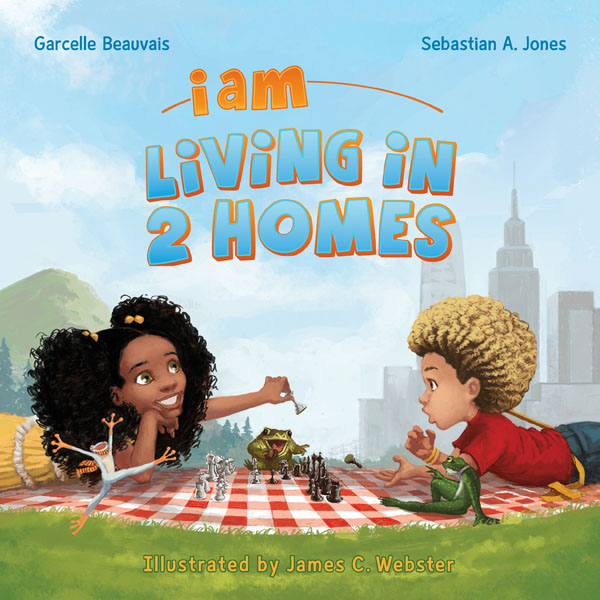
Come one, come all to a beautiful evening where authors Garcelle Beauvais and Sebastian A. Jones will read to you and your kids their two books from the I Am Book Series, I AM MIXED and I AM LIVING IN 2 HOMES. Get your copies signed. Take a pic. You never know who will show up.
 Barnes & Noble at the Grove
189 Grove Dr K30,
Los Angeles, CA 90036

Omilaju Miranda, Founder of Mixed Diversity Reads, Recognized on Thank You Page
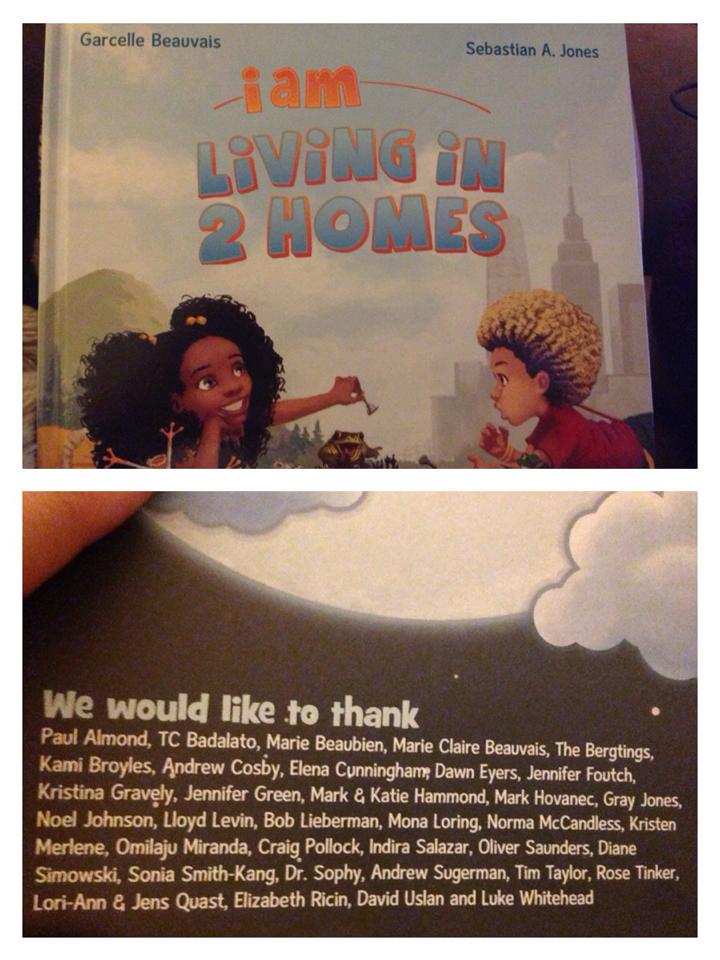 Follow @Diversekidreads Authors of I Am Living in 2 Homes and I Am Mixed, Sebastian A. Jones and Garcelle Beauvais thanked the founder of Mixed Diversity Reads Children’s Book Review, Omilaju Miranda, amongst other contributors and mixed and multiracial community advocates on the gratitude page of I Am Living in 2 Homes. Pre-book sales of I Am Living in 2 Homes started in June and August 19, 2014 was the release date for the book, which features fraternal twins of mixed heritage, working through the joys and sorrows of life in the aftermath of their parents’ divorce. Read our review and buy the title for your kids.

Always an Olivia: A Remarkable Family History by Caroliva Herron
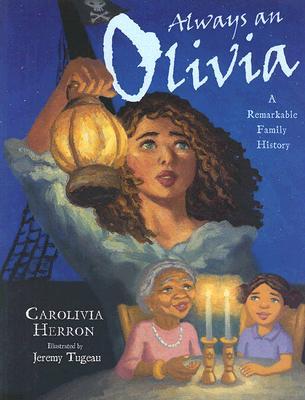
Heartbreaking, historically informative, and beautifully illustrated, Always An Olivia:A Remarkable Family History is the true family history of scholar and author, Olivia Herron (Nappy Hair) whose family has preserved their Jewish traditions even seven generations removed from the family’s Jewish matriarch. While the story is being told to a granddaughter in 2007 by her great-grandmother, the narrative actually tells the story of their ancestor Sarah who, hundreds of years ago, was the Italian Jewish granddaughter of victims of Jewish pogroms in Spain and Portugal. She is captured by pirates to be ransomed off but saved by another captive with whom she falls in love and sails to the USA to avoid recapture, death or the burning of the homes and businesses of the Jews to whom she was supposed to be ransomed. Still afraid of anti-Jewish violence, Sarah adopts the middle name Olivia instead of using her given middle name, Shulamit.
In the U.S., customs settles Sarah and her husband on the Georgia Islands in the free, black African Geechee community. Sarah and her husband have children and their children marry Geechees. Their descendants continue to practice the Jewish rituals that Sarah remembered (because, the text lets us know, she forgot many) including lighting the Shabbat candles on Friday nights. The women are the keepers of the tradition from being in charge of lighting the Shabbat candles to the legacy of naming a daughter of each generation Olivia or, as Sarah requested, a name that means “peace”. They choose to preserve the original name by naming a girl in each generation “Olivia” after Sarah.
From the opening line in which the girl child Carol Olivia asks her great-grandmother about black U.S.American slavery and is told that her family experienced enslavement in Egypt, witnessed U.S.American chattel slavery, but was not descended from enslaved black U.S.Americans, this biography is an eye opening account of the different histories of blacks and mixed racial heritage people in the U.S. since the 16th century.
Despite the book’s engagement of the heavy subject matter of slavery, racial and religious persecution, kidnapping, family separation, and near identity loss, there is a hopeful tone in the reading, achieved through James Tugeau’s use of light in his dramatic pastel illustrations, the tone of the narrative, and narrative breaks in the relaying of violence to fully describe life in peaceful times. Thus, this story of a resilient family communicates the necessity of remembering family history. Always an Olivia makes it clear that despite their family history of terror, renewal, survival and reinvention, the family of Olivias is proud of, and takes comfort in, their family traditions and heritage.
Recommendation: Highly Recommended; Ages 8-Adult (buy)
Reviewer: Omilaju Miranda

I Am a Ballerina by Valerie Coulman
 The pastel drawings of I Am a Ballerina are soft and subtle, and the story straightforward and sweet. Not overly pink and frilly, and not going too deep below the surface of a little girl exploring a new passion, this book would be a great read for children considering a new sport or interest.
After watching a ballet performance on her birthday, little Molly decides that she is a ballerina. At first her parents’ response to her leaping around the house in imitation of the gazelle-like picture of a ballerina on her wall is, “Jump down, dear.” When she smears her face with baby-blue eyeshadow and rouge, announcing herself as beautiful as a ballerina, her mother tells her to, “Go wash your face, dear.” Finally, after she nearly knocks some things over, her father concedes: “If you’re going to be a ballerina, maybe you should take some lessons.”
At Madame Cherie’s ballet school, Molly falls and trips, but it’s all part of learning. She practices and practices, and finally dons a merry-go-round horse costume for the ballet performance. The moment at the end of the book that Molly truly feels like she is a ballerina, however, is when her father lifts airplane-style: “It felt like flying. And then I knew…I am a ballerina.”
As seen in some “diverse” children’s books, the author plays it safe, saying nothing about ethnicity or appearance, even though the illustrator makes a point of creating a distinctly mixed family. Molly’s father is Caucasian or mixed, with curly brown hair and a bushy moustache, whereas her mother is Asian-featured. In this case, however, since it’s a nice ballet story that’s realistic and not overly pink and filled with tutus, I don’t mind that Asian-looking Molly isn’t identified ethnically or culturally (for all we know, her father is her stepfather, or she’s adopted).
Recommendation: Recommended: 4-6 years
Reviewer: Yu-Han Chao

Yoko Writes Her Name by Rosemary Wells
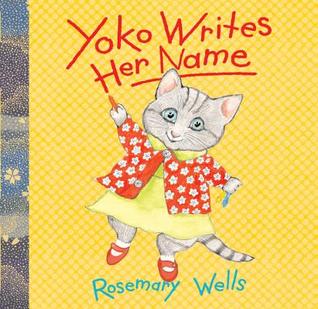
Rosemary Wells’s Yoko Writes Her Name, a contemporary fable about linguistic difference, shows what kindergarten might be like for an ELL (English Language Learner) kitten or child. Through this book a child might learn some good lessons about diversity, forgiveness, and acceptance. Little gray tabby Yoko speaks and reads out loud in English, but writes in Japanese, and that is how the whole story and conflict begins.
The first time the teacher asks everyone to write their names, Yoko writes hers in Japanese, and the teacher acknowledges “How beautifully Yoko writes in Japanese,” but two other kittens in kindergarten whisper, “Yoko can’t write. She is only scribbling!” “She won’t graduate from kindergarten!” Things get worse when the teacher invites Yoko to bring a book from home to read to the class and she reads it from right to left, not left to right. “Yoko is only pretending to read!” “She’ll never make it to first grade!” the mean kittens say.
Yoko feels forlorn and dejected until a gray mouse seeks her out and admires her “secret language.” She teaches him how to write out numbers in Japanese, and soon all the little animals want to write their names in Japanese. On parent’s night, Yoko’s mother brings in a big Japanese alphabet and the teacher declares that Japanese will be the class’s second language.
Soon Japanese is everywhere in the classroom, and all the little animals, with the exception of the two mean kittens, learn to write their names in Japanese. On graduation day, the class writes their names in two languages on their diploma, but the two mean kittens hide in the closet, worried they won’t graduate. Yoko finds them and teaches them to write their names in Japanese—just in time to join the graduation march.
While this book makes Japanese seem easier to learn than it might be for a kindergarten teacher and her class, it’s a nice ideal of how such a conflict would be resolved in a fantasy world. The illustrations are adorable, and in the top corners of facing pages the author/illustrator provides a small picture of things like a cup or a dog, and its corresponding page is the Japanese translation. You or your child probably won’t pick up Japanese from this book if you don’t already read and speak it a little, but this is the kind of multicultural text schools and libraries should have to celebrate diversity and inclusion.
Recommendation: Recommended: 3-6 years
Reviewer: Yu-Han Chao

Visiting my Father’s Homeland: Book Review for I Lost My Tooth in Africa by Penda Diakité

Losing teeth is a rite of passage for every child and, based on twelve-year-old Penda Diakité’s I Lost My Tooth in Africa, a visit from the elusive tooth-fairy is a welcome surprise for children all over the world as well—even in Mali, West Africa!
In the story, Amina, a girl born and raised in the U.S., and her family travel from Portland, Oregon to Bamako, Mali, her father’s birthplace and childhood home. Amina’s loose tooth—which she discovers while en route to Mali— tags along. After her father shares with her that the African tooth fairy trades a chicken in exchange for a little boy or girl’s tooth, Amina is determined to lose her wiggly tooth before this family trip to Africa is over.
Infused with a strong representation of words from Bamabara (a glossary is in the back of the book), the most widely used indigenous language of Mali, and Malian cultural traditions, I Lost My Tooth in Africa is a mildly suspenseful narrative that children between the ages of 5 and 8 who are also going through the “snaggle-tooth” phase could especially appreciate while learning informative tidbits about a new culture and geographical location. The children in your life will be further inspired by the fact that this book, published by one of the five major publisher’s of children’s books, is the creation of a pre-teen author and her illustrator father.
Recommendation: Highly Recommended ages 5-8
Reviewer: LaTonya Jackson
 Diverse Kids Books--Reviews