
Home » African American Child (Page 3)
Category Archives: African American Child
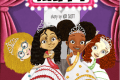
My Hair is So Happy by Nik Scott
 I thought any little girl with curly hair would love seeing images similar to herself in this book. My first response when I read it was “I love these illustrations.” As I read, it was exciting to see four girls representing nearly the full spectrum of skin tones and hair textures found amongst African Diaspora and African Diaspora mixed heritage kids. The writing makes a well-intentioned commitment to reforming the language of curly hair from “nappy” to “happy”. There is no story here though and no character-based reasons for a child to attach to any of these characters. Many will find it disconcerting that, in a book that seems to celebrate unity and self-love, the characters are participating in a beauty contest. Although they are all wearing tiaras and “Lil’ Miss Curly” sashes, we all know that competition means someone must be judged better or more beautiful than the other. Also, depending on one’s beliefs, there is language of being “fearfully” made that may be inexplicable to your children. When I read the book to my three-year-old, she asked why the girl was happy, was more interested in the dog in the illustrations and started chanting “My Hair is So Angry.” If I were a child psychologist I would analyze my daughter’s responses and offer insight into how other little girls might respond to this book but I’m not. As a reader and writer, I say the illustrations in this book offer images showing girls enjoying all aspects of life while leaving their hair curly and parents can create many conversations based on these images.
Recommendation: Recommended. We rarely see these many representations of different types of curly-haired children on the page and these girls are also happy and happy about their hair so if that is valuable to your little one, buy the book.
Book Review by Omilaju Miranda.

I Love My Hair by Natasha Anastasia Tarpley
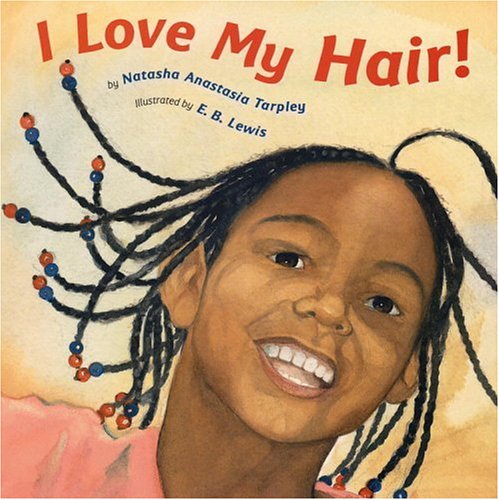 This board book is a first person narrative that lets you hear the defined voice of a child on a journey of loving herself led by her own mother’s love. The book doesn’t fall into the categories to which this page is dedicated however, it is a wonderful celebration of the realistic challenges and versatility of Afro-curly/ kinky coily hair that I think many on this page will find value in reading it with, and for, your children with Afro-curly hair. Discussing everything from necessary oils, the occasional tear-inducing pain of combing and the wonder of hair that braids well, curls into the air and afros out, If you are looking for a resource outside of yourself to validate the natural beauty of your child’s hair, this is one of the best books I’ve seen. As there is no father mentioned, single mothers can enjoy this book as a reflection of their relationship with their children as well.
Recommendation: Highly Recommended; Ages 4+
Reviewer: Omilaju Miranda
Amazing Grace by Mary Hoffman
 Grace has a limitless imagination. Like many of the children who will read this story, she likes to dress up as any character she has ever seen or can imagine from spiders to pirates. When her teacher announces that the class is going to stage “Peter Pan”, Grace wants to play the lead role of Peter despite the fact that two of her classmates tell her she can’t play Peter because he is a boy and he’s white. Grace who lives with her single mother and grandmother goes home sad, and her mom and grandmother assure her that she can play Peter if she wants. Grace memorizes Peter Pan’s lines and Grandma even takes her to the ballet to see an Afro-Trinidadian friend of the family play Juliet in “Romeo and Juliet”. Grace wins the part of Peter and does an amazing job playing the role. Every child with an imagination will connect with Grace. Children of single mothers or parents who get tired but still make time to play will see themselves reflected in Grace’s family. My 3-year-old expected the story to continue so the fullness of the story arc will register more with readers instead of pre-literate children.
Recommendation: Highly Recommended; Ages 6-9
Reviewer: Omilaju Miranda

All the Colors of the Earth by Sheila Hamanaka
 Poetically, the children of this book become the natural bounty of the earth, their skin color and hair textures compared to the beautiful colors of nature and hair compared to the textures of other living creatures.
With typical sentences/stanzas like,
“Children come in all the colors of the earth—
The roaring browns of bears and soaring eagles,
The whispering golds of late summer grasses,
And crackling russets of fallen leaves,”
a child is able to glean a confidence-inspiring insight into their physical look. This is a beautifully illustrated book that lives up to the lyrical poetry of its narrative. The illustrations go far beyond the normal representation of the human rainbow and, with very detailed rendering of facial characteristics, skin complexions and hair textures, the reader sees real differences in many, many different ethnic types. On the pages of this book, children of every ethnic heritage will find reflections of themselves enjoying life and the world around them. While every physical type of child is represented in ‘All the Colors of the Earth,’ only interracial families are represented, which I think is an exceptional and novel choice however disappointingly inconsistent with the universal inclusiveness of the other illustrations.
Recommendation: Highly Recommended; Ages 3+
Book Review by Omilaju Miranda.

Everywhere Babies by Susan Meyers
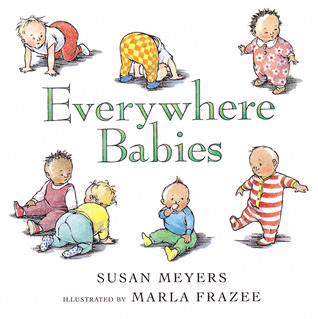 This sweet board book is a like a buffet of babies charming both children and adult readers. The author, Susan Meyers, and the illustrator, Marla Frazee, celebrate baby’s first year of life beginning with swaddled newborns, through all the late night rocking and feeding, into the crawling and playing, exploring life all the while and ending with a cake-covered baby on the first birthday. It is very clear Meyers and Frazee spent a lot of time just watching babies and families. It is also unmistakable they had a message when writing this book—diversity is joyful. We see light-skinned hands lifting a dark-skinned baby and a light-skinned baby reaching out for dark-skinned hands. We hear that babies can be fed “by bottle, by breast, with cups and with spoons.” We see two moms, single parents, two dads, twins, a variety of body shapes and sizes, grandmas and grandpas, and many combinations of skin tone. This book really is the I Spy of family diversity, so the reader will have no problem finding a picture that resembles himself and his family.
The one criticism I have for this book is we do not see any persons with physical disabilities. There is one grandmother holding a baby on her knee while her cane rests beside her, but no obvious example of a child or parent with a disability. We see babies crawling and one baby learning to walk, but it would have been lovely to have seen a child with a walker or braces on her legs. Beyond that, I have nothing but glowing remarks for this book. It is an old favorite of ours and my go-to present for 1-year olds, given that it ends with a birthday party. The closing of the book also speaks to me personally as the mother of an internationally adopted child. “Every day, everywhere, babies are loved—for trying so hard, for traveling so far, for being so wonderful… just as they are!” This simple inclusion of “traveling so far” always made me and my child feel as if the story was hers.
Recommendation: I highly recommend this book for ages 9 months to 3 years. It deserves a place on every book shelf in every home and every place of learning.
Book Reviewer: Amanda Setty
Willow by Denise Brennan-Nelson
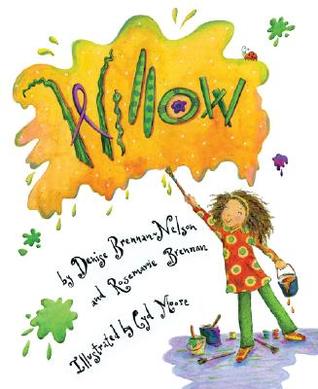 Willow, the protagonist of this book has a personality reminiscent of Eloise and Madeline. Her stubborn determination to be imaginative and artistic even as her art teacher, Miss Hawthorne tries to break the spirit of creativity with rigid rules eventually transforms her teacher. Willow’s open, loving spirit is innocent and generous and the story is an inspiring example of adult-child interaction. The illustrations are energetic, riveting paintings that transport the reader into a parallel universe of creativeWorld. I’ve already gifted this book to one of my daughter’s friends. I bet you’ll find it just as infectious and worthy of sharing.
When one reads Willow, it is easy to believe that you are reading about a child of color, however I bought the second book in the series, Willow and the Snow Day Dance and the character’s parents are both white with no explanation of adoption so I’m thinking that I’m wrong about her being a child of color. In addition, when I read A Fire Engine for Ruthie, I noticed, with the illustrations of Ruthie that it is Cyd Moore’s style to draw her girl protagonists with wavy krinkly hair (although that doesn’t negate Willow’s brown skin). I emailed the illustrator, Cyd Moore and the publisher, Sleeping Bear Press asking if Willow is a child of color and have not yet received an answer. Despite that, I’m including Willow on this site because sometimes children just need to see their likeness on the page in a book with a real story and a child with a dynamic personality, and there are plenty of children of color who can look at Willow and see themselves in her light brown skin and wavy hair that grows out instead of down.
Recommendation: Highly Recommended; Ages 5+
Reviewer: Omilaju Miranda
A Father Like That by Charlotte Zolotow
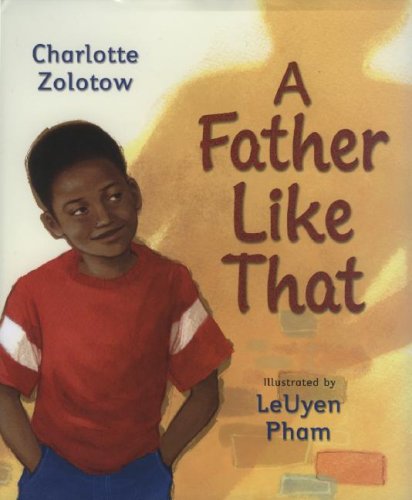 So just bowl me over and break my heart. This narrative comes from celebrated author Charlotte Zolotow who recently passed away. Books like this of hers make us thankful for the stories she gave us before moving to the next life, while we feel the void left in the future children’s literary canon. With the direct, “I wish I had a father,” Zolotow opens up this first person narrative with the painful yearning of her protagonist’s existence. In the conversation with his mother that follows, we see how a child missing a parent imagines a full and complex icon of love for himself and his mother. His pining for a father has moved him to think of every aspect of how a father would treat him and communicate with him, including the way that father would smooth things over with mom and speak in a low voice when angry. An insightful rendering of the depth and breadth of a child’s understanding of the nuances of human relationships, the book gives all single parents a role model in the mother who is just as powerfully evocative. In her one line, she responds with sensitivity to her son’s description of a father, embracing that that type of father sounds wonderful and offers the empowering suggestion that if that father never comes, the protagonist can be that type of father himself one day. Blow me away—this picture book has delivered the best response to a child wanting an absent parent that I’ve heard in a long time. LeUyen Pham’s illustrations pull us in and hold us close to the family of this child’s imagination and secure our emotional connection with mother and son at the end. The narrative is very intimate and feels targeted to the community it specifically represents.
Recommendation: Highly Recommended; ages 6+
Reviewer: Omilaju Miranda

Documentary Film –“Off and Running: An American Coming of Age Story” by Avery Klein-Cloud and Nicole Opper
 Spanning two years in the life of high school track star, Avery Klein-Cloud, this is the documentary of her journey to reconnect with her birth mother. New Yorker Avery Klein-Cloud is the African American daughter of two white Jewish mothers and sister to two brothers –one Korean and the other African American and Puerto Rican. The documentary opens with Avery reaching out to her birth mother and in a heart wrenching, emotional journey of attempting to balance living a high performer’s daily life with hoping to fill in the voids of her identity, we watch Avery struggle with both of her families, school, and a new found Black awareness as part of her personal self-knowing. At the risk of spoiling, this film is a testimony to the power that love and raising a child with all possible social, familial, and educational advantages have to make sure that those who lose their way make it back home.
I highly recommend this film for everyone and definitely for transracial families and soon-to-be transracial adoptive parents.
Available on Netflix , Shop PBS, and Amazon.
–Transracial Adopted Child (African American/Jewish)
Recommendation: Highly Recommended
Reviewer: Omilaju Miranda
In Our Mothers’ House by Patricia Polacco
 This is one of the best first person narrative children’s books I’ve ever read. The voice is so authentic I thought it was a children’s nonfiction story until I read the back bookflap. An African descendant woman tells the story of her life with her two mothers, Asian brother and carrot-top sister from their at-birth adoptions until their parents pass away, leaving the family home to the protagonist’s brother. Polacco’s narrative style is one of such candor and fluidity that as the protagonist shares with us the milestones of her life from becoming a big sister to seeing her mothers in dresses for the first time to finding emotional comfort in the home after her parents pass away , the reader is increasingly emotionally invested in their ever expanding world of friends, family and tradition. Polacco also includes the conflict of an anti-gay neighbor in the book, who turns the dial up on that confrontational anti-gay anger pretty high without actually saying “lesbian, gay, or homosexual.” The mothers handle the confrontation in a protective and reassuring manner that gives parents reading this book with children the freedom to explain as little or as much about sexual orientation as parents wish, including saying nothing about sexual orientation and just explaining that sometimes people don’t like others who are different. Illustrated with engaging animation and expressiveness, readers will see and feel a full spate of emotions as we do in real life. While the mothers demonstrate friendly touch affection towards each other and familial touch affection toward the children, for some, it will be important to see that the three children enter heterosexual marriages, framed in family portraits near the end of the book. The choice to show the oldest daughter and the son married to people within their “own” racial groups, demonstrates to me a silent acknowledgement of efforts made by the Italian and English-Irish mothers to encourage, support and preserve their children’s unique cultural identities. Complete with three children who grow up to become successful professionals with happy families of their own, In Our Mothers’ House is the multi-dimensional All American LGBT-parent family story.
Recommendation: Highly Recommended; ages 6+
Reviewer: Omilaju Miranda
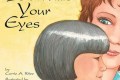
I Don’t Have Your Eyes by Carrie A Kitze
 Written with transracial adoptee children in mind, this book, with a series of lyrical statements, contrasting the differences in the physical appearances of children’s and parents’ body parts to the emotions, attitudes , and life perspectives associated metaphorically with the physical, sensorial, or functional purpose of the body part, communicates the conscientious and humane value system that parents teach and transfer to their children with such fluidity and beauty that you feel the text bringing you and your child closer and helping your child see the best in themselves and their depthful connection to you. In no cheesy, but a substantial, poetic, non-didactic prose, the book really conveys that who we are and who we help each other grow to be inside is what is valuable and what makes us family. The illustration is beautiful, realistic and includes illustrations of many different parent-child racial pairings including parents and children who share the same race but obviously different features so it doesn’t have to read as a book about “all of us racially different kids”; a child walks away from this book understanding that no one looks exactly like their parents but the loving way we navigate in the world is the offspring of our parents way of raising us.
Recommendation: Highly Recommended; Ages 4-12
Book Reviewer: Omilaju Miranda
 Diverse Kids Books--Reviews