
Home » Bilingual (Page 4)
Category Archives: Bilingual
Mama, I’ll Give You the World by Roni Schotter
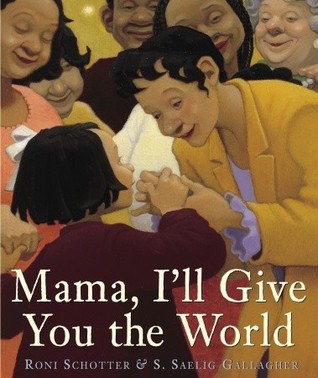 “When Papa was around, Mama loved to dance, but Mama doesn’t dance anymore,” is the first line of Mama I’ll Give You the World and that semi-vague statement is all that is ever said about the absent Papa that lives in the subtext of this children’s story. Perhaps he has passed away, maybe he has abandoned the family; either way, children being raised by single mothers with no father in their lives will feel like their family construct is reflected in Luisa and her mother’s family. Luisa’s mother wants to give Luisa the world that is “so big. So much more for you to know. So much more for you to see.” And that starts every day with Luisa doing her homework beneath a palm tree in the beauty salon and Luisa’s mother saving for Luisa’s college tuition. Doing homework looks exotic, Luisa’s working class world looks like a holiday getaway.
The text is accessible prose that brings the reader smoothly and easily into Luisa’s daily life with her mother in Walter’s World of Beauty– the beauty salon where her mother works. As is so often the case in real life, the salon where Luisa’s mother works is a community gathering place where Luisa’s extended family bonds. The story is a narrative of Luisa communicating with all the adults (hairdressers and clients in her mother’s hair salon) to organize a special gift for her mama—a secret gift that even surprises the reader. Luisa’s dedication to her mother culminates in a climax that made me cry as her daughter celebrates her mother’s birthday by connecting her mother to the past. In the midst of the celebration, the story subtlety introduces a new suitor who has been a trusted friend throughout the book.
Luisa is an observant, sensitive, intelligent character who loves her mom, communicates impressively, and with the realistic precociousness of a child, who while protected by many adults in her life, also lives with the worry about her mother’s happiness and past that overshadows their lives. The illustration is fanciful and engaging, telling the story of the loving community to which Luisa belongs.
Luisa’s world is diverse, filled with people of all races and may ethnicities. Although there are no Spanish words spoken, several of the characters bear Spanish names and the full range of physical features found amongst white, tan and moreno Latinos. Children whose families are from many parts of Latin America—whether the Spanish Caribbean, Central, or South America will feel reflected in the characters represented. Additionally, there are two male hair dressers working with Luisa’s mother—one of whom seems to be slightly effeminate so that without saying it directly, we see that Luisa lives in a diverse and all inclusive world.
Recommendation: Highly Recommended
Reviewer: Omilaju Miranda
Hairs & Pelitos by Sandra Cisneros
 A very simple story told by a little girl who seeks comfort in her mother’s smell, embrace, and love. The first person narrative partially frames the oil painting illustrations with the English text at the top and the Spanish text at the bottom of the page. The protagonist enters the story through a discussion of her family’s different hair types. With uncommon descriptions of their hair as analogous to brooms, rosettes, and fur, she tells us of the diverse look and behavior (slippery, lazy, etc.) of her family members’ hair. Diversity is also found in the family through the illustration of each of them as a different color so that they are literally a rainbow family. The front and back covers of the book have educational lessons and crafts exercises for readers making this a hands on bilingual story of family love.
Recommendation: Highly Recommended; ages 5+
Reviewer: Omilaju Miranda
I Love Saturdays y domingos by Alma Flor Ada
 This is a valuable book to show the bilingual and bicultural immersion of a girl who is multiracial Mexican and Caucasian USAmerican. On every alternate page the protagonist speaks Spanish with her Mexican grandparents. On the surface, the grandparents are different—in addition to their race/ethnicity, the USAmerican grandparents live in the city or suburbs, the Mexican grandparents live on a farm near a fishing pier. The illustrations are lively and evocative. It is a formulaic story of comparisons: My grandpa buys me balloons: my abuelo buys me a kite; my grandma makes pancakes; my abuela makes me huevos rancheros…fourteen pages in, I drifted from boredom. Despite the fact that the comparisons went on for too long in my opinion, the parallel lifestyles and interests of the grandparents makes a powerful impression on the reader of the similarities of people who seem very different. Although the details of their lives are very different, both sets of grandparents love their pets, enjoy the circus, like making things by hand, create exceptional ways to make the protagonist happy and, of course, love their granddaughter.
The plot turn which is actually fun should have come earlier in the book—the protagonist has a party at her house that both sets of grandparents attend during which the grandparents help out with the children. The Pinata and the traditional Mexican birthday song are fun. You and your child may actually want to learn the song as I did.
Recommendation: Mildly recommended
Reviewer: Omilaju Miranda

My Mom is a Foreigner but Not to Me by Julianne Moore
 I love this book so very much
I can read it ten good times
She represents a child’s experience
With such cool, catchy rhymes
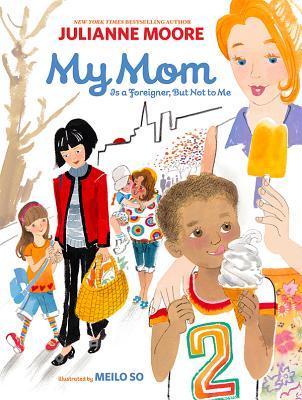
This book by Julianne Moore, primarily written in ABCB rhyming quatrain stanzas, is a first person narrative from the perspective of a dozen different children, which talks about the varied experiences of a child living in the U.S. with a mother from another country. The illustrator, Meilo So has chosen a “framed” illustration style which, other than the fact that it leaves a lot of white space on the page is successful at providing images for many different aspects of the “story” simultaneously.
Not only do I like the fact that Moore’s rhyme is perfect ninety per cent of the time, the text shows the dynamic conflicts faced by children who love their mothers but experience, with a little shame, all of the ways in which their mother is different from other mothers and people they encounter daily, including their different food and culturally different greeting and doting customs. The children also communicate their discomfort with their mothers’ use of a different language in communicating with them and their mothers’ slow mastery of English as their second language.
Most of the children from whose voice the book is written appear to be between the ages of 7-11. While there are several pages in the book illustrating the mothers caring for a second child in the infant/toddler age range, there is only one page in the book that shows a mother and father together (in a photo on a dresser) so children living in single-mother led households can easily find a reflection of their family construct in this book.
Most of the mother-child relationships in the book are clearly representative of an interracial family (even though we don’t see fathers) with children who look racially different from their mothers. Moore and Meilo So cover the full gamut of children who look racially different from their mothers whether the mothers are East Asian, Subsaharan African, or Dutch with children whose features present as the entire world spectrum of all racial/ethnic features. Meilo So does not just throw kids on the page who are holding hands with mothers—no, her vivid, emotionally realistic, water color illustrations are done with such attention to detail that on one page there is a brown-skinned, gele scarf wearing mother with her pale-skinned, red-haired daughter who the reader can see look exactly alike–like twins except their skin color, height, and weight are different. The “twin” mother and daughter are walking up the stairs as a boy behind them keeps staring at them and a mother holding a child that is like her in every obvious way walks towards them staring at them with a surprised, questioning look on her face. The text that goes along with this illustration speaks of the emotional weight a child faces when her features are just like her mom’s but because of different racial markers people don’t always see their likeness:
“Some people say we look alike
Others wonder: What’s HER name?
I get so upset when they say,
“Why don’t you look the same?””
Finally, this book ends with a celebration of all the universal ways in which a mother and child bond,
“She gives me lots of kisses,
she tucks me in at night,
she laughs at ALL my jokes,
SHE HOLDS ME VERY TIGHT”
With this well-written, fancifully illustrated picture book, Julianne Moore and Meilo So have hit a home run for all readers and definitely for intercultural and multi-lingual and interracial families that also keeps children belonging to single parent households from feeling like outsiders.
Recommendation: Highly Recommended; Ages–3-10
Reviewer: Omilaju Miranda

Nina Bonita by Ana Maria Machado
 This book was originally written in Spanish and I read the English translation. Set in Brazil, with a spotlight on that country’s African Diaspora population, the magical friendship between a child and a rabbit whose speech every human can understand, grounds the narrative in levity and fantasy from the first page. Creating a balanced contrast with the text that likens the child to princesses of Africa and fairies from the moon, the straightforward discussion of family likeness and illustration of a full range of Brazilian phenotypes and ethnicities gave me goosebumps as I read this story. Nina Bonita is a girl whose dynamic dark beauty includes “hair curly and pitch black as if made of unwoven threads of night; skin dark and glossy just like a panther in the rain,” who has captured the heart and adoration of a white bunny who wants so much to have a daughter like her. He thinks he must be black himself to have such a daughter and asks Nina “what makes your skin so dark and pretty?” Nina has no idea how she got to be black especially since her mother is brown and her father is white but she makes up stories of how she may have gotten her color. Although the narrative is funny, Nina’s stories are a testimony to the sad fact that white or light is considered normal in her life so she comes up with extreme reasons for “becoming” dark instead of seeing herself as a reflection of her family. The bunny rabbit’s misfortunes in trying to become black like her by following her stories –mainly ending up sick and with diarrhea from drinking coffee and eating blackberries—also demonstrate the pitfalls of not discussing a child’s heritage with him/her. Ultimately, Nina Bonita’s mother overhears the conversation between the girl and the rabbit and tells them that Nina looks just like her grandmother. “Of course!” declares the rabbit who immediately ventures out to find a beautiful “night black” rabbit wife with whom he can make a daughter.
I don’t know if this is because of the translation or if the original had this wording but I’m disappointed in the language that makes it “natural” that Nina Bonita would become the godmother of the jet black bunny that is born to the bunny couple and the assertion that the bunnies have lots of babies “because when rabbits start having babies they never seem to stop” – I’m aware that I’m made uncomfortable by my own experience with racist stereotypes in the U.S. –an issue a few of you may or may not have as well. Other than those little blips, this story contains lyrical language and spirited drawings that bring to life the beautiful diversity of a Brazilian family, elevating the beauty of the least celebrated phenotype in most societies without any negative controversy over her belonging or her natural beauty. It will take you three weeks to receive the book when you order it from Amazon.com but it is well worth it and if you can read it in Spanish, you should get it in the original or maybe both versions. Enjoy.
Recommendation: Highly Recommended; Age 5+
Reviewer: Omilaju Miranda
Grandfather Counts by Andrea Cheng
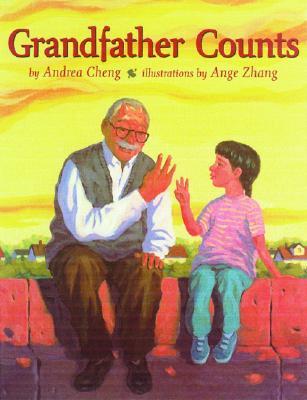 As simple as the language needs to be for a child to easily connect with the narrative, this story is dynamic in its attention to a child facing major changes in her home life when her grandfather arrives from China. Not only does Helen, our protagonist, have to give her up her bedroom and her view of the cargo train that runs outside of her room but, her mother becomes a perfectionist, and her grandfather’s is nearly mute in the household because he doesn’t speak English. But Helen, a little lost in her relationship with her grandfather, is persistent in observing him and trying to connect with him. Ultimately, she makes the connection by mistake in a sentimental manner that I felt was “sweet”. Like her, her grandfather likes watching the trains; together they count the cars and teach each other English and Chinese. Towards the end of the story, the family commits to privately learning Chinese through a computer program her Euro-American father has purchased; one gets the feeling that Helen and her grandfather are going to feel “at home” again. I was gratified to see this book give attention to the American Chinese children who don’t know Chinese and didn’t “fit in” at Chinese language school because the dominant narrative of Asian life still seems to be the immigrant story and first generation story of children who are fluent in the Chinese language. Helen and her siblings are first generation American children of mixed Euro and Chinese heritage who, despite her parents attempts to integrate Chinese culture into their lives, are not immersed in Chinese culture. Any child of immigrant parents whose lives make them consider themselves American descendents of their parents’ culture instead of members of the non-United States culture, will identify with Helen and see something of themselves in Helen’s story. All others will enjoy observing Helen’s lived identity and the multigenerational bonding experience in this simply told, complex story.
Recommendation: Highly Recommended; ages 4-8
Reviewer: Omilaju Miranda

That’s My Mum by Henriette Barkow

Inside page–Kai with his mom and Amelia with her mom
That’s My Mum is a book that will have obvious significance for many in the Mixed-Heritage communities. One of the things I like about this book is that while the protagonist and first person narrator is Amelia who is brown with a white mother, her best friend whose family gets just as much space on the page is Kai, a biracial white boy whose mom is brown-skinned.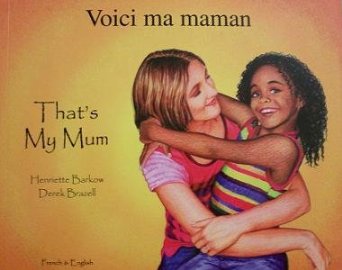
This is only the second picture book I’ve come across that gives attention to the fair-skinned, straight-haired children of brown mothers and the only picture book with a full story arc that does so. The author smartly pairs Amelia and Kai to show that their emotional responses to the mother mix-up are the same. Together, Kai and Amelia face the emotionally and pragmatically challenging issue of people questioning their relationships with their mothers. Though these two friends find the mother mix-up frustrating and saddening, the language of the book remains
light while giving realistic attention to the children’s feelings and communications with people outside of their family. In a humorous twist to their story, the two friends collaborate to create a solution to their shared issue. Many of their ideas are silly, one of which they reject out of self-love and appreciation for what they look like. Ultimately, they decide to make buttons with photos of their mothers– a solution that if noticed by others would completely clarify their relationship with their parents and will put a smile on the adult reader’s face as it represents the innocence and innovation of children’s minds. Child readers may still be confused.
The author’s effort in the middle of the book to demonstrate through the narrative language, the confusion other people face when interacting with them, actually results in confusing the reader as the illustration and the wording are not entirely clear. Due to this, I’d place reading age at no younger than 6-years-old.
Published by the London based Educational Company Mantra Lingua, the book ships from England and is published in dual languages. My copy is in English with Urdu translation, pictured is an English-French copy but the book cover states that it is available in English with 22 other languages. The one drawback to this book for those outside of England –the four weeks it takes to receive the book when ordering through Amazon.com. Enjoy.
Recommendation: Highly Recommended especially for families with brown or yellow parents of white appearing children since this is only the second picture book that I’ve found which acknowledges these parents and children.
Book Review by Omilaju Miranda.

Jalapeno Bagels by Natasha Wing
 With beautiful illustrations from Robert Casilla, this story which reads like a training and orientation day in a bakery, comes to life. This is a first person narrative from Pablo, the son of a Mexican mother and Jewish father who own a bakery together. Pablo has to decide what to take to school for International Day and throughout the story as he helps his mother make Mexican pastries and his father make Jewish pastries, he questions if each pastry is the one he should take to his school. A story peppered with Pablo’s easy translations of his parents’ Spanish and Yiddish words of expression and names of food, makes one feel like they are in a regular day in the life of Pablo and his parents. On this day, Pablo decides to take Jalapeno Bagels to school because, like him, they represent the cultures of both of his parents. The back of the book contains two recipes and a glossary of the terms used throughout the book. While I think this is a valuable representation of a Mixed Heritage family of Mexican/Jewish ethnicities which gives some history of the two ethnicities, the most exciting aspect of the book is its title.
Recommendation: Unenthusiastically recommended for the sake of diversity representation; Ages 4+
Book Review by Omilaju Miranda.

Book Review for Marisol McDonald Doesn’t Match/Marisol McDonald No Combina by Monica Brown
 Just looking at the cover image of this book—a little red-head with toasty brown complexion and Punky Brewster clothing hanging upside down, pink and blue polka dot wrapped pig-tails flapping against her arms, I couldn’t wait to read it. With the title written in English and Spanish, I knew it was going to be a fun read. And, it didn’t disappoint. Once finished, I was so excited, I had to take a few minutes to calm down before writing this review. Marisol embodies and off-beat charm: think Pippi Longstocking, think Eloise, think Madeline; except, Marisol is a Mixed Heritage, Peruvian-Scottish-American and her story is written in English and Spanish with some dialogue in both languages as well. But she is just as confident, plucky, and determined as the other children’s stories’ heroines. Just as her friends and family say she doesn’t match because of her freckled brown skin and red hair (“the color of carrots” says her cousin; “the color of fire”, says Marisol), they say she doesn’t match because she puts peanut butter and jelly on tortillas, they say she doesn’t match because she paints stars in the same sky as the sun, Marisol says all these are good and tasty and unique. Then a friend says she couldn’t match if she wanted to. In true scrappy style, Marisol responds to this comment as if it is a challenge and tries to “match”. Matching is woefully, sad-faced boring until her teacher gives her a note encouraging her to be her mixed up, non-matching self because that is mismatching is true to her. So Marisol in the end is dressed in her Peruvian hat with pink ballet tutu, polka dot skirt and striped leg warmers. She likes herself not matching in every single way. You and your kid will like her too.
Recommendation: Highly Recommended; Age range: 4-8
Book Review by Omilaju Miranda
 Diverse Kids Books--Reviews