
Home » Black Child (Page 4)
Category Archives: Black Child

I Don’t Have Your Eyes by Carrie A Kitze
 Written with transracial adoptee children in mind, this book, with a series of lyrical statements, contrasting the differences in the physical appearances of children’s and parents’ body parts to the emotions, attitudes , and life perspectives associated metaphorically with the physical, sensorial, or functional purpose of the body part, communicates the conscientious and humane value system that parents teach and transfer to their children with such fluidity and beauty that you feel the text bringing you and your child closer and helping your child see the best in themselves and their depthful connection to you. In no cheesy, but a substantial, poetic, non-didactic prose, the book really conveys that who we are and who we help each other grow to be inside is what is valuable and what makes us family. The illustration is beautiful, realistic and includes illustrations of many different parent-child racial pairings including parents and children who share the same race but obviously different features so it doesn’t have to read as a book about “all of us racially different kids”; a child walks away from this book understanding that no one looks exactly like their parents but the loving way we navigate in the world is the offspring of our parents way of raising us.
Recommendation: Highly Recommended; Ages 4-12
Book Reviewer: Omilaju Miranda

Bluish by Virginia Hamiliton
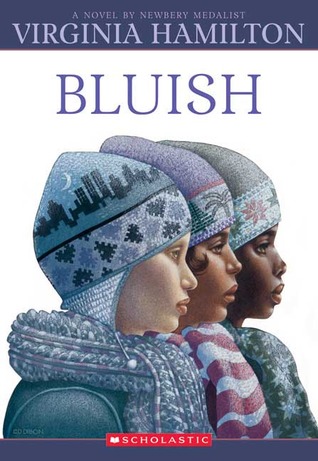 Most of the time I pick books for my children based on their experiences so they know they are not the only ones. Many times, I pick books to introduce adventures we plan to do or places we plan to go. Often I pick books that reinforce our family’s values or our ways of being. But sometimes I come across a book with a new character—a character with a life story we have not encountered yet, but I know we will.
The image on the cover of the book shows three girls in knit hats with varying skin tones and facial features. Natalie is identified as Jewish and Black and her mom bristles at the idea of kids calling her “Blewish”, not realizing her nickname “Bluish” has more to do with blue tint of her skin tone because of her illness. Dreenie and the third girl on the cover are never labeled with a particular heritage although Dreenie calls herself a “sorta sweet chocolate color” and calls Tuli “more honey color.” At one point, Dreenie’s little sister taunts her by saying, “I know who your mama ain’t, Drain. Because you sure ain’t one of us Anneva and Gerald Browns!” causing me to wonder if Dreenie was adopted but there is no more mention of this leaving me confused. But I am not the only one confused– honey-colored Tuli is right there with me. Tulifoolie pretends to speak Spanish singing out phrases, “chica-chica, do the mambo” and calling folks “muchcha” but is told by a Spanish speaking girl that she “gives Spanish kids a bad name.” Tuli lives with her grandmom in a not-so-good part of town. Tuli’s aunt is mentioned but never a mention of a mother or father–and no mention to confirm if she is indeed Latina. Your young reader might not have the need to know the exact heritage of Dreenie and Tuli and therefore might escape the confusion I experienced. All three girls play a major role in the story and present very different individuals who come together as friends. And that is a theme with which many readers can relate.
Recommendation: This book is appropriate for readers ages 9-14.
Reviewer: Amanda Setty
Book Review for My Princess Boy by Cheryl Kilodavis (Ages 3+)
 Heartwarmingly sentimental, a plea for compassion and acceptance of a child who is different and an illustration of a child’s unique life all at once, the reader can feel that this story poured out from a mother’s heart on to the page. Princess Boy loves girl’s clothes and toys. His family loves him and supports him even as others outside the family laugh at him and them. The faceless illustrations make Princess Boy and his family universal. Will you, reader, accept and love Princess Boy?
In addition to being moved by the direct sensitivity of the narrative, the author’s message on the back cover and rear back flap are ones we all need to hear. Written by a mother to educate the children, parents, and teachers who may otherwise have bullied her four-year-old son, My Princess Boy enters your heart and expands it if it’s open and softens it if you were resistant to difference. At the preschool age children are adamantly trying to figure out the details of gender segregation, My Princess Boy involves a child’s senses in the lesson that pink is for boys, too and anybody can like dresses—values that I keep trying to teach my daughter. Whether you borrow it or buy it, it will definitely earn it’s place in your reading space and heart
 Diverse Kids Books--Reviews