
Home » Posts tagged 'African American' (Page 2)
Tag Archives: African American

Always an Olivia: A Remarkable Family History by Caroliva Herron
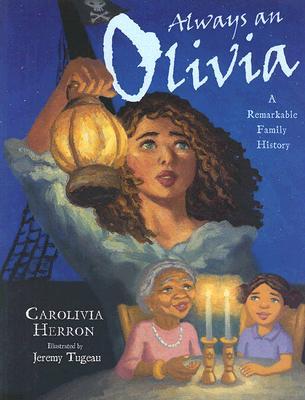
Heartbreaking, historically informative, and beautifully illustrated, Always An Olivia:A Remarkable Family History is the true family history of scholar and author, Olivia Herron (Nappy Hair) whose family has preserved their Jewish traditions even seven generations removed from the family’s Jewish matriarch. While the story is being told to a granddaughter in 2007 by her great-grandmother, the narrative actually tells the story of their ancestor Sarah who, hundreds of years ago, was the Italian Jewish granddaughter of victims of Jewish pogroms in Spain and Portugal. She is captured by pirates to be ransomed off but saved by another captive with whom she falls in love and sails to the USA to avoid recapture, death or the burning of the homes and businesses of the Jews to whom she was supposed to be ransomed. Still afraid of anti-Jewish violence, Sarah adopts the middle name Olivia instead of using her given middle name, Shulamit.
In the U.S., customs settles Sarah and her husband on the Georgia Islands in the free, black African Geechee community. Sarah and her husband have children and their children marry Geechees. Their descendants continue to practice the Jewish rituals that Sarah remembered (because, the text lets us know, she forgot many) including lighting the Shabbat candles on Friday nights. The women are the keepers of the tradition from being in charge of lighting the Shabbat candles to the legacy of naming a daughter of each generation Olivia or, as Sarah requested, a name that means “peace”. They choose to preserve the original name by naming a girl in each generation “Olivia” after Sarah.
From the opening line in which the girl child Carol Olivia asks her great-grandmother about black U.S.American slavery and is told that her family experienced enslavement in Egypt, witnessed U.S.American chattel slavery, but was not descended from enslaved black U.S.Americans, this biography is an eye opening account of the different histories of blacks and mixed racial heritage people in the U.S. since the 16th century.
Despite the book’s engagement of the heavy subject matter of slavery, racial and religious persecution, kidnapping, family separation, and near identity loss, there is a hopeful tone in the reading, achieved through James Tugeau’s use of light in his dramatic pastel illustrations, the tone of the narrative, and narrative breaks in the relaying of violence to fully describe life in peaceful times. Thus, this story of a resilient family communicates the necessity of remembering family history. Always an Olivia makes it clear that despite their family history of terror, renewal, survival and reinvention, the family of Olivias is proud of, and takes comfort in, their family traditions and heritage.
Recommendation: Highly Recommended; Ages 8-Adult (buy)
Reviewer: Omilaju Miranda

Visiting my Father’s Homeland: Book Review for I Lost My Tooth in Africa by Penda Diakité

Losing teeth is a rite of passage for every child and, based on twelve-year-old Penda Diakité’s I Lost My Tooth in Africa, a visit from the elusive tooth-fairy is a welcome surprise for children all over the world as well—even in Mali, West Africa!
In the story, Amina, a girl born and raised in the U.S., and her family travel from Portland, Oregon to Bamako, Mali, her father’s birthplace and childhood home. Amina’s loose tooth—which she discovers while en route to Mali— tags along. After her father shares with her that the African tooth fairy trades a chicken in exchange for a little boy or girl’s tooth, Amina is determined to lose her wiggly tooth before this family trip to Africa is over.
Infused with a strong representation of words from Bamabara (a glossary is in the back of the book), the most widely used indigenous language of Mali, and Malian cultural traditions, I Lost My Tooth in Africa is a mildly suspenseful narrative that children between the ages of 5 and 8 who are also going through the “snaggle-tooth” phase could especially appreciate while learning informative tidbits about a new culture and geographical location. The children in your life will be further inspired by the fact that this book, published by one of the five major publisher’s of children’s books, is the creation of a pre-teen author and her illustrator father.
Recommendation: Highly Recommended ages 5-8
Reviewer: LaTonya Jackson
Every Little Thing by Cedella and Bob Marley with by Vanessa Brantley-Newton
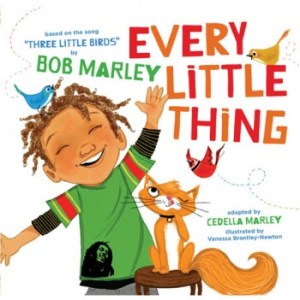 Every Little Thing, Cedella Marley’s adaptation of Bob Marley’s song Every Little Thing could be called the companion book to Marley’s adaptation of her father’s One Love song. This time, the protagonist is a little boy from a loving family who spreads the joy and comfort that his parents give him through their affection and forgiveness, with other kids. Once again, Brantley-Newton’s illustrations powerfully tell a story with Marley’s words serving as the lyrical underscore for what is happening. I couldn’t help singing this book to my daughter and she easily and happily sang along in between asking questions about what was going on in the story. The narrative starts when the protagonist wakes up in the morning, follows him through a day of playing in the rain, and sun, enjoying time with his pets and three little birds, as well as his friends. He befriends a shy and isolated friend, makes a mess of his kitchen trying to bake a cake, is forgiven by his parents, sulks about bedtime, before his parents hug him and tuck him in, then he awakens in the next morning happy again. While the cast of characters is much smaller than that in One Love, a fair representation of black and white characters with different phenotypes is present. I was particularly happy to see an Asian child included as the subject of the protagonist’s friendship in the illustrations of this book as Asians were absent from the book One Love. Without question, this book is a joy to read, and once again the illustrations are perfect for the pre-literate child to practice “reading” comprehension skills in decoding the story told by the illustrations.
Recommendation: Highly Recommended ages 0+
Reviewer: Omilaju Miranda

Josephine by Patricia Hruby Powell and Christian Robinson
 A free verse prose poem tells the life story of the first black American international musical superstar Josephine Baker, born out of wedlock and raised in part by a single mother. Collage drawings give the book a rich tactile feel that almost transcends the flat page. The language, which tells the story of Baker’s creativity and success amidst the U.S.’s violent racism is continuously evocative. While the images are fun to look at for all ages, only children ready to learn about racism, race riots, and shadism should read the book, as those harsh realities made a huge impact on Josephine Baker’s life and career, and are represented in heartrending language and images in the book. This is a beautifully told story that will tempt both the child who loves, and the child who hates reading and poetry, to become a poet. Verse after verse, the reader will learn of Josephine’s courage, and her fierce determination to be center stage as the dancing star she believed she could become. Those afraid to move on to middle school, go off to boarding school, or attend a training camp for their sport or art will see in Josephine, a girl so committed to the fulfillment of dancing that she left home at thirteen-years-old to tour the country, and left her husband for Broadway when she was only fifteen-years-old. Those who never consider the power of humor will learn how Baker attracted the spotlight with her comedic facial expressions as she danced. Her dynamism will inspire the reader learning of her many landmark performances, as well as her choice to become a pilot and fight as a spy against the Nazis during WWII. With dramatic punctuations in the poetic language, the author tells of Baker’s economic fall, and how bankruptcy proved to be a painful lesson in excess for the generous humanitarian. But Powell makes sure the reader knows that Baker was a socially conscious performer. At one point the richest Negro woman in the world, Baker was a civil rights fighter who convinced the army and many venues to allow integrated audiences to attend her performances, and even convinced owners of segregated corporations to hire blacks. The language and illustrations will make you feel Josephine’s life— her ups and downs, her ultimate triumph in achieving every dream she had, including dying “breathless, spent, after a dance.” (buy)
Recommendation: Highly Recommended; Ages 10+

Diversity Children’s Books Website is Live
Mixed Diversity Children’s Book Reviews is officially a website: http://mixeddiversityreads.com/.
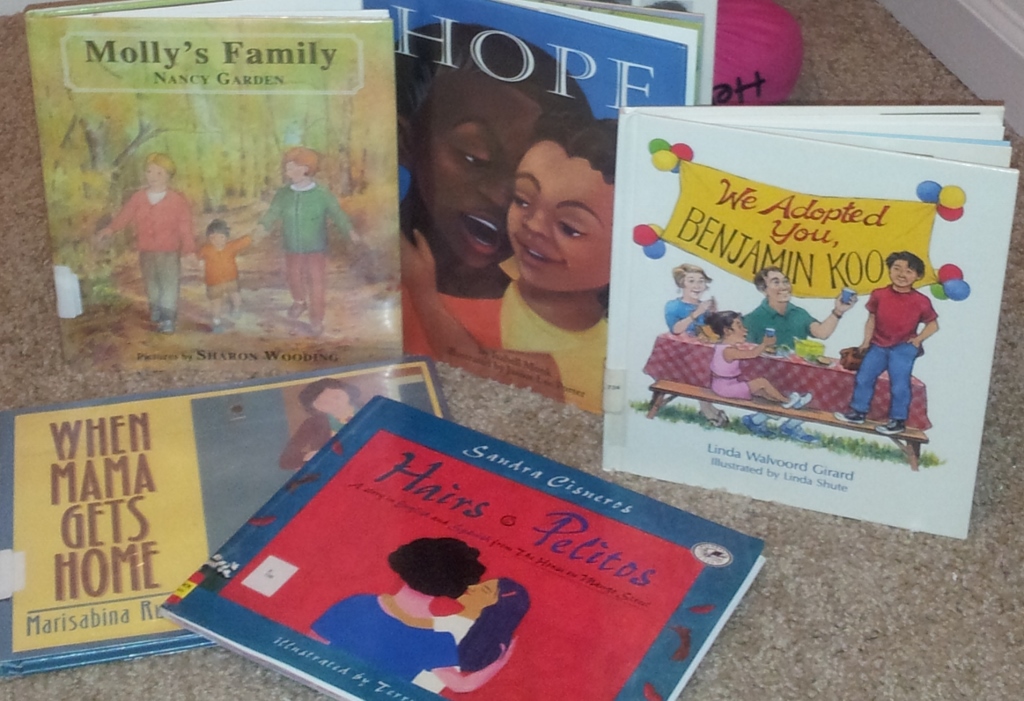 The Website, which founder Omilaju Miranda began as a page on facebook is now a full website with blog where you can find books with diverse protagonists by specific category. Books are easily locatable on a drop down menu. The site is dedicated to listing and reviewing children’s and YA books with protagonists who are either: biracial/mixed, transracial adoptee, bilingual, lgbt-parented, single-parented, or gender non-conforming. There is also a magazine where the site will feature writing for, and by children, and an opportunity for parents to send in photos and videos of their children reading or reciting stories and poems. Check out the book site and find the book for your little one today. If you are a writer or interested in communications and publicity, the site is actively seeking children’s book reviewers and interns to publicize and network with schools and libraries.

All the Colors of the Earth by Sheila Hamanaka
 Poetically, the children of this book become the natural bounty of the earth, their skin color and hair textures compared to the beautiful colors of nature and hair compared to the textures of other living creatures.
With typical sentences/stanzas like,
“Children come in all the colors of the earth—
The roaring browns of bears and soaring eagles,
The whispering golds of late summer grasses,
And crackling russets of fallen leaves,”
a child is able to glean a confidence-inspiring insight into their physical look. This is a beautifully illustrated book that lives up to the lyrical poetry of its narrative. The illustrations go far beyond the normal representation of the human rainbow and, with very detailed rendering of facial characteristics, skin complexions and hair textures, the reader sees real differences in many, many different ethnic types. On the pages of this book, children of every ethnic heritage will find reflections of themselves enjoying life and the world around them. While every physical type of child is represented in ‘All the Colors of the Earth,’ only interracial families are represented, which I think is an exceptional and novel choice however disappointingly inconsistent with the universal inclusiveness of the other illustrations.
Recommendation: Highly Recommended; Ages 3+
Book Review by Omilaju Miranda.

Jackie’s Gift by Sharon Robinson
 When Jackie Robinson bought his first house in Brooklyn, NY, some people in the neighborhood sent around a petition trying to keep him and his family out because they were black. It failed and upon moving in, the first friend Jackie Robinson made was a young Jewish fan, Steven Satlow. Steve comes over and helps the Robinson family decorate their Christmas Tree. When Robinson learns that the Satlows don’t have a Christmas tree, he thinks it is because they can’t afford one and buys them a huge Christmas tree. The Robinsons end up learning about a new religion and culture and both the Satlows and Robinsons demonstrate communicating with grace and appreciation in the face of misunderstanding. Ultimately, out of appreciation for Jackies gift, the Satlows chose to have a Christmas tree and a Menorah for Hannukah that year and the Robinsons learned that Jews don’t celebrate Christmas. Written by Jackie Robinson’s daughter, Sharon who writes in the afterword that the Satlows and Robinsons are still friends.
Recommendation: Highly Recommended; ages 5+
Book Reviewer: Omilaju Miranda

Shades of Black by Sandra L. Pinkney
 This seems to be one of the most celebrated books of the early 21st century for speaking to children about color, race and having pride in one’s Black identity. When I asked people for help in the face of my daughter having trouble from other kids regarding the difference in my and her skin complexions, everywhere I asked, several people suggested this book. It is a photo essay, that on an elementary school level, displays and discusses, in lyrical, free verse poetry nearly the full range of phenotypes of African Diaspora children from white as Vanilla Ice Cream to Blue Midnight. Unlike the children we see on t.v. and featured on many Natural Hair, Black Beauty, and Mixed Heritage websites who are breathtakingly beautiful, the children in Shades of Black are average-looking kids with whom many kids can relate. Although it is not a story book, Shades of Black also stands out amongst children’s books featuring children of the African Diaspora because, unlike most story books that choose medium brown skinned characters as protagonists whether the family is monoracial or interracial, Shades of Black also gives attention to the lightest and darkest of the African Diaspora Spectrum of complexion. While many children of monoracial Black Heritage, Mixed Heritage black and white, or Mestizo Latino and black, will find someone in this book who reflects them or comes close to it, there is only one child who may represent those whose heritage is also South Asian, and none who look like they are also of East Asian Heritage. There are plenty of braided hair styles and one child with dreadlocks featured in this book but no girls wearing afros. What is not here sharpens the focus on what is present: this book is effectively dedicated specifically to the different colors of skin and eyes found amongst children of African Descent.
Because of that contradiction between skin colors of white, brown, gold, orange, etc. and their categorization as “Black,” which can seem illogical to the young child (like my own 3-year-old) who has learned their colors but doesn’t understand the intricacies and inconsistences of racial labels, this book is appropriate as is for the child who has already been introduced to the concept of “Black” as an ethnic/racial group or as a way to introduce your child to “Black” as an ethnic/racial group. For the pre-literate child who doesn’t understand “black” as a race/ethnicity, you can change the words to “I have African Ancestors” and still share the book with them.
I find it challenging that this book presents children who I suspect are either biracial or Multigenerational Mixed Kids as “black” without acknowledging their mixed heritage. Although I don’t agree with this choice from the editor it is an opportunity for parents to discuss with their child how being of African Descent gives one a place in the Black community even when of Mixed Heritage. On the two pages whose statements are “I am Black. I am Unique,” the author chose to feature,” light-skinned children with light eyes as if being black is only unique when “black” manifests in an obviously mixed phenotype. I feel that on one of these pages, a brown or dark-skinned child with brown eyes should have been featured. Pinkney (the author) also features children with hazel green eyes on two different pages, giving two different descriptions for the same color eyes. I cannot find any logical reason behind this choice because the two children featured are also nearly the same complexion; this focus on the same color eyes would have been more effective if the children were different complexions.
However, and whenever you read this book to your child, it is a valuable celebration of the full spectrum of skin colors and many physical traits found amongst children of African Descent.
Recommendation: Highly Recommended
Age Group: As is–after the child knows that “Black” is a racial category; If changing the words to “I have African Ancestors” –age 3+
Reviewer: Omilaju Miranda
Willow by Denise Brennan-Nelson
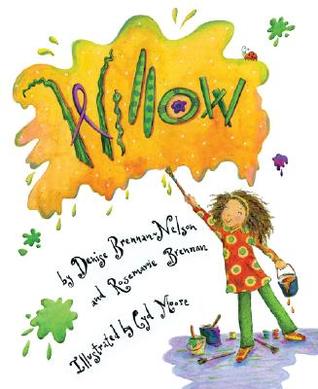 Willow, the protagonist of this book has a personality reminiscent of Eloise and Madeline. Her stubborn determination to be imaginative and artistic even as her art teacher, Miss Hawthorne tries to break the spirit of creativity with rigid rules eventually transforms her teacher. Willow’s open, loving spirit is innocent and generous and the story is an inspiring example of adult-child interaction. The illustrations are energetic, riveting paintings that transport the reader into a parallel universe of creativeWorld. I’ve already gifted this book to one of my daughter’s friends. I bet you’ll find it just as infectious and worthy of sharing.
When one reads Willow, it is easy to believe that you are reading about a child of color, however I bought the second book in the series, Willow and the Snow Day Dance and the character’s parents are both white with no explanation of adoption so I’m thinking that I’m wrong about her being a child of color. In addition, when I read A Fire Engine for Ruthie, I noticed, with the illustrations of Ruthie that it is Cyd Moore’s style to draw her girl protagonists with wavy krinkly hair (although that doesn’t negate Willow’s brown skin). I emailed the illustrator, Cyd Moore and the publisher, Sleeping Bear Press asking if Willow is a child of color and have not yet received an answer. Despite that, I’m including Willow on this site because sometimes children just need to see their likeness on the page in a book with a real story and a child with a dynamic personality, and there are plenty of children of color who can look at Willow and see themselves in her light brown skin and wavy hair that grows out instead of down.
Recommendation: Highly Recommended; Ages 5+
Reviewer: Omilaju Miranda
Book Review for My Princess Boy by Cheryl Kilodavis (Ages 3+)
 Heartwarmingly sentimental, a plea for compassion and acceptance of a child who is different and an illustration of a child’s unique life all at once, the reader can feel that this story poured out from a mother’s heart on to the page. Princess Boy loves girl’s clothes and toys. His family loves him and supports him even as others outside the family laugh at him and them. The faceless illustrations make Princess Boy and his family universal. Will you, reader, accept and love Princess Boy?
In addition to being moved by the direct sensitivity of the narrative, the author’s message on the back cover and rear back flap are ones we all need to hear. Written by a mother to educate the children, parents, and teachers who may otherwise have bullied her four-year-old son, My Princess Boy enters your heart and expands it if it’s open and softens it if you were resistant to difference. At the preschool age children are adamantly trying to figure out the details of gender segregation, My Princess Boy involves a child’s senses in the lesson that pink is for boys, too and anybody can like dresses—values that I keep trying to teach my daughter. Whether you borrow it or buy it, it will definitely earn it’s place in your reading space and heart
 Diverse Kids Books--Reviews