
Home » Posts tagged 'Mixed' (Page 2)
Tag Archives: Mixed
You Be Me and I’ll Be You by Pili Mandelbaum
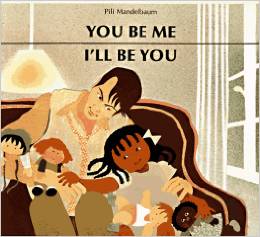 A well intentioned father tries to help his brown-skinned biracial daughter feel comfortable with her skin color by plaiting his straight hair, donning black face and having her don white face. I was almost too insulted to continue reading but out of duty, I finished the book. The narrative attempts to redeem itself by showing people laying out on the beach tanning, using rollers to make their hair curly, and pointing out that every one wants features they can’t have. I don’t know if this did well in Belgium where it was originally published but as a U.S.American, I would never read this to my child.
Recommendation: Not Recommended.
Reviewer: Omilaju Miranda

All the Colors of the Earth by Sheila Hamanaka
 Poetically, the children of this book become the natural bounty of the earth, their skin color and hair textures compared to the beautiful colors of nature and hair compared to the textures of other living creatures.
With typical sentences/stanzas like,
“Children come in all the colors of the earth—
The roaring browns of bears and soaring eagles,
The whispering golds of late summer grasses,
And crackling russets of fallen leaves,”
a child is able to glean a confidence-inspiring insight into their physical look. This is a beautifully illustrated book that lives up to the lyrical poetry of its narrative. The illustrations go far beyond the normal representation of the human rainbow and, with very detailed rendering of facial characteristics, skin complexions and hair textures, the reader sees real differences in many, many different ethnic types. On the pages of this book, children of every ethnic heritage will find reflections of themselves enjoying life and the world around them. While every physical type of child is represented in ‘All the Colors of the Earth,’ only interracial families are represented, which I think is an exceptional and novel choice however disappointingly inconsistent with the universal inclusiveness of the other illustrations.
Recommendation: Highly Recommended; Ages 3+
Book Review by Omilaju Miranda.

Shades of Black by Sandra L. Pinkney
 This seems to be one of the most celebrated books of the early 21st century for speaking to children about color, race and having pride in one’s Black identity. When I asked people for help in the face of my daughter having trouble from other kids regarding the difference in my and her skin complexions, everywhere I asked, several people suggested this book. It is a photo essay, that on an elementary school level, displays and discusses, in lyrical, free verse poetry nearly the full range of phenotypes of African Diaspora children from white as Vanilla Ice Cream to Blue Midnight. Unlike the children we see on t.v. and featured on many Natural Hair, Black Beauty, and Mixed Heritage websites who are breathtakingly beautiful, the children in Shades of Black are average-looking kids with whom many kids can relate. Although it is not a story book, Shades of Black also stands out amongst children’s books featuring children of the African Diaspora because, unlike most story books that choose medium brown skinned characters as protagonists whether the family is monoracial or interracial, Shades of Black also gives attention to the lightest and darkest of the African Diaspora Spectrum of complexion. While many children of monoracial Black Heritage, Mixed Heritage black and white, or Mestizo Latino and black, will find someone in this book who reflects them or comes close to it, there is only one child who may represent those whose heritage is also South Asian, and none who look like they are also of East Asian Heritage. There are plenty of braided hair styles and one child with dreadlocks featured in this book but no girls wearing afros. What is not here sharpens the focus on what is present: this book is effectively dedicated specifically to the different colors of skin and eyes found amongst children of African Descent.
Because of that contradiction between skin colors of white, brown, gold, orange, etc. and their categorization as “Black,” which can seem illogical to the young child (like my own 3-year-old) who has learned their colors but doesn’t understand the intricacies and inconsistences of racial labels, this book is appropriate as is for the child who has already been introduced to the concept of “Black” as an ethnic/racial group or as a way to introduce your child to “Black” as an ethnic/racial group. For the pre-literate child who doesn’t understand “black” as a race/ethnicity, you can change the words to “I have African Ancestors” and still share the book with them.
I find it challenging that this book presents children who I suspect are either biracial or Multigenerational Mixed Kids as “black” without acknowledging their mixed heritage. Although I don’t agree with this choice from the editor it is an opportunity for parents to discuss with their child how being of African Descent gives one a place in the Black community even when of Mixed Heritage. On the two pages whose statements are “I am Black. I am Unique,” the author chose to feature,” light-skinned children with light eyes as if being black is only unique when “black” manifests in an obviously mixed phenotype. I feel that on one of these pages, a brown or dark-skinned child with brown eyes should have been featured. Pinkney (the author) also features children with hazel green eyes on two different pages, giving two different descriptions for the same color eyes. I cannot find any logical reason behind this choice because the two children featured are also nearly the same complexion; this focus on the same color eyes would have been more effective if the children were different complexions.
However, and whenever you read this book to your child, it is a valuable celebration of the full spectrum of skin colors and many physical traits found amongst children of African Descent.
Recommendation: Highly Recommended
Age Group: As is–after the child knows that “Black” is a racial category; If changing the words to “I have African Ancestors” –age 3+
Reviewer: Omilaju Miranda
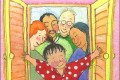
I Love Saturdays y domingos by Alma Flor Ada
 This is a valuable book to show the bilingual and bicultural immersion of a girl who is multiracial Mexican and Caucasian USAmerican. On every alternate page the protagonist speaks Spanish with her Mexican grandparents. On the surface, the grandparents are different—in addition to their race/ethnicity, the USAmerican grandparents live in the city or suburbs, the Mexican grandparents live on a farm near a fishing pier. The illustrations are lively and evocative. It is a formulaic story of comparisons: My grandpa buys me balloons: my abuelo buys me a kite; my grandma makes pancakes; my abuela makes me huevos rancheros…fourteen pages in, I drifted from boredom. Despite the fact that the comparisons went on for too long in my opinion, the parallel lifestyles and interests of the grandparents makes a powerful impression on the reader of the similarities of people who seem very different. Although the details of their lives are very different, both sets of grandparents love their pets, enjoy the circus, like making things by hand, create exceptional ways to make the protagonist happy and, of course, love their granddaughter.
The plot turn which is actually fun should have come earlier in the book—the protagonist has a party at her house that both sets of grandparents attend during which the grandparents help out with the children. The Pinata and the traditional Mexican birthday song are fun. You and your child may actually want to learn the song as I did.
Recommendation: Mildly recommended
Reviewer: Omilaju Miranda

My Mom is a Foreigner but Not to Me by Julianne Moore
 I love this book so very much
I can read it ten good times
She represents a child’s experience
With such cool, catchy rhymes
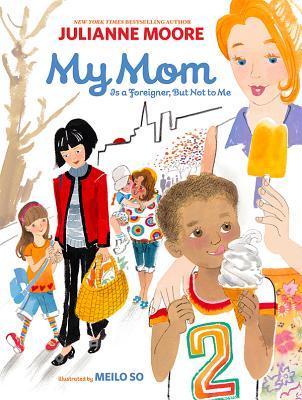
This book by Julianne Moore, primarily written in ABCB rhyming quatrain stanzas, is a first person narrative from the perspective of a dozen different children, which talks about the varied experiences of a child living in the U.S. with a mother from another country. The illustrator, Meilo So has chosen a “framed” illustration style which, other than the fact that it leaves a lot of white space on the page is successful at providing images for many different aspects of the “story” simultaneously.
Not only do I like the fact that Moore’s rhyme is perfect ninety per cent of the time, the text shows the dynamic conflicts faced by children who love their mothers but experience, with a little shame, all of the ways in which their mother is different from other mothers and people they encounter daily, including their different food and culturally different greeting and doting customs. The children also communicate their discomfort with their mothers’ use of a different language in communicating with them and their mothers’ slow mastery of English as their second language.
Most of the children from whose voice the book is written appear to be between the ages of 7-11. While there are several pages in the book illustrating the mothers caring for a second child in the infant/toddler age range, there is only one page in the book that shows a mother and father together (in a photo on a dresser) so children living in single-mother led households can easily find a reflection of their family construct in this book.
Most of the mother-child relationships in the book are clearly representative of an interracial family (even though we don’t see fathers) with children who look racially different from their mothers. Moore and Meilo So cover the full gamut of children who look racially different from their mothers whether the mothers are East Asian, Subsaharan African, or Dutch with children whose features present as the entire world spectrum of all racial/ethnic features. Meilo So does not just throw kids on the page who are holding hands with mothers—no, her vivid, emotionally realistic, water color illustrations are done with such attention to detail that on one page there is a brown-skinned, gele scarf wearing mother with her pale-skinned, red-haired daughter who the reader can see look exactly alike–like twins except their skin color, height, and weight are different. The “twin” mother and daughter are walking up the stairs as a boy behind them keeps staring at them and a mother holding a child that is like her in every obvious way walks towards them staring at them with a surprised, questioning look on her face. The text that goes along with this illustration speaks of the emotional weight a child faces when her features are just like her mom’s but because of different racial markers people don’t always see their likeness:
“Some people say we look alike
Others wonder: What’s HER name?
I get so upset when they say,
“Why don’t you look the same?””
Finally, this book ends with a celebration of all the universal ways in which a mother and child bond,
“She gives me lots of kisses,
she tucks me in at night,
she laughs at ALL my jokes,
SHE HOLDS ME VERY TIGHT”
With this well-written, fancifully illustrated picture book, Julianne Moore and Meilo So have hit a home run for all readers and definitely for intercultural and multi-lingual and interracial families that also keeps children belonging to single parent households from feeling like outsiders.
Recommendation: Highly Recommended; Ages–3-10
Reviewer: Omilaju Miranda

Mixed Me by Tiffany Catledge
 My immediate reaction to this book is “this is so cute”. I like the voice of the young girl in the book and the choice to put her in a very diverse world—although “a tale of a girl who is both black and white,” her world is filled with the full spectrum of human diversity. I find it to be very didactic. This isn’t so much a story as it is an illustrated speech to the reader. The protagonist discusses all the major issues mixed-race children encounter from people outside of their family and the watercolor illustrations are incredibly appealing. The straightforwardness of this book makes it very valuable as a teaching tool so I think teachers and school librarians should include it in their collection or, parents should buy it and donate it to the school so it can be a part of the classroom and, hopefully diversity lesson plans.
Recommendation: Recommended for Educational Purposes; Ages 5-7

More More More Said the Baby—Three Love Stories by Vera B. Williams
 I didn’t really enjoy this book but I seem to be the only one. It was a Caldecott Honor Book in 1990 and my 3-year-old daughter got in to touching her own belly button during the part where “Little Guy’s” father is kissing his belly button. I may have found this book more engaging if I’d discovered it for my child when she was an infant or early toddler. This is one of Vera B. Williams’ books that exists for the illustrations and not the written narrative. There are three short stories in this book—stories that illustrate three different children receiving affection from their caretakers. The copyright page explains that the book is based on the gouache paintings and as I read it, the narrative was so thin, in my opinion, that I felt the words were just put on the page to justify putting a multicultural children’s book on the shelf but that was 23 years ago and one of the first, if not only Caldecott honor books with interracial families.
So what exists that is multiculturally relevant? There is a lone father caretaker of a child, there is a Caucasian grandmother caretaker of a child of multiracial African descent, and there is a brown-skinned mother of a light-skinned Asian child. The challenge with the Gouache paintings is a lack of defined detail. My daughter thought that “Little Guy” was a girl who didn’t like her father and, while we suspected that the grandmother was Caucasian, my grandmother upon reading it wasn’t sure—the way the features are drawn, she could just as easily have been a light-skinned woman of color. Similarly, I do not know whether the mother with daughter is supposed to be a brown-skinned Asian sharing her daughter’s ethnicity or a woman of a different ethnicity or race. In an interview I can’t find right now, Williams says that she wrote the book to fill the void of in the children’s books market with interracial families so having read that interview, I’m certain the grandmother is Caucasian. You may find the last painting uncomfortable as a child is splayed in a way that is a little exposing—my daughter asked if the girl had on shorts under her dress. What is clear is that readers can definitely see that families are composed of a rainbow of people. Since this is a book about relationships between familial adults and children, without couples or references to two parents, this is a book that can definitely reflect and validate single parent and alternative guardian families.
Recommendation: Valuable to have in your book collection; Ages 0-4
Reviewer: Omilaju Miranda

PBS Kids’ “Superwhy!”
 If you have not yet discovered the PBSKids show “SuperWhy,” discover it. The main characters—Whyatt/SuperWhy, PrincessPea/ Princess Presto, Red/Wonder Red, Alpha Pig, and Webster are children and pet superheroes living in storybook village whose special powers are related to literacy i.e spelling, phonics, writing and reading. In each episode they help solve a child’s problems by flying into a classic fairy tale in which the child’s problem parallels that of the fairytale protagonist. Then, the SuperReaders save the day by changing the story so that the child in trouble and fairytale protagonist triumph over their issue. This show helps the toddler and preschooler engage in a fun adventure that builds their valuation of reading and helps the early reader learn reading concepts. They cover a full range of reading comprehension and word construction concepts. This is definitely ELA enrichment in the form of entertainment.
The lead character, Whyatt, as described by the SuperWhy wikis and obvious when you watch the show, is definitively olive skinned as is his family. While their ethnicity is not discussed, he has an appearance that many in the mixed and multiracial communities would see as a reflection of themselves. Princess Pea, a green-eyed, brown-skinned girl with waste length wavy hair is actually mixed. In the second episode of the first season, the team flies into the story of Princess Pea’s mother who is the original Princess of “The Princess and the Pea” where we meet her mother who is of African Descent and father who is Caucasian. We rarely see the families of the Super Readers but every episode is going to be a fun, learning episode.
Recommendation: Highly Recommended
Reviewer: Omilaju Miranda

The Hello, Goodbye Window by Norton Juster
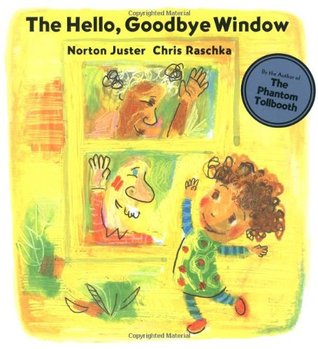 This is my new favorite book. Centered around the magical front window of her grandparents’ home, this is the story of a pre-school child’s normal visit to her grandparent’s house. Norton Juster uses this first person narrative to give us such a dynamic representation of the protagonist’s emotional and practical experience visiting her grandparents. The interaction between the grandparents—Nanna and Poppy—is fun and disciplined, subtly touching on some of the safety and restriction issues that pre-schoolers are learning at this age. Her impressive imagination is on display when she speaks of ANYBODY being able to go by the Hello, Goodbye window including Tyrannosaurus Rex (he’s extinct so doesn’t come often, you know.) The grandparents are an interracial couple as are the protagonist’s parents who come pick her up at the end of the story. These are happy, culturally diverse people—Nanna (who is of African-Descent) is from England so the Queen comes by for tea; Poppy plays the Harmonica and the protagonist hopes the Poppy she marries can play the harmonica, too—who love the protagonist in a comprehensive expression of that love. I literally had a warm feeling in my chest as I was reading this book and constantly smiled at the protagonist’s happy movement through her day. With three generations of family represented through a child’s eyes, you and your kid are going to love this book.
Recommendation: Highly Recommended; Ages 3+
Reviewer: Omilaju Miranda
Hope by Isabell Monk
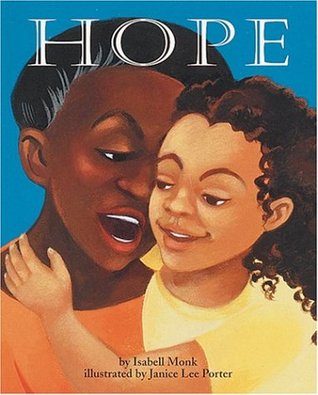 Hope is on her summer visit to spend time with her aunt Poogee. They are having a great time until they run in to an old friend of her aunt’s who has been away for awhile. The woman asks “Is the child mixed?” as if Hope is a weird object instead of a person, which makes Hope feel sad. Aunt Poogee uplifts Hopes spirits by telling her about her ancestry on both sides of her family and that her parents came together in love. This is a straightforward narrative that addresses implied prejudice and recognizes a child’s emotional response to disapproval is felt even when not verbally expressed. Rich illustrations accentuate the emotional impact of the story.
Recommendation: Highly Recommended; Ages 6+
Book Review by Omilaju Miranda
 Diverse Kids Books--Reviews