
Home » Posts tagged 'Mixed' (Page 5)
Tag Archives: Mixed

TV movie “A Country Christmas Story”
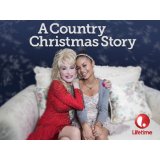 At the outset, this is the story of a small-town, white Appalachian mother and her “brown-skinned biracial” daughter who are living heartbreakingly poor lives in the Appalachian mountains of Tennessee three years after a divorce. The emotionally and economically burdened mother is inflexible in her demand that her daughter commit to math while the daughter wants nothing more than to sing and play guitar like her absent father. When the father returns, both parents think a black girl singing country music is a joke but Grace, (who reminds her parents that she is both black and white) and Grace’s teacher have set as their goal Grace winning Dolly Parton’s Teen Country Star of Tomorrow Contest. Grace and her teacher gain confidence by educating themselves and her parents on the history of blacks and interracial alliances in Country Music. But race relation history takes up less than five minutes of this T.V. movie.
The emotional pull of the story is multi-layered as three generations of mothers and daughters find themselves torn over the demons of their pasts of insecurity and self-doubt vs. their emotional freedom to support Gracie in pursuing her dream. Added conflict comes in the form of the feelings every family member and people in the town have about the father, Danny, who most think abandoned the family; the truth is much more depthful and contoured than a simple abandonment story. I’ll leave it at that since I don’t want to post any spoilers. The father is refreshingly more emotionally complex than a stock, machismo black man; the social spheres of these characters’ lives are filled with people invested in the characters and not the societal issues that influence their world. Even though Dolly Parton and NBC have shined a light on the existence of blacks and mixed people in an oft-forgotten part of the United States –Appalachia, this is a story about a girl’s family and small, country community supporting her as she follows her heart and the music on a path of family unity. I missed the original airing of this movie on NBC but I downloaded it for $0.99 from Amazon.com last night and, since it moved me to tears with great writing for t.v., unexpected plot twists and well developed characters who work their way through all sorts of complex mistakes—you should see this moving story.
Recommendation: Highly Recommended
Reviewer: Omilaju Miranda

Bluish by Virginia Hamiliton
 Most of the time I pick books for my children based on their experiences so they know they are not the only ones. Many times, I pick books to introduce adventures we plan to do or places we plan to go. Often I pick books that reinforce our family’s values or our ways of being. But sometimes I come across a book with a new character—a character with a life story we have not encountered yet, but I know we will.
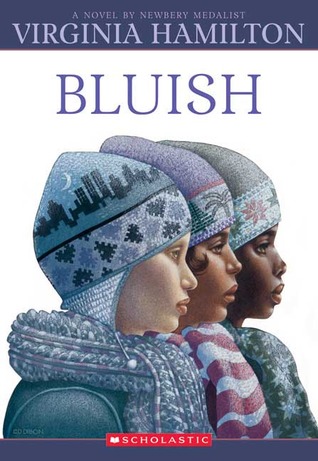
The image on the cover of the book shows three girls in knit hats with varying skin tones and facial features. Natalie is identified as Jewish and Black and her mom bristles at the idea of kids calling her “Blewish”, not realizing her nickname “Bluish” has more to do with blue tint of her skin tone because of her illness. Dreenie and the third girl on the cover are never labeled with a particular heritage although Dreenie calls herself a “sorta sweet chocolate color” and calls Tuli “more honey color.” At one point, Dreenie’s little sister taunts her by saying, “I know who your mama ain’t, Drain. Because you sure ain’t one of us Anneva and Gerald Browns!” causing me to wonder if Dreenie was adopted but there is no more mention of this leaving me confused. But I am not the only one confused– honey-colored Tuli is right there with me. Tulifoolie pretends to speak Spanish singing out phrases, “chica-chica, do the mambo” and calling folks “muchcha” but is told by a Spanish speaking girl that she “gives Spanish kids a bad name.” Tuli lives with her grandmom in a not-so-good part of town. Tuli’s aunt is mentioned but never a mention of a mother or father–and no mention to confirm if she is indeed Latina. Your young reader might not have the need to know the exact heritage of Dreenie and Tuli and therefore might escape the confusion I experienced. All three girls play a major role in the story and present very different individuals who come together as friends. And that is a theme with which many readers can relate.
Recommendation: This book is appropriate for readers ages 9-14.
Reviewer: Amanda Setty
Sofie’s Role by Amy Heath
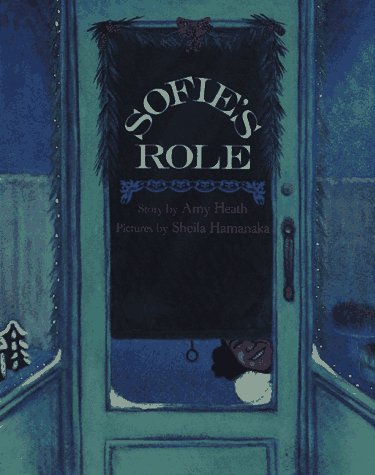 Sofie’s mom and dad own the Broadway Bakery, it is Christmas Eve, and Sofie is excited to be working in the front of her parents’ bakery for the first time. Usually she works in the back with dad but today she is going to work with mom and the college students in the front. The hustle and bustle of the bakery is punctuated by the author’s use of onomatopoeia. Children and the adults reading will enjoy making the sounds of adults gulping and sipping, machines whushing to make bread, the galumping of the mixer as they progress through the story. Each illustration is an action painting that brings to life the organized chaos of the work day on Christmas eve at the bakery. The reader will journey with Sofie from being overwhelmed by the rush of customers’ demands to finding the way that she can be helpful. We see that Papa is Caucasian and Mama is African American but Sofie and her families ethnicities are never mentioned.
Recommendation: Recommended; Age: 4-7
Book Review by Omilaju Miranda.

The Other Half of My Heart by Sundee T. Frazier
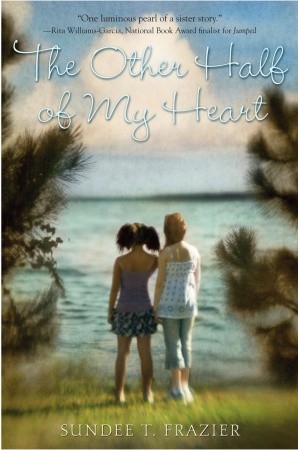 Have you ever read one of those books which prompts such a good discussion you begin planning how to give it as birthday present to your child’s friends? Or you find yourself suggesting it to random bi-racial families at parties? Well, that is how The Other Half of My Heart by Sundee T. Frazier hit me.
Minni and Keira King, 11-year old fraternal twins shake up people’s ideas of genetics and how bi-racial siblings should look. Born to a Caucasian dad and an African-American mom, Minni has red hair and light skin while Keira has tight afro puffs and dark skin. The girls live in a mostly Caucasian town in Washington State, but for the summer they are traveling to their maternal grandmother’s hometown in North Carolina to enter Miss Black Pearl Preteen of America Pageant, just as their mom did as a girl. The change in location offers a big change in demographics and stirs up issues between the girls. Minni wonders if she will be “black” enough. Keira is excited to finally be in a place where she can shine.
Part of their father’s reason for wanting to send them to the South was so they can get in touch with their black roots and their mother’s family, and the girls do. Both girls hear family stories and spend time looking at old photos of family members with varying degrees of skin tone. Minni has a particularly moving experience in church listening to the choir sing and being part of the community. Later, the girls’ grandmother, Minerva Johnson-Payne, surprises them with a photo of her sitting behind Dr. Martin Luther King, Jr. Grandmother Johnson talks of her experience as one out of five African American teachers at an all-white school and how hard she worked to prove “quality is colorless”. Although not her intent, it is the girls’ grandmother who educates the reader on the subtle ways African-Americans are made to feel inferior to Caucasians. She is always reminding Keira to put on sunscreen to avoid letting her skin get any darker. She also takes Keira to a salon to get her hair relaxed, even though their mother is completely against it. Not until the end does Minni build enough confidence to confront her grandmother about her hurtful comments toward Keira.
Even though I do love the concept of this book, I have a couple of criticisms. Grandmother Johnson never has enough story time to redeem herself. The girls rebel against her old-fashioned, strict ideas and domineering ways by pranking their grandmother and making fun of her behind her back. I wish the author had spent less time setting up the pageant and more time allowing for the girls and their grandmother to truly connect and understand one another. The story is told from Minni’s point of view, yet I think with more from Keira the story would be much richer with many avenues for young readers to identify with both sisters. And the mom just plain bothers me. It seems her method of protecting her children from possible hurt is to hide them away. There are no photos of the girls in the media, even though they are world famous for their opposite features. She seems to want to avoid the topic of race instead telling them they are not a color but strong humans. While this may be told with good intentions, this approach does not serve them well as they face the world outside their little foursome. In fact the girls seem completely unprepared for how to deal with questions regarding their looks and the feelings stirred up when they are affected by racism.
Even though this book focuses on black-white dynamic, I believe it brings up many great topics all families of mixed heritage will face.
Recommendation: I highly recommend this book for readers ages 9-13.
Book Review by Amanda Setty

My Basmati Bat Mitzvah by Paula J. Freedman
 I sucked this book down like a mango lassi. It was smooth, sweet and went down quickly. So quickly, in fact I read it in 24 hours. And then like my girls, I sat back, took a breath and dove back in for a second reading, running my finger along the side of the cup looking for some goodness that I left behind.
Paula J. Freedman created a strong female character, for which I thank her. Tara Feinstein is the girl we all want our daughters to be. She has her own fashion style—
vintage. She plays hoops with her best boyfriend. She still plays dress up at the age of 12 with her best girlfriend. She is pumped to join the robotics team. She is not afraid to stand up for herself, although she is learning to manage it with words and not fists. She also stands up for others, especially when they need a friend. She gives second chances, preferring to see the good in people. She questions her beliefs and seeks for answers.
But life is not all easy peazy lemon squeezy for Tara. She and her friends are going through a season of preteen changes—bat mitzvahs, changing bodies, shifting relationships and first crushes. As Tara prepares for her own bat mitzvah she struggles to understand how she can be Indian, like her mother, Jewish, like her father and remain herself. How can she be Jewish if she is not even sure she believes in God? If she goes through with this Bat Mitzvah, does that mean she is picking her “Jewish side” over her “Indian side”? Will she only date and marry Jewish boys, like her other Jewish friends? My Basmati Bat Mitzvah raises topics many of our bi-racial, bi-cultural children will face or are facing. Tara’s voice is honest and sturdy, allowing readers from all backgrounds to easily put themselves in her place.
On my second read of the book, I unfortunately did not find many leftover bits of goodness stuck to the side of my cup. I found myself bothered by the underdeveloped characters, orbiting around Tara. I wanted more connection with her parents. Tara’s Jewish Gran and her Indian Auntie seem a bit too stereotypical for my liking. And many of Freedman’s characters seemed like superficial offerings- the immigrant child gone wild, the Korean adopted child, the always in trouble child with ADHD, the Muslim child whose father jokes about getting her married at the age of 12, and the perfect child who turns out to have trichotillomania and problems with shoplifting. Perhaps this book would be a good fit for a book group or classroom, so readers could find ways to make these distinctive characters more vibrant and “finish” them. I was also bothered that the robotics club storyline just disappeared. It held such promise of a preteen girl not only psyched about science but also talented, and then offered us nothing except for scenes of teenage romance and angst. The one bright point in my re-read was to explore Tara’s special relationship with her open-minded and very patient rabbi. Every teenager needs to connect with a trustworthy adult outside of their family.
Recommendation: I recommend this book for ages 12-14. The writing itself is suited for ages 9+ but some of the topics, such as, first heterosexual kiss and a friend suffering from trichotillomania might be better received by an older reader.
Book Reviewer: Amanda Setty

Mommy, Mama, and Me by Leslea Newman
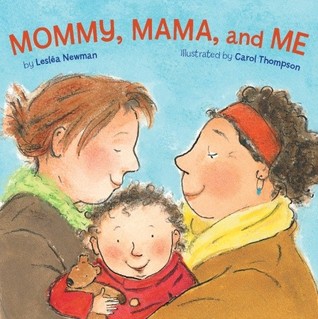 Parenthood through a child’s eyes can’t get any simpler than the way it is presented in this book by Leslea Newman. Mommies are the people who care for you and make sure you have fun. If you have a child under the age of five who you want to see that having two mommies is just regular life, this book should be a part of your home library. It is a board book so if your child younger than three-years-old gets attached in a way that they play roughly with the books, the texts are durable. One mother is white, the other appears to be of multiracial African descent; The child also looks to be multiracial. The book simply carries the reader through a fun day in life; there is no discussion of adoption or biology. When I read Mommy, Mama, and Me with my daughter at age two, she was very interested in clarifying the gender of the child. My daughter asked me several times “Is she a boy or is he a girl?” and she kept trying to figure out which mother was “mommy”. By opening these questions in my daughter’s mind, the book gave, and continues to give us a doorway to discuss having two moms. When this book is read with it’s companion book, Daddy, Papa and Me, my daughter’s questions about the child’s gender elucidate the one problem I have with Mommy, Mama, and Me and the books as a pair—the child in Mommy, Mama, and Me is androgynous and the child in Daddy, Papa, and Me is a boy but what of girls who have two parents of the same gender? I still think these are “must have” books, which are easily accessible and enjoyable for kids of all ages.
Recommendation: Highly Recommended; Age 0-5
Reviewer: Omilaju Miranda

Book Review for I am Living in 2 Homes by Garcelle Beauvais and Sebastian A. Jones
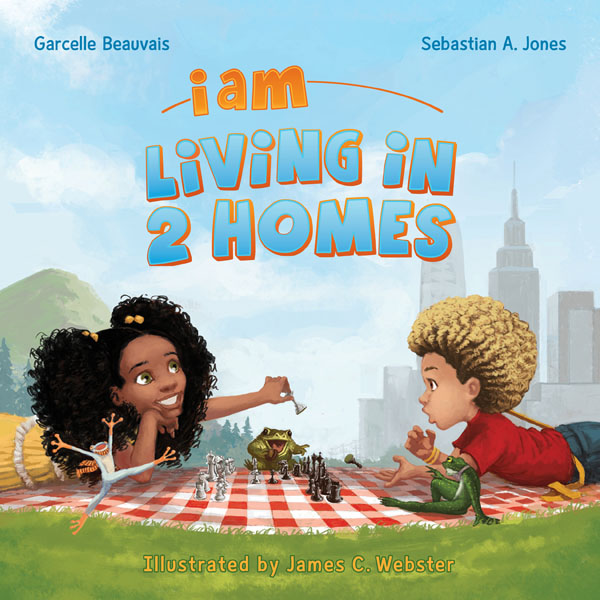 From authors, Sebastian A. Jones and Garcelle Beauvais, we have the second book in the “I am” series of children’s books featuring fraternal twins, Jay and Nia. We met Jay and Nia in their first book, I am Mixed and now in I am Living in 2 Homes, the happy family that we met originally has experienced a split. Mom lives in the country near a river and dad lives in the city near sky scrapers. The children have fun playing in nature doing things like fishing and running after butterflies with mom and doing city things like baseball in the street and eating hot dogs off of food carts, with dad. This book captures the full spectrum of emotions that children feel in the face of their parents splitting up all the while showing us children who are celebrating life; who are joyful in the time they spend with each parent. The difficult feelings that they have to deal with like guilt and fear of their parents forgetting them if they remarry are illustrated first on the faces and in the gestures of the trio of frogs and toads that magically befriend and serve as entourage to Jay and Nia throughout the book. The trio of frogs adds humor throughout the story, which deals with the complexities of this heavy topic through a poetic narrative and many illustrations of parents hugging and reassuring their children.
James C. Webster’s illustrations are evocative and poignant. Adults will feel every emotion I’ve described and more as they read to their children. At the end of the book there’s a note from Jay and Nia about appreciating all family. Children have an opportunity to fill out a discussion form that allows them to identify good things about themselves and good things about living in two homes. There is also a parent discussion guide on using the book to discuss your family. Overall, this is a good book for children to have in the face of divorce or separation and is a great companion for parents who have to discuss the split family with their children and may have difficulty steering the conversation.
Recommendation: Highly Recommended. Age 3-8
Review by Omilaju Miranda
 Diverse Kids Books--Reviews