

My Mommy is a Boy by Jason Martinez
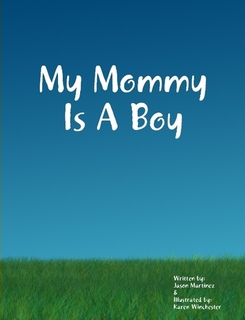 Often our best messages to young children are short, simple and honest. My Mommy is a Boy is just that. It is a story told from the point of view of a 4-year old girl about her female mommy becoming a male. This book addresses some of the questions a child of a transgendered parent might have such as, what to call mommy after she becomes a boy and why a person might want to change her gender. The story also reassures the reader that no matter the gender, the parent’s love for the child never changes. The illustrations match the simple nature of the book and remind me of a homemade book which is perfect considering ‘My Mommy is a Boy’ was written by a transgendered parent to express his love for his daughter.
Recommendation: Recommended for ages 4 and up.
Reviewer: Amanda Setty

Heather Has Two Mommies by Leslea Newman
 A book review page that gives pointed attention to lesbian and gay parent led families can only be complete with a review of this classic book which was the first book ever published in the United States featuring a daughter of two mothers. Out of print now, you will either find this book at your library or buy it through a used bookseller (used copies start at $13; new copies start at $29 plus shipping). The story is a straightforward narrative introducing the reader to Heather and her family, which includes her, her two mommies, a cat and a dog. When she goes to daycare, Heather learns that not having a dad is weird, which saddens her to the point of tears. The teacher and other children are sympathetic and discuss how their families have different relationships with father figures as well, from not having a father, to having two daddies, or grandparents as primary caregivers. The black and white pencil drawings add poignancy and depth to the story. Children and adults will also be drawn into the attention given to children’s participation and representation of their world as the children’s drawings of their families are shown to the reader. The text and illustrations evocatively portray the universal vulnerability of children in the face of feeling like an outsider, their dependency on parental love and the neighborly generosity they express when coming from loving homes.
Recommendation: Recommended; ages 3-8
Reviewer: Omilaju Miranda
Uncle Bobby’s Wedding by Sarah S. Brannen
 This lovely story of family bonds in a guinea pig family. Chloe loves her uncle Bobby and is opposed to his getting married to Jaime because she doesn’t want to be unimportant. Her mother explains that when adults love each other that much they want to be married and encourages Chloe to speak to her uncle about her worries. When Bobby, Jaime, and Chloe all spend time together, Chloe realizes she will gain a second wonderful uncle when Bobby and Jaime get married. Then, she endorses their marriage and agrees to be the flower girl at the wedding. On the day of the wedding, she saves the day when Bobby and Jaime forget things necessary for the ceremony. Brannen does a great job of carrying us through Chloe’s emotional changes and showing us how a strong bond with an adult can make a child feel confident that they are the most important part of the adult’s life.
Recommendation: Recommended; Ages 3+
Reviewer: Omilaju Miranda

King and King by Linda de Hann and Stern Nijland
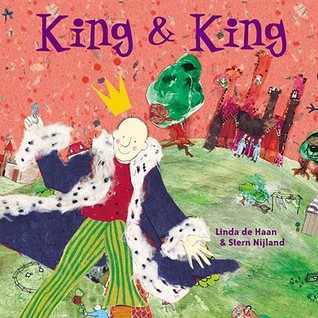 A quirkily illustrated fairytale of a prince whose mother, the queen requires that he get married so she can have some time to herself. After a succession of princesses come to woo him, he falls in love with a prince chaperoning another princess visiting to woo him. The story is simple and easy to follow and a nice way to introduce children to the fairy tale of what may have been the story of their two dads’ beginning.
Recommendation: Recommended; ages 5+ .
Reviewer: Omilaju Miranda

A Tale of Two Mommies by Vanita Oelschlager
 All dialogue, this rhyming book is a conversation between the adopted son of two others and his friends while the protagonist and his friends play on the beach. As they run, play ball, swim, and have other beach fun, the questions and answers volley in sets of two. “Which mom is there when you want to go fishing? Which mom helps out when Kitty goes missing?” “Mommy helps when I want to go fishing, Both mommies help when Kitty goes missing.” The narrative continues in such a trajectory until it includes answers in which the protagonist says he is the one doing certain things. This is a full portrait of the emotional and activity life of a family from the perspective of a child who is increasingly taking on responsibilities. The child happens to be the African-Descendant child of two white moms but that is not discussed. This is a story with which every child who has taken note of how their parents nurture and mentor them, can identify.
Recommendation: Recommended; ages Ages 2-8
Reviewer: Omilaju Miranda
A Mother for Choco by Keiko Kasza
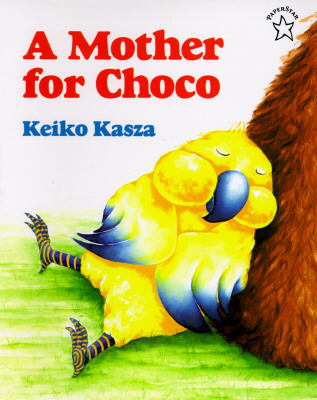 I am so impressed with this book. Love this story. Slightly reminiscent of Dr. Seuss’ Are You My Mother, Choco is a yellow and blue chick who needs a mother. Many of the animals of the forest tell him they can’t be his mother because he doesn’t look like them until Mrs. Bear takes him in, lets him define what makes a mother and, upon doing those things, the two decide that she is his mother despite the fact that she doesn’t look him. At his new home, Choco has three siblings who are all different species of animal—none of them a bear. This felt so good to read, and the illustrations were rollicking fun. Every home should have this book but I think this is an especially easy way to help a little one see transracial adoption family structure as fun and “normal”.
P.S. My daughter immediately identified the bear as Choco’s mother before the story concluded that it would be so, which I think is a sign that we create “normal” for our children.
Recommendation: Highly Recommended; Ages 0-10
Reviewer: Omilaju Miranda

When Kathy is Keith by Wallace Wong
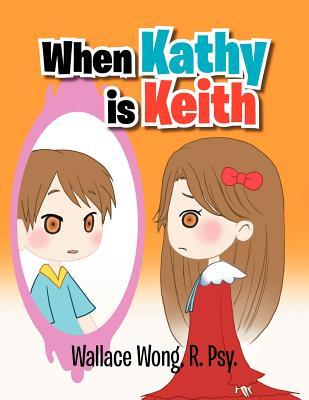 Written by a clinical psychologist, this book is more of a short illustrated manual on childhood transgendered identity than a children’s story. It is written in simple language that a child can easily follow but I don’t know how enjoyable it would be for a child to read or have read to them but it would be very valuable to guide a parent and other adults in the life of a child who sees themselves as the opposite gender in the practical steps to take to attend to the identity supportive needs of a trans child. The book starts with an intro to Kathy and the different scenes of her life in which she showed and voiced her interest in being a boy, then moves the reader through the steps that Kathy’s parents take to help Kathy live as a boy at home and at school. At the end of the book there is a short list of resources to support the family with a transgendered identified child.
Recommended Age: 5+ for non transgender identified children; as young as parents feel appropriate for transgendered identified children.
Reviewer: Omilaju Miranda

Best, Best Colors/ Los Mejores Colores by Eric Hoffman
 I like everything about this book. The watercolor illustrations are dreamy and perfect for a book focused on a boy’s struggle with loving all the colors of the rainbow. Written simultaneously in Spanish and English, this is the story of the protagonist Nate having trouble deciding which color is his best color so he keeps on changing his mind based on liking a new object. Whatever color the sneakers or cape or paints are is his favorite color. He wants to integrate whatever color is his favorite into his world and he chooses his “best mom” or best friend according to whether or not they say “yes”, he can have the color in his life the way that he wants. When they say “no”, as mothers must, he takes away best mother status—which is such a candid representation of the mercurial nature of children. Without making reference to it, we see Nate with his moms and his sister who are all different races/ ethnicities (Nate and one of his moms are African Diaspora people while his other mom is Caucasian and his sister is East Asian) enjoying life on Nate’s journey of figuring out what and who he likes best. In the end, his nightmare of colors fighting opens his mind to choosing an object in which all the colors get along: the Pride Flag. This is one of the few books representing LGBT parents with an African Diaspora mother or child so it is refreshing that is has a well-written story line independent of its representation of diversity.
Recommendation: Highly Recommended
Book Review by Omilaju Miranda

My Mom is a Foreigner but Not to Me by Julianne Moore
 I love this book so very much
I can read it ten good times
She represents a child’s experience
With such cool, catchy rhymes
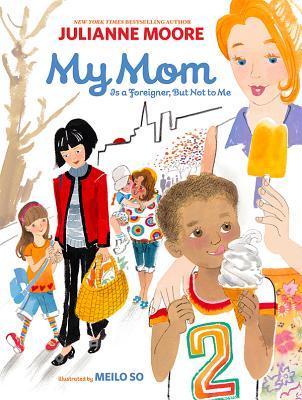
This book by Julianne Moore, primarily written in ABCB rhyming quatrain stanzas, is a first person narrative from the perspective of a dozen different children, which talks about the varied experiences of a child living in the U.S. with a mother from another country. The illustrator, Meilo So has chosen a “framed” illustration style which, other than the fact that it leaves a lot of white space on the page is successful at providing images for many different aspects of the “story” simultaneously.
Not only do I like the fact that Moore’s rhyme is perfect ninety per cent of the time, the text shows the dynamic conflicts faced by children who love their mothers but experience, with a little shame, all of the ways in which their mother is different from other mothers and people they encounter daily, including their different food and culturally different greeting and doting customs. The children also communicate their discomfort with their mothers’ use of a different language in communicating with them and their mothers’ slow mastery of English as their second language.
Most of the children from whose voice the book is written appear to be between the ages of 7-11. While there are several pages in the book illustrating the mothers caring for a second child in the infant/toddler age range, there is only one page in the book that shows a mother and father together (in a photo on a dresser) so children living in single-mother led households can easily find a reflection of their family construct in this book.
Most of the mother-child relationships in the book are clearly representative of an interracial family (even though we don’t see fathers) with children who look racially different from their mothers. Moore and Meilo So cover the full gamut of children who look racially different from their mothers whether the mothers are East Asian, Subsaharan African, or Dutch with children whose features present as the entire world spectrum of all racial/ethnic features. Meilo So does not just throw kids on the page who are holding hands with mothers—no, her vivid, emotionally realistic, water color illustrations are done with such attention to detail that on one page there is a brown-skinned, gele scarf wearing mother with her pale-skinned, red-haired daughter who the reader can see look exactly alike–like twins except their skin color, height, and weight are different. The “twin” mother and daughter are walking up the stairs as a boy behind them keeps staring at them and a mother holding a child that is like her in every obvious way walks towards them staring at them with a surprised, questioning look on her face. The text that goes along with this illustration speaks of the emotional weight a child faces when her features are just like her mom’s but because of different racial markers people don’t always see their likeness:
“Some people say we look alike
Others wonder: What’s HER name?
I get so upset when they say,
“Why don’t you look the same?””
Finally, this book ends with a celebration of all the universal ways in which a mother and child bond,
“She gives me lots of kisses,
she tucks me in at night,
she laughs at ALL my jokes,
SHE HOLDS ME VERY TIGHT”
With this well-written, fancifully illustrated picture book, Julianne Moore and Meilo So have hit a home run for all readers and definitely for intercultural and multi-lingual and interracial families that also keeps children belonging to single parent households from feeling like outsiders.
Recommendation: Highly Recommended; Ages–3-10
Reviewer: Omilaju Miranda

Mixed Me by Tiffany Catledge
 My immediate reaction to this book is “this is so cute”. I like the voice of the young girl in the book and the choice to put her in a very diverse world—although “a tale of a girl who is both black and white,” her world is filled with the full spectrum of human diversity. I find it to be very didactic. This isn’t so much a story as it is an illustrated speech to the reader. The protagonist discusses all the major issues mixed-race children encounter from people outside of their family and the watercolor illustrations are incredibly appealing. The straightforwardness of this book makes it very valuable as a teaching tool so I think teachers and school librarians should include it in their collection or, parents should buy it and donate it to the school so it can be a part of the classroom and, hopefully diversity lesson plans.
Recommendation: Recommended for Educational Purposes; Ages 5-7
 Diverse Kids Books--Reviews