

Josephine by Patricia Hruby Powell and Christian Robinson
 A free verse prose poem tells the life story of the first black American international musical superstar Josephine Baker, born out of wedlock and raised in part by a single mother. Collage drawings give the book a rich tactile feel that almost transcends the flat page. The language, which tells the story of Baker’s creativity and success amidst the U.S.’s violent racism is continuously evocative. While the images are fun to look at for all ages, only children ready to learn about racism, race riots, and shadism should read the book, as those harsh realities made a huge impact on Josephine Baker’s life and career, and are represented in heartrending language and images in the book. This is a beautifully told story that will tempt both the child who loves, and the child who hates reading and poetry, to become a poet. Verse after verse, the reader will learn of Josephine’s courage, and her fierce determination to be center stage as the dancing star she believed she could become. Those afraid to move on to middle school, go off to boarding school, or attend a training camp for their sport or art will see in Josephine, a girl so committed to the fulfillment of dancing that she left home at thirteen-years-old to tour the country, and left her husband for Broadway when she was only fifteen-years-old. Those who never consider the power of humor will learn how Baker attracted the spotlight with her comedic facial expressions as she danced. Her dynamism will inspire the reader learning of her many landmark performances, as well as her choice to become a pilot and fight as a spy against the Nazis during WWII. With dramatic punctuations in the poetic language, the author tells of Baker’s economic fall, and how bankruptcy proved to be a painful lesson in excess for the generous humanitarian. But Powell makes sure the reader knows that Baker was a socially conscious performer. At one point the richest Negro woman in the world, Baker was a civil rights fighter who convinced the army and many venues to allow integrated audiences to attend her performances, and even convinced owners of segregated corporations to hire blacks. The language and illustrations will make you feel Josephine’s life— her ups and downs, her ultimate triumph in achieving every dream she had, including dying “breathless, spent, after a dance.” (buy)
Recommendation: Highly Recommended; Ages 10+

You Be Me and I’ll Be You by Pili Mandelbaum
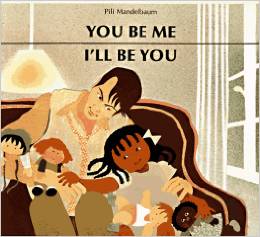 A well intentioned father tries to help his brown-skinned biracial daughter feel comfortable with her skin color by plaiting his straight hair, donning black face and having her don white face. I was almost too insulted to continue reading but out of duty, I finished the book. The narrative attempts to redeem itself by showing people laying out on the beach tanning, using rollers to make their hair curly, and pointing out that every one wants features they can’t have. I don’t know if this did well in Belgium where it was originally published but as a U.S.American, I would never read this to my child.
Recommendation: Not Recommended.
Reviewer: Omilaju Miranda

One Love by Cedella Marley, Bob Marley and Vanessa Brantley-Newton
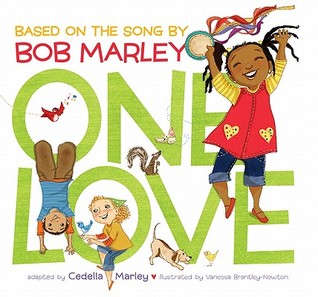 Look closely at the illustrations as you read this book and each time you will discover something new. The words are the lyrics of Bob Marley’s song “One Love”, the illustrations tell the story of community togetherness. A little girl waves goodbye to her loving mom and dad and walks into the friendly world outside her door, which is filled with nature, happy neighbors and close friends who play, plant, and recycle together. The illustrations are vivid, exciting and contagiously spread a smile across your face. Although the only obvious racial phenotypes are Caucasian, African Diaspora and black/white mixed, the full range of phenotypes within those ethnicities is represented. Children of all ages will enjoy this book and those who remember the song will love sharing the song with a new generation as they follow the illustrations telling the story of community responsibility and cooperation to repair, rebuild, and landscape a neighborhood park in disrepair. Simple, loving, lyrical of course, and with such strong illustration dependent story telling that this is a great book for the pre-literate child to practice decoding and multiple levels of “reading” comprehension, which is what I did with my pre-reading daughter. This is a book everyone should have and all who have children should read and discuss with their kids. (buy)
Recommendation: Highly recommended Ages 2+

First ever openly Trans-identified Picture Book Protagonist: 10,000 Dresses by Marcus Ewert
 My gender conforming, princess imitating 4-year-old cis-girl who, like most 4-year-olds, has pretty conservative views about gender roles was drawn to the 10,000 Dresses book cover, which features the protagonist in a crystal blue, sparkly formal gown. I was focused on other writing jobs but I finally took a break when my daughter begged me repeatedly to read the book to her and after we finished it, she asked me to read it another two times which is distinctive in our reading this week. She was very interested in all the dresses that Bailey, the protagonist dreamed up and surprised me when she approved of Bailey wearing dresses even after Bailey’s family called her a boy. The narrative refers to the protagonist, Bailey with the pronoun “her”. However, in dialogue between Bailey and her family members, it comes out that Bailey is a biological male who doesn’t feel like a “boy”. My four-year-old understood feeling but not why we were referring to the character as both “her” and a boy. It was very easy for my daughter to understand that it wasn’t nice for the parents to tell Bailey “don’t mention dresses again!” and she thought the brother who threatened to kick Bailey was ‘really mean’
This story is as depthful as it is simple and straightforward. Bailey starts out with a dream of 10,000 dresses and excitedly shares her dream of wearing each one with different members of her family, asking them to buy her a dress like the one in her dream. When her brother threatens to kick her because it’s “gross for boys to wear dresses, Bailey runs away and befriends a fashion designing older girl with whom Bailey makes dresses. While I have read the other gender non-conforming classics to my daughter, which are all about biological boys wearing dresses (hint authors and publishers: please write and publish about gender non-conforming bio-girls soon), this is the first one that gained my daughter’s acceptance of a physiological boy wearing dresses. Maybe that’s because my daughter is older now, maybe it’s because I’ve already read three others to her, maybe it’s because this is the first of all these books to be daring enough to actually have the protagonist declare their trans identity. In the other books, the biological boys are fighting to be accepted for wearing traditionally feminine clothes with no mention of them feeling trans identified, whereas in response to her family members telling her that “Boys don’t wear dresses”, Bailey responds with, “But I don’t feel like a boy.” While I think that we need the books that say it’s okay for a cis-boy to wear dresses, barrettes, and pink (My Princess Boy, Jacob’s New Dress, Roland Humphrey is Wearing a What?), hooray for 10,000 Dresses making the full commitment to a character who identifies as trans. The family rejection that Bailey endures is painful but Bailey’s self-acceptance and choice to seek an ally instead of attempting to conform to the intolerant family is a powerful move that leads to a poignant conclusion.
While the gender issue is the primary theme, the sub theme concerned with the creative process–following the story of Bailey’s creative visions and ideas being developed into wearable art–is incredibly valuable; the story ends on the note of creative ingenuity and compromise, allowing two of Bailey’s dress ideas to manifest in one dress. This is a profoundly affirming book for trans or gender non-conforming children and powerful enough to open the minds and hearts of conservative, gender conforming children towards acceptance.
Considering the things my daughter didn’t understand like those mentioned above and what the word “gross” means, I’d say that this is appropriate for cis children 6 and older, while trans and gender non-conforming children should have this book read to them with a parent’s explanation of that which they don’t understand, as early as they have trans feelings. This is one of my new favorite books if only because it is a non-Disney princess, diversity book that my daughter asks to have read to her over and over again.
Recommendation: Highly Recommended. 6+
Book Reviewer: Omilaju Miranda
The Wakame Gatherers by Holly Thompson
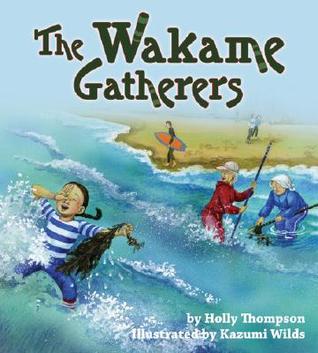 Holly Thompson tackles the difficult subject of war with grace and beautiful writing in The Wakame Gatherers. The book begins with a little girl saying, “My name is Nanami—Seven Seas—and I have two grandmothers from two different seas: Gram from Maine, and Baachan, who lives with us here in Japan.”
Gram visits Japan, and several pages are dedicated to descriptions and illustrations of the beaches of Maine and Japan, with particular focus on the local color of Nanami’s Japanese hometown. As a translator between her two grandmothers, Nanami helps them compare and contrast their two lands, learns about hooking and preparing seaweed as she takes care to “[use] the right language with the right grandmother.”
Then comes conflict: not in the present, but seeping through from history. The illustrations become dark and ominous as Baachan reminisces about the war. Nanami continues to translate, and understands, “when my grandmothers were my age they were enemies, their countries bombing each other’s people.” The two old women, through their shared granddaughter’s translation, apologize for their countries’ past actions, and in the space of two pages, a feeling of peace and happiness is restored as they return to wakame gathering.
With exquisite illustrations and vivid descriptions, The Wakame Gatherers brings together two cultures by not just acknowledging similarities and differences, but addressing the past. Of additional educational value at the end of the book are a fact sheet about wakame, a glossary of Japanese phrases, and three wakame recipes.
Recommended: Highly recommended. Ages 4-8.
My Nose , Your Nose by Melanie Walsh
 My Nose, Your Nose is a little picture book with just a few words per page, talks about more than just noses. “Daisy’s skin is brown, Agnes’s skin is white, but they both have cheeky pink tongues!” And so it goes, with skin, hair (texture and color), length of legs, and eye color. Simple and colorful illustrations depict many children who look similar besides the differences in skin, hair, and nose highlighted in the narrative, teaching children (and reminding parents) that we’re all the same beneath it all.
This would be a great book for a daycare so that during story time all the babies, toddlers and children can feel included. For children who aren’t exposed to diverse families during daycare or social gatherings, this would be a great way to prepare them for seeing people who look different from them as they grow up.
My only nitpick here, which is a personal one, is the lack of Asian representation in the text and illustration. That doesn’t stop me from recommending the book, however.
Recommended ages: 0+
Book Reviewer: Yu Han Chao
Music, Music for Everyone by Vera B. Williams
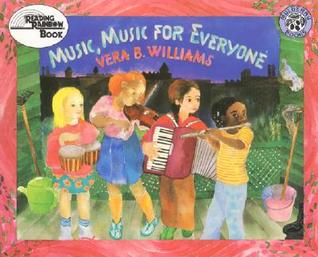 In what may be considered the third of Vera B. Williams’ “Rosa” series, Music, Music for Everyone, Rosa’s new found accordion hobby and relationship with her Grandmother continue. When Rosa’s Grandmother grows ill, Rosa and her friends try to make her feel better. They finally decide the best way to help her recover is to fill the coin jar again, by raising money as a musical band. After practicing and finding a party to play at, their performance not only brings Rosa’s Grandmother a sense of joy, but it also brings their families and the neighborhood even closer.
The illustrations in this book are as fun as those in Williams’ A Chair for My Mother and Something Special for Me. While the characters do not seem as physically active in the artwork as they were in the previous books, the art is still appealing. In this book, Williams used color as a strong medium to convey the emotional tone of the story, with scenes that seem gloomier than others painted darker colors. The illustration I liked the most was the two pages of family and friends dancing at the anniversary party. I even found myself spending a couple of minutes trying to see how each character was dancing. The artwork also included a wide range of ethnicities, which I thought I added to this story’s theme.
Family bonds is the primary theme of this story with music being used to bring each family closer, especially Rosa and her Grandmother. The story’s subtext conveys the importance of being able to use your own talents to help others and maybe bring people closer. Just as the other two Rosa stories are more female oriented when it comes to the characters, Music, Music, for Everyone, is focused more on female familial relationships than other relationships. However, the characters’ gender only adds to the overall strength of the story that all people would enjoy.
Recommendation: Recommended; ages 5+
Reviewer: Warren Stokes
Dear Primo: a Letter to my Cousin by Duncan Tonatiuh
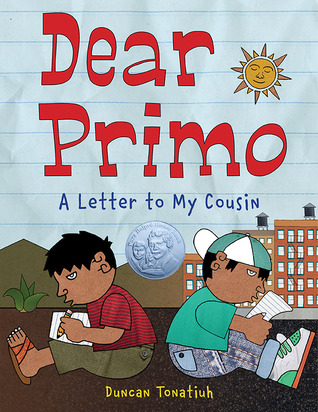 Comparing Cultures, A Review of Duncan Tonatiuh’s “Dear Primo: a Letter to my Cousin”
This epistolary children’s book not only fills a much needed niche in the narrative for children living in America, it gives us a glimpse into a different kind of family structure, a family structure whose existence is an arbitrary border away.
Charlie, the Mexican-American boy living in New York, experiences life as an assimilated child: basketball, pizza, and video games; while his cousin, Carlitos, a village dweller in Mexico, experiences a similar but different experience: his sport is soccer, his cheese is found in a quesadilla and his games are found in the beauty of his natural environment. The two kids’ lives mimic one another; one is associated with the other in a way that would be interesting to a child, if cliche for adults.
Children like familiarity which is provided through Charlie’s perspective, but children also respond to new sounds, so the sprinkling of Spanish is welcomed. Familiar Spanish nouns like perros (dogs) and gallo (rooster) are introduced as captions or interjections which provide intertextual experience; you and your child could spend extra time on the page isolating those words and building a small vocabulary.
But the most amazing part of this book is beyond the words: the illustrations! These full-page, hand-drawn, hand-colored images are warm with the color of earth when we experience Carlitos’ narrative and steely cool when Charlie’s sterile city scene is set. The boys are boxy and asymmetrical with profile-facing, round heads in a style reminiscent of Mayan art. The boys are modern versions of their ancestors: a mixture of animal and human, earth and man; even their spirally fists are imaginative.
This book presents two cultures which overlap and exist on the same continent. Two cultures positioned in contrasting contexts: different settings in the same family.
Recommendation: Highly recommended, ages 4 – 8
Book Review by: Rachelle Escamilla

Nappy Hair by Carolivia Herron
 Carolivia Herron’s Nappy Hair tells the story of Brenda, a dark-skinned girl with a massive bush of kinky, untamed hair towering above her slender frame. The true protagonist in this story is Brenda’s hair, which takes on a vivacious life of its own as Brenda’s elder, Uncle Mordecai, shares with the rest of the family at a picnic the colorful and rhythmic story of how Brenda ended up with all that nappy hair. Setting this book apart from other stories that I have read that are designed to affirm positive self-image in Black children, Nappy Hair does not present the main character as having a problem with either who she is or her hair’s texture. Sure, there were other characters who express disapproval of her tightly coiled hair—namely, members of the Heavenly choir who are present during her creation. They pitied her hair to such an extent that they have the audacity to reproach God by asking:
“Why you gotta be so mean, why you gotta be so willful, why you gotta be so ornery, thinking about giving that nappy, nappy hair to that innocent little child?”
Nevertheless, even at the very beginning of the story, Brenda exudes confidence —her head is always held high, she wears a wide smile, and she refuses to allow family members to tame her maverick coils with brushes, hair spray, and broken-toothed combs.
For centuries, hair has been a sensitive issue in Black communities in the United States, and with the recent revitalization of a natural hair movement committed to the ethos of expressing black pride by embracing afros, locs, and braids in lieu of hair relaxers and other chemicals, Herron’s Nappy Hair (which was published in 1997) remains a relevant teaching tool for parents, mentors, and educators. This book presents a clever call and response narrative that may be shared with boys and girls of all races and hair types to encourage them to love how their hair naturally grows from their scalp and to encourage an appreciation for how they may be different from others but equally as beautiful. When I first read this book to my third grade class five years ago, the students laughed in derision at the title and at how Uncle Mordecai was describing Brenda’s hair. In the community where my students were growing up, “nappy” was a cruel word that connotes the polar opposite of good and beautiful; and, they would often use the term to make fun of each other. However, through a read-aloud with them, they realized Uncle Mordecai’s comments about Brenda’s hair being nappy were not derogatory at all. In fact, at the very end of his story, he proclaims:
“I got me at long last this cute little brown baby girl…And she’s got the nappiest hair in the world.”
Notably, Herron’s Nappy Hair also alludes to the profound obligation that adults have in shaping children’s self-esteem. In fact, the book conveys the message that children look to us for affirmation, reassurance, and to learn standards of beauty. Brenda was blessed with an Uncle Mordecai who spoke a life of rich heritage, strength, and beauty into her and her naturally kinky coils—a life that says you are perfect just the way you are. This book could serve as a springboard for parents and educators to engage in that same edifying dialogue with the children in their lives.
Recommendation: Highly Recommended; ages 6+ (with parental guidance to avoid misinterpretation) (buy)
Book Review by: La Tonya Jackson

Maxwell’s Mountain by Shari Becker
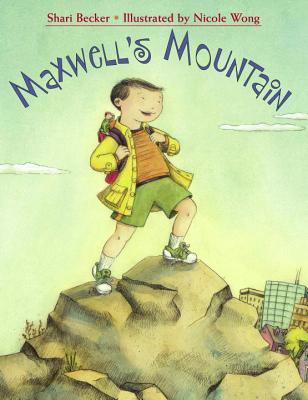 Maxwell’s Mountain features a little boy with an Asian-featured father and Caucasian-looking, redheaded mother. Maxwell sees a mountain near a new park, and goes on a mountain-climbing adventure. The illustrations are beautiful watercolor-and-ink, though the story, while it teaches some good lessons, could have been so much more.
The story could have addressed the diversity so lovingly depicted by the illustrations. If you have a mixed family, you and your child might enjoy seeing the representation of diversity here. It’s interesting that the author says nothing about Maxwell’s family and background, however—not only is this a missed opportunity, it feels like a multi-racial elephant in the room.
The actual morals tackled here also seem ambiguous. One lesson a child might learn from this story is to be prepared before undertaking a large task. Maxwell is determined to the point of obsession (“At dinner Maxwell saw mountains everywhere”) and does his research by (unrealistically) checking out all the books on mountain-climbing from the library and looking through them all in one night. He trains for his hike by repeatedly climbing up and down the stairs at home (depending on the age of your child, maybe not the safest activity to encourage). And the overt moral of the book is, “When he’s in trouble, a true outdoorsman uses his head.” The gendered “outdoorsman” and “he/his” throughout the book can be limiting gender-wise, and in the end, Maxwell doesn’t really use his head that much besides backtracking a little when he gets lost.
In conclusion, Maxwell’s Mountain features lovely and intriguing illustrations, though the story does not live up to its full potential. We might wish the world were post-racial and post-feminist, that race and gender are no longer issues we should give voice to for children when an obvious opportunity presents itself, but we’re not quite there yet.
Recommendation: 4-8 years. (buy)
Review by Yu-Han (Eugenia) Chao
 Diverse Kids Books--Reviews