

Pinata by Ken Locsmandi and Sebastian A. Jones
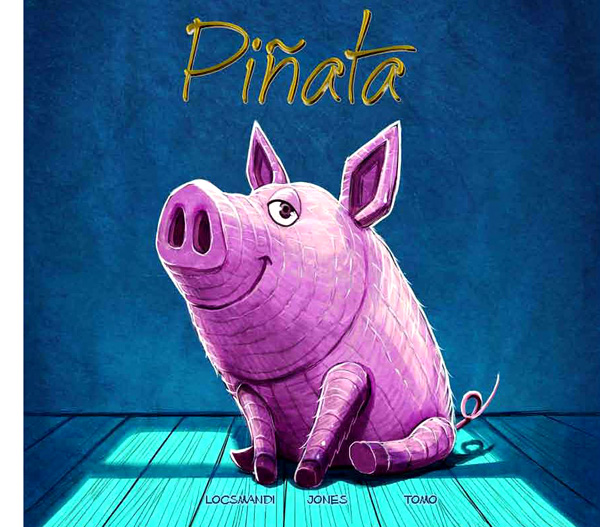 Oh, the piñatas talk and I love this book but more importantly, my daughter loves this book. She asked me to read it to her five times the first night and three times the next. It sits atop her dresser like a favorite family photo—her comfort and entertainment. This is the magical Pinnochioesque story of Pancho the Piñata. Pancho is a creation of Jorge the piñata maker who uses a magical, secret, paper mache mix to bring to life piñatas that speak.
Other than the fact that there is only a partial commitment to rhyme in the story, this is a narrative that transports you into a mystical reality and keeps you there. These piñatas enjoy being at the center of a party. Making the children who break them happy is their life mission. With a plentiful smattering of Spanish words of endearment, Pinata tells the story of Pancho maturing from a scared new piñata into a piñata who finds his self-worth in making Lulu, Jorge’s granddaughter happy on her birthday.
Lulu is confined to a wheel chair but that is never mentioned. So, in just a few pages and with the answering of my daughter’s one question about her, “Why does she have that chair?” the story transported differently abled people from unseen in my daughter’s life to normal. Pancho lives on after his candy is spilled and the extra special fantasy of Pinata continues through the other characters, especially the little candy addicted mice that keep the wonder of this world going. Pinata is an exciting, bilingual, magical experience. At the end of the book, you and your child will learn how to make your own, real life, magical pinata. So, turn a page and swing a bat!
Recommendation: Highly Recommended
Reviewer: Omilaju Miranda
‘Mine, Mine, Mine’ by Shelly Becker
 This is a great story about Gail, the protagonist, learning to share. As an exciting break in the pleasant, prose of most of the books I’ve been reading lately, this story has conflict between two children, a tantrum over not wanting to share, youthful sarcasm, an arc of growth on the part of the 1st person narrator and it is all told in accurate rhyme, the melody of which I am certain contributed to holding my daughter’s attention so intently that she only interrupted me with one question during the read. The protagonist who doesn’t want to share her toys with her visiting cousin and then decides to share disgusting cast-off items, does by the end of the story— after her mother speaks to her twice and models sharing for her—learn to share and the reader is the recipient of a surprising shared gift. After we finished the story my daughter did something she rarely does—she took the book from me and not only asked if she could sleep with it (that she does all the time), she began to “read” the story back to me, telling it as closely as she could from memory. Sharing is a skill that most, if not all small children resist, so coupled with an energetic, melodic story, the topic captivates the young child’s interest. This book is sure to be a hit with your little one.
Although this book does not mention the protagonist and her mommy being the only ones in the household, it covers a large span of time in the protagonist’s life in which we never see a second parent. The first time I read it, I also thought the protagonist was a Mixed Heritage child although upon second read I’m not sure but there are certainly mixed heritage children who will see themselves reflected in Gail’s physical features especially in contrast to her mother’s and her cousin’s phenotypes.
Recommendation: Highly recommended
Ages: 3+
Reviewer: Omilaju Miranda
When Mama Gets Home by Marisabina Russo
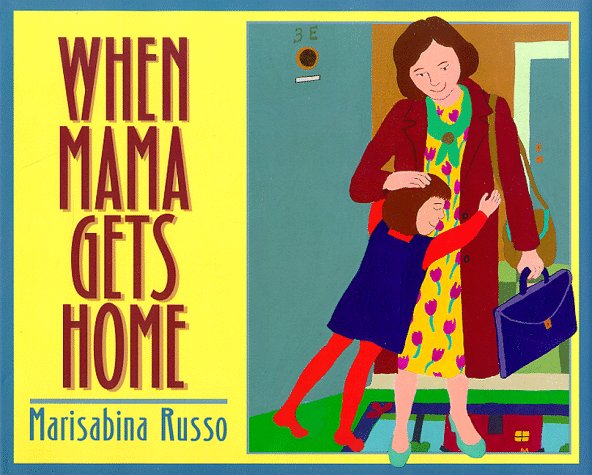 Every kid is self-absorbed, wants all their mother’s attention, sees the world through the lens of “mommies and daddies” and tolerates their siblings as much as they have to just to please their mother. So is the reality that many experience and that Russo writes in When Mama Gets Home. Three siblings begin dinner as they eagerly await their mother’s arrival from work, then each of them ambush her with their own agenda before she even has a chance to take off her coat. The mother is a diplomat, finding a way to give each child the attention s/he needs. Although the ten-year-old protagonist has a teenage brother and sister, the protagonist gets the most time with Mama as she needs her for the end of night and bedtime routine. As parents, we always love stories that include the bedtime routine and carry the reader to bed and this one delivers, ending with a “goodnight” tuck in. When Mama Gets Home demonstrates how a family led by a single mother must be a team on which the children are major players and the mother communicates with a strong level of patience in order to make sure each child feels loved and heard.
Recommendation: recommended; ages 3+
Reviewer: Omilaju Miranda
Amazing Grace by Mary Hoffman
 Grace has a limitless imagination. Like many of the children who will read this story, she likes to dress up as any character she has ever seen or can imagine from spiders to pirates. When her teacher announces that the class is going to stage “Peter Pan”, Grace wants to play the lead role of Peter despite the fact that two of her classmates tell her she can’t play Peter because he is a boy and he’s white. Grace who lives with her single mother and grandmother goes home sad, and her mom and grandmother assure her that she can play Peter if she wants. Grace memorizes Peter Pan’s lines and Grandma even takes her to the ballet to see an Afro-Trinidadian friend of the family play Juliet in “Romeo and Juliet”. Grace wins the part of Peter and does an amazing job playing the role. Every child with an imagination will connect with Grace. Children of single mothers or parents who get tired but still make time to play will see themselves reflected in Grace’s family. My 3-year-old expected the story to continue so the fullness of the story arc will register more with readers instead of pre-literate children.
Recommendation: Highly Recommended; Ages 6-9
Reviewer: Omilaju Miranda

A Chair for My Mother by Vera B. Williams
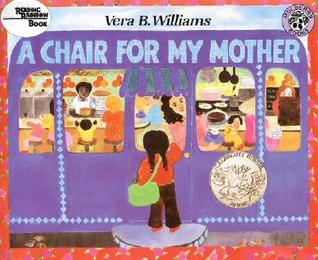 With the dedication to giving every single detail that is so commonly heard in a child’s story telling, Vera B. Williams spins a believable first person narrative in A Chair for My Mother . Rosa, the protagonist lives with her mother and her grandmother who have survived a fire and are saving their coins to buy a new chair because all their old furniture was “spoiled” in the fire. The day of the fire, Rosa got new sandals and her mother got new pumps; other details include the fact that one day, while helping out at her mother’s waitress job, Rosa peeled all the onions for the onion soup. Rosa, her mother, and grandmother take turns in the chair at the story before they buy it and take turns enjoying it once it is in their home. This is another Caldecott Honor book for Vera B. Williams. I like the consistency of the child’s voice, the cohesiveness of the family, support of the community that donates almost all the furniture for their new apartment, and colorful, emotionally balanced way that Williams deals with the sensitive issue of surviving a fire. At one point my interest did drift—I got a little bored but this goes hand in hand with the believability of Rosa’s voice. Children will often give you every single detail they can remember which can be challenging to entertain in real life as it was for me for two pages of the book. Vera B. Williams has written two other books in the Rosa series: Something Special For Me and Music, Music For Everyone. Rosa is a child whose first-person narrative story deserves a place in a child’s library.
Recommendation: Highly Recommended; Ages 5-8
Reviewer: Omilaju Miranda
Mama, I’ll Give You the World by Roni Schotter
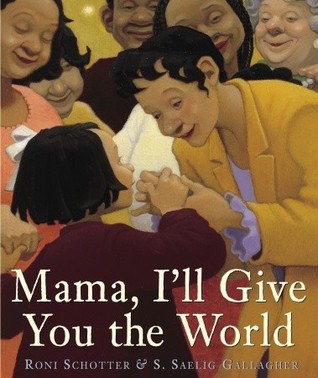 “When Papa was around, Mama loved to dance, but Mama doesn’t dance anymore,” is the first line of Mama I’ll Give You the World and that semi-vague statement is all that is ever said about the absent Papa that lives in the subtext of this children’s story. Perhaps he has passed away, maybe he has abandoned the family; either way, children being raised by single mothers with no father in their lives will feel like their family construct is reflected in Luisa and her mother’s family. Luisa’s mother wants to give Luisa the world that is “so big. So much more for you to know. So much more for you to see.” And that starts every day with Luisa doing her homework beneath a palm tree in the beauty salon and Luisa’s mother saving for Luisa’s college tuition. Doing homework looks exotic, Luisa’s working class world looks like a holiday getaway.
The text is accessible prose that brings the reader smoothly and easily into Luisa’s daily life with her mother in Walter’s World of Beauty– the beauty salon where her mother works. As is so often the case in real life, the salon where Luisa’s mother works is a community gathering place where Luisa’s extended family bonds. The story is a narrative of Luisa communicating with all the adults (hairdressers and clients in her mother’s hair salon) to organize a special gift for her mama—a secret gift that even surprises the reader. Luisa’s dedication to her mother culminates in a climax that made me cry as her daughter celebrates her mother’s birthday by connecting her mother to the past. In the midst of the celebration, the story subtlety introduces a new suitor who has been a trusted friend throughout the book.
Luisa is an observant, sensitive, intelligent character who loves her mom, communicates impressively, and with the realistic precociousness of a child, who while protected by many adults in her life, also lives with the worry about her mother’s happiness and past that overshadows their lives. The illustration is fanciful and engaging, telling the story of the loving community to which Luisa belongs.
Luisa’s world is diverse, filled with people of all races and may ethnicities. Although there are no Spanish words spoken, several of the characters bear Spanish names and the full range of physical features found amongst white, tan and moreno Latinos. Children whose families are from many parts of Latin America—whether the Spanish Caribbean, Central, or South America will feel reflected in the characters represented. Additionally, there are two male hair dressers working with Luisa’s mother—one of whom seems to be slightly effeminate so that without saying it directly, we see that Luisa lives in a diverse and all inclusive world.
Recommendation: Highly Recommended
Reviewer: Omilaju Miranda

The Family Book by Todd Parr
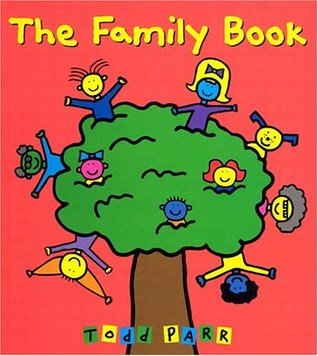 Todd Parr makes the idea of family a fun thing to read about in this book illustrated with crayon-colored people. The silly illustrations and simple statements give the reader a feeling of “family” meaning acceptance more than anything else. Using animals and people to represent the many different family structures in our society, this is an easy, sensory stimulating, colorful way to introduce or further conversation on family diversity with your children, especially small children.
Recommendation: Recommended; 2+
Reviewer: Omilaju Miranda
Hairs & Pelitos by Sandra Cisneros
 A very simple story told by a little girl who seeks comfort in her mother’s smell, embrace, and love. The first person narrative partially frames the oil painting illustrations with the English text at the top and the Spanish text at the bottom of the page. The protagonist enters the story through a discussion of her family’s different hair types. With uncommon descriptions of their hair as analogous to brooms, rosettes, and fur, she tells us of the diverse look and behavior (slippery, lazy, etc.) of her family members’ hair. Diversity is also found in the family through the illustration of each of them as a different color so that they are literally a rainbow family. The front and back covers of the book have educational lessons and crafts exercises for readers making this a hands on bilingual story of family love.
Recommendation: Highly Recommended; ages 5+
Reviewer: Omilaju Miranda
If I Were Your Father by Margaret Park Bridges
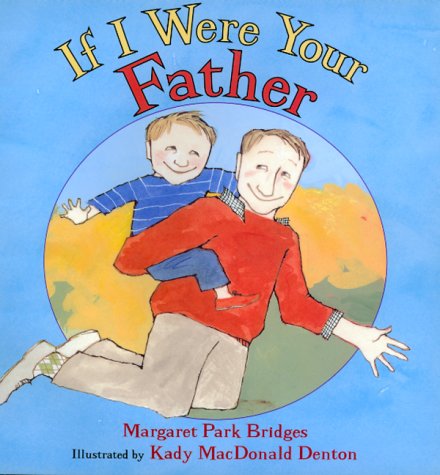 This book is a feel good conversation between father and son as the son shares his unrealistic imagination of what an ideal father should be and his father entertains the son’s musings as they move through the mundane activities of their day. The illustrations do not always coincide with the dialogue which may be a little confusing for children under five but red print for the son and blue print for the father’s words make it incredibly easy to know who is speaking through out. No matter what your family construct, you’re going to love the repartee between parent and child in this book but with no mother present, this is definitely a book with which children, especially sons of single fathers will be able to connect and of course is a good way to introduce the idea that some families are led by a single father to the children in your life.
Recommendation: Recommended; Ages 4+
Reviewer: Omilaju Miranda

Adventure Annie goes to Kindergarten’ by Toni Buzeo
 Annie Grace starts her day with her mom who helps her get ready and takes her to her first day of Kindergarten where Annie tries to create adventures for herself because, after all, Annie Grace is Adventure Annie. She gets into all sorts of trouble around the classroom and school as she single-mindedly tries to find an “adventure”. Eventually, the two quiet, obedient students who her teacher sends to get the milk for snack time get lost and Annie gets her adventure. Mr. Todd charges her with the task of going to find the “milk getters” who are lost. And sure enough, with the help of the walkie talkies that she packed in her adventure toolkit, she finds her classmates and the milk, and brings the wagon of milk back to the class. So, Annie the Adventurer gets to be a super heroine and in the end she is in her mom’s arms with a hug and a smile. Although the story was a little banal and repetitive, Adventure Annie is clearly being raised by a single mom and she’s having a rip-roaring time being herself.
Recommendation: Unenthusiastically Recommended; Ages: 4+
Book Reviewer: Omilaju Miranda
 Diverse Kids Books--Reviews