

Elan, Son of Two Peoples by Heidi Smith Hyde
 Elan, Son of Two Peoples by Heidi Smith Hyde and illustrated by Mikela Prevost is an artistically captivating and rustic story about thirteen-year-old Elan’s journey to becoming a man across the cultures of Judaism and the Acoma Pueblo. Set in 1898, Elan and his parents travel from their home in San Francisco to Albuquerque, New Mexico where his mother’s family lives. Elan’s father is a Jewish immigrant from Eastern Europe, and his mother is the granddaughter of a Pueblo Indian chief. The story takes place just days after Elan’s thirteenth birthday, a very important coming-of-age marker in both cultures. The reader does get a glimpse of his Bat Mitzvah and his Jewish culture, but a majority of the story focuses on Elan’s trip to New Mexico and the ceremony that honors him as a Pueblo tribesman. (more…)

Flowers from Mariko by Rick Noguchi and Deneen Jenks
 This book, written by husband and wife team Rick Noguchi & Deneen Jenks, is a real gem. It tells the story of a young Japanese American girl, Mariko, and her family as they return to California after being imprisoned in American concentration camps (also known as internment camps or relocation centers; simply referred to as ‘Camp’ by Japanese Americans of that time) during World War II. An authors’ note provides additional context at the end of the book.
I found this book to be excellent in several ways. To begin with, the artwork of Michelle Reiko Kumata is a revelation. It is apparent that the illustrations were based on actual black-and-white photos from the 1940s, but Kumata’s pictures bring the story to life in beautiful full color. Drawn with bold outlines, her pictures are full of patterns and textures from period fabrics, shadowing that adds depth to every scene, and subtle, authentic details such as the furoshiki-wrapped bundle that one woman carries on her way to Camp. Though the story’s subject matter is far from uplifting, it was still a joy to gaze at every page of this book. (more…)
Dust of Eden–a novel in verse by Mariko Nagai.
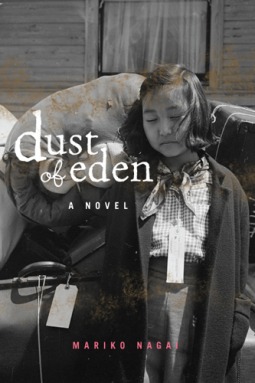 Mariko Nagai’s Dust of Eden is a lovely, spare story told by a young Japanese American protagonist who goes by both her American name, Mina, as well as her Japanese name, Masako. This book is a series of images and scenes that tell how a young girl in the United States in the 1940s navigates being both Mina and Masako, both American and Japanese, both feeling at home and feeling alien.
The novel is a set of poems from Mina’s point of view interspersed with letters to and from her best friend in Seattle as well as short personal essays Mina writes for school. These lyric pieces are arranged chronologically and geographically, with the first poem of the book titled “Seattle, Washington October 1941,” and the last poem called “Epilogue December 1945.” In the span between, Mina details her life in Seattle right before Pearl Harbor (a life filled with her parents, grandfather, brother, best friend, and school), and she writes us through her father’s unjust imprisonment in Montana after Pearl Harbor and her family’s internment first in Washington and then in Idaho, ending with her brother volunteering to fight for the Allies and her family finally being allowed to return to their Seattle home after the war is over.

A Kiss Means I Love You by Kathryn Madeline Allen
 It’s as important for babies and toddlers to feel like their emotions are understood and validated as it is for them to learn how to express how they feel, whether it’s through body language or words. A Kiss Means I Love You, a picture book with photographs of diverse children and families in various emotional and physical states, does just this.
Ranging from a smile to coughs and sneezes, the formula of “a ___ means I’m ___” will help babies and toddlers expand their vocabulary for expressing themselves, and hopefully develop sympathy and empathy through seeing the different children in various moods and states in the book. Like Dr. Seuss’s My Many Colored Days, the simple words on each page may help a child feel their emotions validated and shared by others.
This book would be great for daycares, especially diverse ones—my daughter took it to school and the toddlers matched one another’s names to the children on the pages, seeing themselves in them. A Kiss Means I Love You makes a good bedtime story as well, ending with the familiar line (in a new order), “I love you…goodnight.”
Reviewer: Yu-Han Chao
Recommended: 2-5 years
Abby Spencer Goes to Bollywood by Varsha Bajaj
 Varsha Bajaj’s novel, Abby Spencer Goes to Bollywood presents the story of a bi-racial Indian-America girl who’s never met her father. She’s spent her life living in Houston, Texas with her mother being a happy, well-loved American girl who only knows one thing about her father: he is from India.
The story opens with Abby having an allergic reaction to coconut. After having to admit she knows nothing about the medical history of the father of her child, Abby’s mother realizes she needs to attempt to contact him, something she has not tried since she found out she was pregnant. After a very small window of waiting, she is finally able to contact her ex-boyfriend and as it turns out, he never received the registered letter she sent all those years ago explaining Abby’s existence. Abby not only has to deal with the shock that her father never knew about her—up until this point she believed he simply didn’t want to be a part of her life—but she also finds out he is a huge Bollywood star. The rest of the novel revolves around Abby traveling to Mumbai to meet her father and the other half of her ethnicity.

Promise Me Something by Sara Kocek
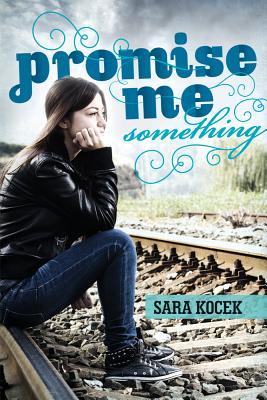 Due to unfortunate zoning laws, Reyna Fey becomes the new girl at school and misses her old life dearly. While at her old school she was not part of the most popular crowd, she did have a core group of friends who’d been BFFs most their lives. Reyna makes for a relatable teen character in that she has a lot of drama going on at home and school. Her mother was killed in a car accident 7 years ago and since then her father has been raising her by himself. But, his most recent girlfriend, Lucy, is becoming a permanent fixture in their household and Reyna is not coping well with that scenario. Reyna finds Lucy particularly intolerable because a few months prior to the beginning of the story, Lucy’s reckless driving caused a wreck that severely injured, and almost killed, Reyna’s dad.
Love, Lizzie: Letters to a Military Mom written by Lisa Tucker McElroy
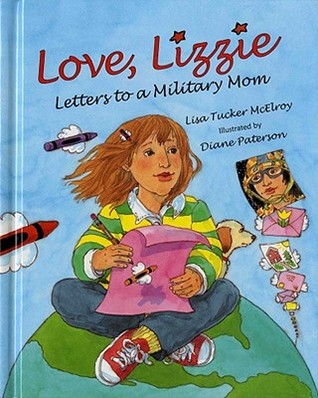 Love, Lizzie: Letters to a Military Mom written by Lisa Tucker McElroy and Illustrated by Diane Paterson, tells a story written entirely in epistolary form in which nine-year-old Lizzy writes letters to her mother, who is deployed and fighting in a war overseas. In Love, Lizzy, Lizzy asks hard-hitting questions about patriotism and “how long does defending freedom take?” The reader follows Lizzy’s letters from June to May of the following year as Lizzy deals with missing her mother for holidays, her birthday, and school activities like Lizzy’s soccer tournament. Each letter feels personal to Lizzy’s character, but also resonates with the universal difficulties that any child missing a military parent would endure: the normalcy of their previous parent-child relationship changed into more complex feelings of uncertainty and anxiety over their parent’s safety.
Lizzy’s letters feel more intimate due to Paterson’s illustrations featuring pictures of Lizzy engaged in the activities of her daily life about which she is writing. There are also photos and doodles from Lizzy to her mother included in the letters that make Lizzy’s character more dynamic. The most interesting of these doodles are the maps that Lizzy draws, which start out small, showing the private space of her bedroom, and eventually grow broader and more global—until they feature the town, the United States, and a map of the entire globe. These illustrations make Lizzy’s story feel all the more personal by adding complexity to her character.
Love, Lizzy can be an important resource for any parent who is missing a loved one due to their military service. Not only is the story relevant to many American children, but the book also contains practical advice for military families whose children are dealing with the separation of a deployed parent.
Recommendation: Highly Recommended Ages 6-11
Reviewer: Erin Koehler

Helen Keller’s Best Friend Belle by Holly M. Barry
 You’ve heard of Helen Keller, but do you know Belle? Helen Keller’s Best Friend Belle by Holly M. Barry is a furry tale (tail?) about Helen’s adventures with her childhood friend, an old setter named Belle. This children’s book is basically a diluted version of Arthur Penn’s 1962 biopic, The Miracle Worker. The readers are introduced to Helen at birth and quickly learn that an illness leaves her completely deaf and blind before she reaches her 2nd birthday. From that point on, her world is filled with soundless darkness that only her dogs can comfort her in for the next few years.

When Christmas Feels Like Home by Gretchen Griffith
 This is a story about finding peace. Many of the Children’s books which feature Latin or South American children leaving home often cling to the concept of acceptance. The characters yearn to be part of the new culture’s home, or they have a desire to accept their current state of life or accept that nothing will ever be the same.
Acceptance is a very complicated and almost jarring concept. In this book, Eduardo is moving, and he must come to terms with this movement. He feels confused when children are playing football with a brown, egg-shaped ball, while he understands futbol to be different. He has to constantly accept that this new world is different, confusing, unreal.
Soon the unreal becomes real: the hillsides turn color “…the color of the sun” (12), the trees began to lose their leaves and stand like skeletons (13), and the winter comes with all of the anticipation of Christmas. The book reels forward, moved by the rich, dark illustrations and the comforting, and repetitive call of Eduardo, whose acceptance of this world is suspended in disbelief, and he repeats “No se puede” (that can’t happen).
Despite the title’s suggestion, the story is not driven by the concept of Christmas, but by the treasure within a secret box which can only be opened at Christmas. As time moves on, Eduardo’s hard reality begins to smooth. He learns and grows. Eventually he accepts the changes around him. Acceptance is no longer an indicator of difference, abruptness, or shock; acceptance begins to smooth into peace. And on the last page, the reader is given a very strong, and comforting message of peace.
Reviewer: Rachelle Escamilla
Recommendation: Recommended
Age group 2 – 9
Just Like Home / Como En Mi Tierra by Elizabeth I. Miller
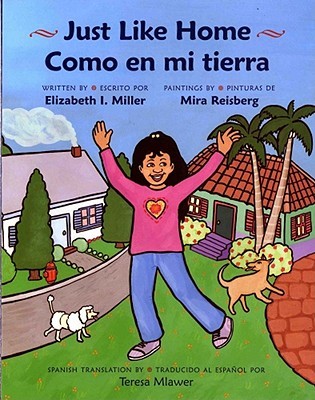 One thing that is important to do when considering books for your children, is to consider the wholeness of a book. Not only should we encourage books which highlight diverse stories, we should also encourage innovation and cultural understanding. “Just Like Home / Como En Mi Tierra” satisfies the first, but is lacking in the latter.
The story follows a girl who emigrates to the United States from Mexico (assumed). The girl is anywhere from 4 – 9 years old, but her age and the age of the intended audience is not specific. The unnamed girl observes the world around her and makes comparisons: this is like home, this is not like home. The English is translated into Spanish and there is a glossary in the back.
However, there are a lot of mistakes. Namely, the title of the book in English is correctly capitalized, but the Spanish is incorrectly capitalized, which sets a very awkward tone for the book: as if the Spanish portion of this story is just tossed in for good measure. There is an air of laziness in the construction of the story and the illustrations. The book feels and looks like those 50 cent books your mom bought you from the pharmacy rack in 1985 and although some of my favorite children’s books came from that same rack, this book has unremarkable characters, sloppy illustrations, and was even offensive in one moment.
On page 20 the unspecified female character is not included in the school yard games. On the next page she says “Not like home,” comparing the exclusion to her life back “home” (again, unspecified OTHER place), but the illustration is what bothers me: Children playing with a pinata. On pg. 20 they are in a school yard, on pg 21 she is playing at a party with a pinata. If this unspecified girl was at a party in America with her family, she WOULD play with a pinata, but the pinata in this specific comparison seems to be working as some kind of cultural indicator which is pinpointed through an overused and lazy stereotype. The pinata, although a staple in Mexican-American and Mexican parties alike, is not some kind of cultural marker as exclusively “Mexican.” It isn’t necessary to toss tacos, sombreros, or pinatas into a book just to pinpoint the “other” culture. If it is contextually relevant, sure, but in this case it is not. “Not like home” should have been a caption for an image which depicted the girl playing in her school yard back home.
In the end, I like to encourage books which use English and Spanish; books which present children of color and their struggles; books which encourage new representations of cultures with a deep awareness of that culture; I want you to buy books that are not just doing these things on a shallow, let’s-just-get-a-brown-kid-on-a-page, kind of book, but books whose goals are deeper and more rooted than that.
Recommendation: Not Recommended; Ages: 3-7
Reviewer: Rachelle Escamilla
 Diverse Kids Books--Reviews