
Home » Girl Protagonist (Page 5)
Category Archives: Girl Protagonist

Something Special For Me by Vera B. Williams
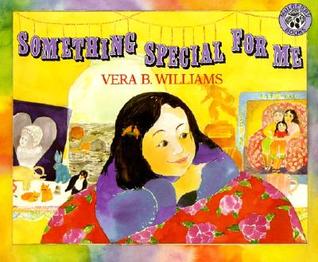 Vera. B Williams’, Something Special for Me, follows Rosa, once again as she narrates a series of situations in her life. Even as a child, I grinned when stories contained nods to a protagonist’s earlier titles and several details including the reappearance of the chair and coin jar from A Chair for My Mother lent that special touch here. The accordion also brings the idea of family tradition to in this book.
After the coin jar from A Chair for My Mother, is filled once again, Rosa’s mother and Grandmother decide to use it for Rosa’s birthday present. Rosa comes close to buying herself roller skates, clothes, and even a red tent, but backs out of each buy (to be honest, I was hoping for the skates).
After she hears a man playing an accordion and finds out that her Grandmother also played the same instrument, Rosa chooses to buy an accordion. I really enjoyed this ending because Rosa found a way to make herself happy, and bring a small joy to her mother and Grandmother. It was enjoyable to see Rosa doing something for herself this time. This is different from the approach to family loyalty in A Chair for My Mother and Music, Music, for Everyone in which Rosa is solely focused on her mother and grandmother.
I found Williams’ artwork, although somewhat simple, engaging. I was so intrigued that with each page, I tried to see every item in the artwork. Young girls may enjoy Something Special for Me moreso than other readers but Williams writes a story in which gender is not significant to the plot.
Recommendation: Recommended. Ages 5+
Reviewer: Warren Stokes

Josephine by Patricia Hruby Powell and Christian Robinson
 A free verse prose poem tells the life story of the first black American international musical superstar Josephine Baker, born out of wedlock and raised in part by a single mother. Collage drawings give the book a rich tactile feel that almost transcends the flat page. The language, which tells the story of Baker’s creativity and success amidst the U.S.’s violent racism is continuously evocative. While the images are fun to look at for all ages, only children ready to learn about racism, race riots, and shadism should read the book, as those harsh realities made a huge impact on Josephine Baker’s life and career, and are represented in heartrending language and images in the book. This is a beautifully told story that will tempt both the child who loves, and the child who hates reading and poetry, to become a poet. Verse after verse, the reader will learn of Josephine’s courage, and her fierce determination to be center stage as the dancing star she believed she could become. Those afraid to move on to middle school, go off to boarding school, or attend a training camp for their sport or art will see in Josephine, a girl so committed to the fulfillment of dancing that she left home at thirteen-years-old to tour the country, and left her husband for Broadway when she was only fifteen-years-old. Those who never consider the power of humor will learn how Baker attracted the spotlight with her comedic facial expressions as she danced. Her dynamism will inspire the reader learning of her many landmark performances, as well as her choice to become a pilot and fight as a spy against the Nazis during WWII. With dramatic punctuations in the poetic language, the author tells of Baker’s economic fall, and how bankruptcy proved to be a painful lesson in excess for the generous humanitarian. But Powell makes sure the reader knows that Baker was a socially conscious performer. At one point the richest Negro woman in the world, Baker was a civil rights fighter who convinced the army and many venues to allow integrated audiences to attend her performances, and even convinced owners of segregated corporations to hire blacks. The language and illustrations will make you feel Josephine’s life— her ups and downs, her ultimate triumph in achieving every dream she had, including dying “breathless, spent, after a dance.” (buy)
Recommendation: Highly Recommended; Ages 10+

You Be Me and I’ll Be You by Pili Mandelbaum
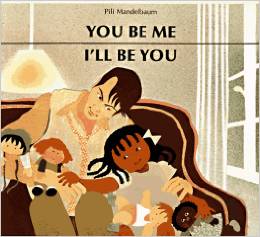 A well intentioned father tries to help his brown-skinned biracial daughter feel comfortable with her skin color by plaiting his straight hair, donning black face and having her don white face. I was almost too insulted to continue reading but out of duty, I finished the book. The narrative attempts to redeem itself by showing people laying out on the beach tanning, using rollers to make their hair curly, and pointing out that every one wants features they can’t have. I don’t know if this did well in Belgium where it was originally published but as a U.S.American, I would never read this to my child.
Recommendation: Not Recommended.
Reviewer: Omilaju Miranda

One Love by Cedella Marley, Bob Marley and Vanessa Brantley-Newton
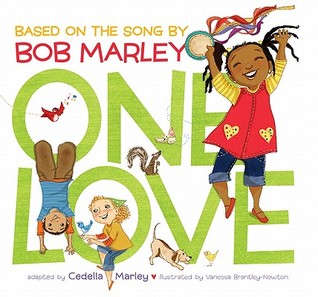 Look closely at the illustrations as you read this book and each time you will discover something new. The words are the lyrics of Bob Marley’s song “One Love”, the illustrations tell the story of community togetherness. A little girl waves goodbye to her loving mom and dad and walks into the friendly world outside her door, which is filled with nature, happy neighbors and close friends who play, plant, and recycle together. The illustrations are vivid, exciting and contagiously spread a smile across your face. Although the only obvious racial phenotypes are Caucasian, African Diaspora and black/white mixed, the full range of phenotypes within those ethnicities is represented. Children of all ages will enjoy this book and those who remember the song will love sharing the song with a new generation as they follow the illustrations telling the story of community responsibility and cooperation to repair, rebuild, and landscape a neighborhood park in disrepair. Simple, loving, lyrical of course, and with such strong illustration dependent story telling that this is a great book for the pre-literate child to practice decoding and multiple levels of “reading” comprehension, which is what I did with my pre-reading daughter. This is a book everyone should have and all who have children should read and discuss with their kids. (buy)
Recommendation: Highly recommended Ages 2+
The Wakame Gatherers by Holly Thompson
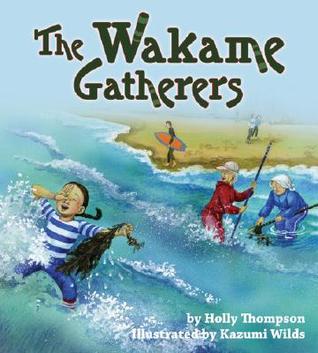 Holly Thompson tackles the difficult subject of war with grace and beautiful writing in The Wakame Gatherers. The book begins with a little girl saying, “My name is Nanami—Seven Seas—and I have two grandmothers from two different seas: Gram from Maine, and Baachan, who lives with us here in Japan.”
Gram visits Japan, and several pages are dedicated to descriptions and illustrations of the beaches of Maine and Japan, with particular focus on the local color of Nanami’s Japanese hometown. As a translator between her two grandmothers, Nanami helps them compare and contrast their two lands, learns about hooking and preparing seaweed as she takes care to “[use] the right language with the right grandmother.”
Then comes conflict: not in the present, but seeping through from history. The illustrations become dark and ominous as Baachan reminisces about the war. Nanami continues to translate, and understands, “when my grandmothers were my age they were enemies, their countries bombing each other’s people.” The two old women, through their shared granddaughter’s translation, apologize for their countries’ past actions, and in the space of two pages, a feeling of peace and happiness is restored as they return to wakame gathering.
With exquisite illustrations and vivid descriptions, The Wakame Gatherers brings together two cultures by not just acknowledging similarities and differences, but addressing the past. Of additional educational value at the end of the book are a fact sheet about wakame, a glossary of Japanese phrases, and three wakame recipes.
Recommended: Highly recommended. Ages 4-8.
Music, Music for Everyone by Vera B. Williams
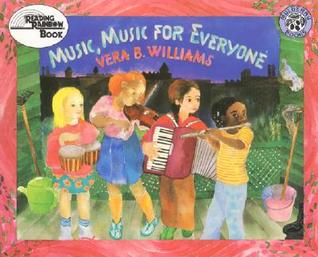 In what may be considered the third of Vera B. Williams’ “Rosa” series, Music, Music for Everyone, Rosa’s new found accordion hobby and relationship with her Grandmother continue. When Rosa’s Grandmother grows ill, Rosa and her friends try to make her feel better. They finally decide the best way to help her recover is to fill the coin jar again, by raising money as a musical band. After practicing and finding a party to play at, their performance not only brings Rosa’s Grandmother a sense of joy, but it also brings their families and the neighborhood even closer.
The illustrations in this book are as fun as those in Williams’ A Chair for My Mother and Something Special for Me. While the characters do not seem as physically active in the artwork as they were in the previous books, the art is still appealing. In this book, Williams used color as a strong medium to convey the emotional tone of the story, with scenes that seem gloomier than others painted darker colors. The illustration I liked the most was the two pages of family and friends dancing at the anniversary party. I even found myself spending a couple of minutes trying to see how each character was dancing. The artwork also included a wide range of ethnicities, which I thought I added to this story’s theme.
Family bonds is the primary theme of this story with music being used to bring each family closer, especially Rosa and her Grandmother. The story’s subtext conveys the importance of being able to use your own talents to help others and maybe bring people closer. Just as the other two Rosa stories are more female oriented when it comes to the characters, Music, Music, for Everyone, is focused more on female familial relationships than other relationships. However, the characters’ gender only adds to the overall strength of the story that all people would enjoy.
Recommendation: Recommended; ages 5+
Reviewer: Warren Stokes
 Diverse Kids Books--Reviews