
Home » Posts tagged 'Hapa'
Tag Archives: Hapa

Mommy, Why’s Your Skin So Brown by Maria Leonard Olsen
 The brown skinned, multiracial mixed heritage mother of two children who are lighter than her discusses with her children why she is darker than both of them and much darker than the son who has fair skin, silky blond hair, and blue eyes. The book reads as if the author simply transcribed a conversation that she had with her children. Her anger or annoyance with people who were asking the author if she was the nanny (according to interviews she has given) comes through evocatively in the tone of the narrative as well as on the book’s back cover blurb, which both address the necessity to admonish people to not allow their “curiosity to overwhelm their manners”.
That is a salient point that many parents of interracial families would like to communicate to those who rudely ask questions like “Are you the nanny?” “Is she adopted?” “Is that child yours?”, which confuse and sometimes sadden our children. However, in a children’s book, the tone of the mother’s frustration doesn’t communicate as a part of the children’s characterization and reads as the words of an angry author. It just doesn’t feel like it is from the children, and there’s nothing in the narrative to balance it off.
Points of the narrative that could have been the basis for beautiful illustrations of the entire family are missed. This conversation between the mother and her children is boring as a book read to a child and there are points that actually get confusing where the mother narrator is discussing where everybody got their different features (i.e. the mother speaks of getting her own dark skin from her grandmother, herself being a color in between both her parents, and her son getting blue eyes from his father and the mother’s grandfather) yet there are no images of the relatives to accompany this monologue.
This lack of illustration accompanied by no mention of the mother’s actual ethnicity (research into the author reveals she is biracial Filipina and this story is from her personal life) seems like a strong commitment to being vague. I’m sure the author doesn’t mention the ethnic heritages of her family so that the book could be used universally by the many parents of color of all ethnicities and races who face this scenario but because this book’s only story line is this family, the absence of a discussion of the family’s ethnicity and actual heritage leaves a palpable void. With no characterization for any of the characters in the book and a narration primarily from the mother’s perspective, sadly there is no story here. This is such a loss in part because this is the only picture book I’ve read that focuses primarily on the biracial child with almost exclusively Caucasian features. The other books which even present these children, present them as part of a duo led by brown biracial children or as part of an ensemble cast.
While I do not see this as an enjoyable read for children of any age as a standalone book, this book could easily serve as an interesting guide for adults on how to discuss this matter with their children and the points that can be covered regarding family features. If used in that matter, I would definitely suggest incorporating photos of the referenced family members into the conversation. (buy)
Recommendation: If your family is similar to the one in this book then, couple this book with your own family photos and exploration of your family tree or, for people with all types of family constructs and teachers, couple this book with either That’s My Mum by Henriette Barkow or My Mom is a Foreigner but Not to Me by Julianne Moore and this book can lead off the discussion of the serious aspects of a family dealing with people’s reactions to a mother (or father) looking racially different from her children.
Recommendations: For Adults to lead discussions on interracial families and phenotype differences.
Reviewer: Omilaju Miranda

Maxwell’s Mountain by Shari Becker
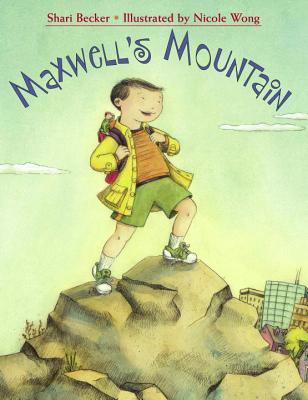 Maxwell’s Mountain features a little boy with an Asian-featured father and Caucasian-looking, redheaded mother. Maxwell sees a mountain near a new park, and goes on a mountain-climbing adventure. The illustrations are beautiful watercolor-and-ink, though the story, while it teaches some good lessons, could have been so much more.
The story could have addressed the diversity so lovingly depicted by the illustrations. If you have a mixed family, you and your child might enjoy seeing the representation of diversity here. It’s interesting that the author says nothing about Maxwell’s family and background, however—not only is this a missed opportunity, it feels like a multi-racial elephant in the room.
The actual morals tackled here also seem ambiguous. One lesson a child might learn from this story is to be prepared before undertaking a large task. Maxwell is determined to the point of obsession (“At dinner Maxwell saw mountains everywhere”) and does his research by (unrealistically) checking out all the books on mountain-climbing from the library and looking through them all in one night. He trains for his hike by repeatedly climbing up and down the stairs at home (depending on the age of your child, maybe not the safest activity to encourage). And the overt moral of the book is, “When he’s in trouble, a true outdoorsman uses his head.” The gendered “outdoorsman” and “he/his” throughout the book can be limiting gender-wise, and in the end, Maxwell doesn’t really use his head that much besides backtracking a little when he gets lost.
In conclusion, Maxwell’s Mountain features lovely and intriguing illustrations, though the story does not live up to its full potential. We might wish the world were post-racial and post-feminist, that race and gender are no longer issues we should give voice to for children when an obvious opportunity presents itself, but we’re not quite there yet.
Recommendation: 4-8 years. (buy)
Review by Yu-Han (Eugenia) Chao

Dumpling Soup by Jama Kim Rattigan
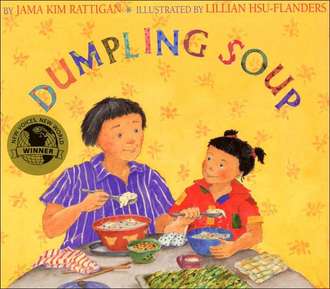 This first person narrative peppered with words from four different languages and a prominent grandmother character who speaks Korean almost every time she talks, was the 1990 winner of the New Voices, New World contest. Marisol, the protagonist narrates with such open vulnerability that the reader becomes easily attached to the story of her Hawaiian family’s New Year’s eve and her first time making dumplings for the Dumpling Soup, which is the most important first meal of the New Year. I can not say any better than the publisher that “Dumpling Soup is a rich mix of food, language, and customs from many cultures—Korean, Japanese, Chinese, Hawaiian, and haole (Hawaiian for “white”) The distinct traditions and heritage of each culture are not forgotten but play a vital part in this close-knit family’s life.” As cousins, aunts and even the grandmother of various heritages bring their different, ethnically distinct foods, speak their different languages, and use their different recipes and techniques for making dumpling soup to the protagonist’s and then, the grandmother’s home, readers from around the world see the reality of recognizing and loving people with, and for their differences instead of for the ways they are the same.
One of the small details that parents can discuss with their kids is the character Maxie. This is a cousin who the protagonist describes as haole but whose phenotype is Asian. The illustration of this cousin presents a great opportunity to discuss how people think of race and ethnicity differently i.e. how for this Hawaiian family, “white” is Asian, also. Because Marisol tells this story with the joy of participating in a family celebration and the anxiety over participating on a big girl level in that celebration, even as she carries us through the different scenes of the family fun, we never forget that Marisol’s sense of accomplishment and feeling of being valuable within the family depends on the decision her grandmother will make about whether or not to serve the dumplings that Marisol made. Accompanied by emotionally transparent illustrations, this is a beautifully told story that you and your child will enjoy.
Recommendation: Highly Recommended; Ages 4-adult
Reviewer: Omilaju Miranda
 Diverse Kids Books--Reviews