
Home » Posts tagged 'invisible parent'
Tag Archives: invisible parent

Mommy, Why’s Your Skin So Brown by Maria Leonard Olsen
 The brown skinned, multiracial mixed heritage mother of two children who are lighter than her discusses with her children why she is darker than both of them and much darker than the son who has fair skin, silky blond hair, and blue eyes. The book reads as if the author simply transcribed a conversation that she had with her children. Her anger or annoyance with people who were asking the author if she was the nanny (according to interviews she has given) comes through evocatively in the tone of the narrative as well as on the book’s back cover blurb, which both address the necessity to admonish people to not allow their “curiosity to overwhelm their manners”.
That is a salient point that many parents of interracial families would like to communicate to those who rudely ask questions like “Are you the nanny?” “Is she adopted?” “Is that child yours?”, which confuse and sometimes sadden our children. However, in a children’s book, the tone of the mother’s frustration doesn’t communicate as a part of the children’s characterization and reads as the words of an angry author. It just doesn’t feel like it is from the children, and there’s nothing in the narrative to balance it off.
Points of the narrative that could have been the basis for beautiful illustrations of the entire family are missed. This conversation between the mother and her children is boring as a book read to a child and there are points that actually get confusing where the mother narrator is discussing where everybody got their different features (i.e. the mother speaks of getting her own dark skin from her grandmother, herself being a color in between both her parents, and her son getting blue eyes from his father and the mother’s grandfather) yet there are no images of the relatives to accompany this monologue.
This lack of illustration accompanied by no mention of the mother’s actual ethnicity (research into the author reveals she is biracial Filipina and this story is from her personal life) seems like a strong commitment to being vague. I’m sure the author doesn’t mention the ethnic heritages of her family so that the book could be used universally by the many parents of color of all ethnicities and races who face this scenario but because this book’s only story line is this family, the absence of a discussion of the family’s ethnicity and actual heritage leaves a palpable void. With no characterization for any of the characters in the book and a narration primarily from the mother’s perspective, sadly there is no story here. This is such a loss in part because this is the only picture book I’ve read that focuses primarily on the biracial child with almost exclusively Caucasian features. The other books which even present these children, present them as part of a duo led by brown biracial children or as part of an ensemble cast.
While I do not see this as an enjoyable read for children of any age as a standalone book, this book could easily serve as an interesting guide for adults on how to discuss this matter with their children and the points that can be covered regarding family features. If used in that matter, I would definitely suggest incorporating photos of the referenced family members into the conversation. (buy)
Recommendation: If your family is similar to the one in this book then, couple this book with your own family photos and exploration of your family tree or, for people with all types of family constructs and teachers, couple this book with either That’s My Mum by Henriette Barkow or My Mom is a Foreigner but Not to Me by Julianne Moore and this book can lead off the discussion of the serious aspects of a family dealing with people’s reactions to a mother (or father) looking racially different from her children.
Recommendations: For Adults to lead discussions on interracial families and phenotype differences.
Reviewer: Omilaju Miranda

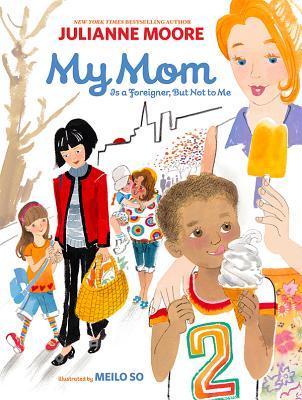
My Mom is a Foreigner but Not to Me by Julianne Moore
 I love this book so very much
I can read it ten good times
She represents a child’s experience
With such cool, catchy rhymes
This book by Julianne Moore, primarily written in ABCB rhyming quatrain stanzas, is a first person narrative from the perspective of a dozen different children, which talks about the varied experiences of a child living in the U.S. with a mother from another country. The illustrator, Meilo So has chosen a “framed” illustration style which, other than the fact that it leaves a lot of white space on the page is successful at providing images for many different aspects of the “story” simultaneously.
Not only do I like the fact that Moore’s rhyme is perfect ninety per cent of the time, the text shows the dynamic conflicts faced by children who love their mothers but experience, with a little shame, all of the ways in which their mother is different from other mothers and people they encounter daily, including their different food and culturally different greeting and doting customs. The children also communicate their discomfort with their mothers’ use of a different language in communicating with them and their mothers’ slow mastery of English as their second language.
Most of the children from whose voice the book is written appear to be between the ages of 7-11. While there are several pages in the book illustrating the mothers caring for a second child in the infant/toddler age range, there is only one page in the book that shows a mother and father together (in a photo on a dresser) so children living in single-mother led households can easily find a reflection of their family construct in this book.
Most of the mother-child relationships in the book are clearly representative of an interracial family (even though we don’t see fathers) with children who look racially different from their mothers. Moore and Meilo So cover the full gamut of children who look racially different from their mothers whether the mothers are East Asian, Subsaharan African, or Dutch with children whose features present as the entire world spectrum of all racial/ethnic features. Meilo So does not just throw kids on the page who are holding hands with mothers—no, her vivid, emotionally realistic, water color illustrations are done with such attention to detail that on one page there is a brown-skinned, gele scarf wearing mother with her pale-skinned, red-haired daughter who the reader can see look exactly alike–like twins except their skin color, height, and weight are different. The “twin” mother and daughter are walking up the stairs as a boy behind them keeps staring at them and a mother holding a child that is like her in every obvious way walks towards them staring at them with a surprised, questioning look on her face. The text that goes along with this illustration speaks of the emotional weight a child faces when her features are just like her mom’s but because of different racial markers people don’t always see their likeness:
“Some people say we look alike
Others wonder: What’s HER name?
I get so upset when they say,
“Why don’t you look the same?””
Finally, this book ends with a celebration of all the universal ways in which a mother and child bond,
“She gives me lots of kisses,
she tucks me in at night,
she laughs at ALL my jokes,
SHE HOLDS ME VERY TIGHT”
With this well-written, fancifully illustrated picture book, Julianne Moore and Meilo So have hit a home run for all readers and definitely for intercultural and multi-lingual and interracial families that also keeps children belonging to single parent households from feeling like outsiders.
Recommendation: Highly Recommended; Ages–3-10
Reviewer: Omilaju Miranda
 Diverse Kids Books--Reviews