
Home » Posts tagged 'Jewish' (Page 2)
Tag Archives: Jewish

Mira in the Present Tense (originally published in the U.K as Artichoke Hearts) by Sita Bhramachari
 Mira in the Present Tense is definitely a three-hankie book. This storyline tows the reader on an emotional roller coaster, gently rocking us back and forth through sadness to acceptance, up to excitement and down to understanding, and over and under through past and present. I found myself tired, but at ease, with the characters slowly strolling through my mind.
We meet Mira, the Indian-Jewish protagonist, days before her 12th birthday and just before she joins a writing class and begins her May Day journal. Mira in the Present Tense is organized by dates instead of chapters, just as a journal would be. For the next month, we jump into Mira’s life as she reaches the highs and lows of the normal coming of age milestones- starting her period, her first crush and first heterosexual kiss, finding her own voice, and standing up to her bullies. At the same time, we join Mira as she and her family live with the impending death of her dad’s mum, Nana Josie. With Nana Josie gracefully leading the way, Mira learns that some heartbreaks are necessary if you truly love the person.
The strength of this book is in its characters, with Nana Josie stealing the spotlight. In her own words, “It is bloody hard work dying well,” but Nana Josie indeed does die well 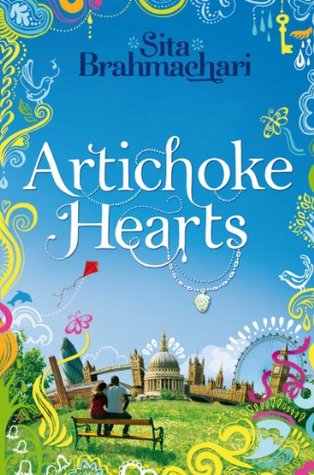 with grace and kindness for all who will miss her. The author, Sita Brahmachari, places layer upon layer until each individual is shaped in our minds. Mira at school is almost painfully shy and introspective, relying only on her best girlfriend and later on a boy in her writing class. But with Nana Josie, Mira is uninhibited. Nana Josie lends Mira her creative strength and her unbound love. Pat Print is another character of note. She appears to Mira in the most honest ways at the most unexpected time, almost as if she is Mira’s guardian angel.
Mira is of Jewish and Indian descent, but beyond her name there is not much mention or focus on this fact in the story. I found this quite normalizing as our children of mixed heritage will no doubt identify with Mira for her racial make-up but everyone can identify with Mira for the struggle she is facing in the death of her grandmother. There are two other characters I would like to point out to potential readers. Mira’s crush, Jide, was a Rwandan refugee adopted by refugee camp workers. There are some small details about the atrocities in Rwanda and if children are unaware it might bring up questions. Jide talks about the physical differences between himself and his adopted parents. He also mentions how frustrating and mad it can make him when strangers make intrusive and uneducated comments. Mira’s Aunt Abi has a female partner, who we are introduced to early on. She does not play a main role and honestly, her brief introduction is quite off putting. When Mira writes, “Nana points to Abi, Aunty Mel—who is actually Abi’s girlfriend, but we call her aunty anyway,” I got the feeling that Abi having a female partner was accepted but not advertised or completely ok.
I recommended this book for ages 10-13.
Reviewer: Amanda Setty

Jalapeno Bagels by Natasha Wing
 With beautiful illustrations from Robert Casilla, this story which reads like a training and orientation day in a bakery, comes to life. This is a first person narrative from Pablo, the son of a Mexican mother and Jewish father who own a bakery together. Pablo has to decide what to take to school for International Day and throughout the story as he helps his mother make Mexican pastries and his father make Jewish pastries, he questions if each pastry is the one he should take to his school. A story peppered with Pablo’s easy translations of his parents’ Spanish and Yiddish words of expression and names of food, makes one feel like they are in a regular day in the life of Pablo and his parents. On this day, Pablo decides to take Jalapeno Bagels to school because, like him, they represent the cultures of both of his parents. The back of the book contains two recipes and a glossary of the terms used throughout the book. While I think this is a valuable representation of a Mixed Heritage family of Mexican/Jewish ethnicities which gives some history of the two ethnicities, the most exciting aspect of the book is its title.
Recommendation: Unenthusiastically recommended for the sake of diversity representation; Ages 4+
Book Review by Omilaju Miranda.

My Basmati Bat Mitzvah by Paula J. Freedman
 I sucked this book down like a mango lassi. It was smooth, sweet and went down quickly. So quickly, in fact I read it in 24 hours. And then like my girls, I sat back, took a breath and dove back in for a second reading, running my finger along the side of the cup looking for some goodness that I left behind.
Paula J. Freedman created a strong female character, for which I thank her. Tara Feinstein is the girl we all want our daughters to be. She has her own fashion style—
vintage. She plays hoops with her best boyfriend. She still plays dress up at the age of 12 with her best girlfriend. She is pumped to join the robotics team. She is not afraid to stand up for herself, although she is learning to manage it with words and not fists. She also stands up for others, especially when they need a friend. She gives second chances, preferring to see the good in people. She questions her beliefs and seeks for answers.
But life is not all easy peazy lemon squeezy for Tara. She and her friends are going through a season of preteen changes—bat mitzvahs, changing bodies, shifting relationships and first crushes. As Tara prepares for her own bat mitzvah she struggles to understand how she can be Indian, like her mother, Jewish, like her father and remain herself. How can she be Jewish if she is not even sure she believes in God? If she goes through with this Bat Mitzvah, does that mean she is picking her “Jewish side” over her “Indian side”? Will she only date and marry Jewish boys, like her other Jewish friends? My Basmati Bat Mitzvah raises topics many of our bi-racial, bi-cultural children will face or are facing. Tara’s voice is honest and sturdy, allowing readers from all backgrounds to easily put themselves in her place.
On my second read of the book, I unfortunately did not find many leftover bits of goodness stuck to the side of my cup. I found myself bothered by the underdeveloped characters, orbiting around Tara. I wanted more connection with her parents. Tara’s Jewish Gran and her Indian Auntie seem a bit too stereotypical for my liking. And many of Freedman’s characters seemed like superficial offerings- the immigrant child gone wild, the Korean adopted child, the always in trouble child with ADHD, the Muslim child whose father jokes about getting her married at the age of 12, and the perfect child who turns out to have trichotillomania and problems with shoplifting. Perhaps this book would be a good fit for a book group or classroom, so readers could find ways to make these distinctive characters more vibrant and “finish” them. I was also bothered that the robotics club storyline just disappeared. It held such promise of a preteen girl not only psyched about science but also talented, and then offered us nothing except for scenes of teenage romance and angst. The one bright point in my re-read was to explore Tara’s special relationship with her open-minded and very patient rabbi. Every teenager needs to connect with a trustworthy adult outside of their family.
Recommendation: I recommend this book for ages 12-14. The writing itself is suited for ages 9+ but some of the topics, such as, first heterosexual kiss and a friend suffering from trichotillomania might be better received by an older reader.
Book Reviewer: Amanda Setty
 Diverse Kids Books--Reviews