
Home » Posts tagged 'Mixed' (Page 3)
Tag Archives: Mixed

Molly Bannaky by Alice McGill
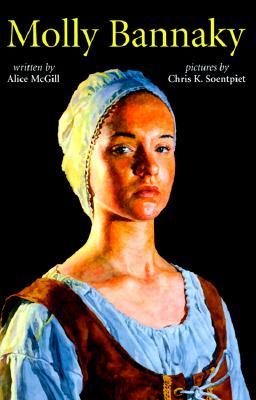 With an awe-inspiring light touch that manages to impart the oppressive colonial history of indentured servants and African slaves without sugar coating or overwhelming the young reader with the harsh realities of this period of history, Alice McGill writes the love and family story of former indentured servant, Molly Walsh and her formerly enslaved husband Bannaky—the grandparents of Benjamin Banneker. Chris Soentpiet’s water color paintings provide an evocative illustration for a story whose complexity holds the reader’s emotional commitment from the first to last page. You feel the griot that is author Alice McGill as you read Molly Bannaky. Every classroom should have a copy of this mini-biography of one of history’s women of strength and every household with or without children should have a copy of this book on its shelves. Not a bedtime story but a story to be read and discussed.
Recommendation: Highly Recommended; Ages 6-10
Reviewer: Omilaju Miranda

Mira in the Present Tense (originally published in the U.K as Artichoke Hearts) by Sita Bhramachari
 Mira in the Present Tense is definitely a three-hankie book. This storyline tows the reader on an emotional roller coaster, gently rocking us back and forth through sadness to acceptance, up to excitement and down to understanding, and over and under through past and present. I found myself tired, but at ease, with the characters slowly strolling through my mind.
We meet Mira, the Indian-Jewish protagonist, days before her 12th birthday and just before she joins a writing class and begins her May Day journal. Mira in the Present Tense is organized by dates instead of chapters, just as a journal would be. For the next month, we jump into Mira’s life as she reaches the highs and lows of the normal coming of age milestones- starting her period, her first crush and first heterosexual kiss, finding her own voice, and standing up to her bullies. At the same time, we join Mira as she and her family live with the impending death of her dad’s mum, Nana Josie. With Nana Josie gracefully leading the way, Mira learns that some heartbreaks are necessary if you truly love the person.
The strength of this book is in its characters, with Nana Josie stealing the spotlight. In her own words, “It is bloody hard work dying well,” but Nana Josie indeed does die well 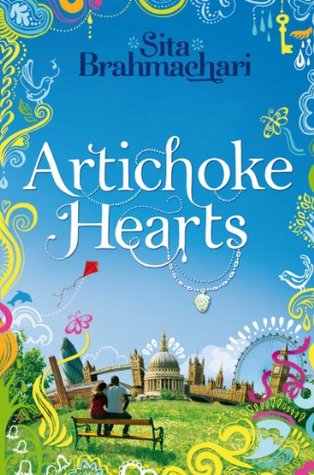 with grace and kindness for all who will miss her. The author, Sita Brahmachari, places layer upon layer until each individual is shaped in our minds. Mira at school is almost painfully shy and introspective, relying only on her best girlfriend and later on a boy in her writing class. But with Nana Josie, Mira is uninhibited. Nana Josie lends Mira her creative strength and her unbound love. Pat Print is another character of note. She appears to Mira in the most honest ways at the most unexpected time, almost as if she is Mira’s guardian angel.
Mira is of Jewish and Indian descent, but beyond her name there is not much mention or focus on this fact in the story. I found this quite normalizing as our children of mixed heritage will no doubt identify with Mira for her racial make-up but everyone can identify with Mira for the struggle she is facing in the death of her grandmother. There are two other characters I would like to point out to potential readers. Mira’s crush, Jide, was a Rwandan refugee adopted by refugee camp workers. There are some small details about the atrocities in Rwanda and if children are unaware it might bring up questions. Jide talks about the physical differences between himself and his adopted parents. He also mentions how frustrating and mad it can make him when strangers make intrusive and uneducated comments. Mira’s Aunt Abi has a female partner, who we are introduced to early on. She does not play a main role and honestly, her brief introduction is quite off putting. When Mira writes, “Nana points to Abi, Aunty Mel—who is actually Abi’s girlfriend, but we call her aunty anyway,” I got the feeling that Abi having a female partner was accepted but not advertised or completely ok.
I recommended this book for ages 10-13.
Reviewer: Amanda Setty

Nina Bonita by Ana Maria Machado
 This book was originally written in Spanish and I read the English translation. Set in Brazil, with a spotlight on that country’s African Diaspora population, the magical friendship between a child and a rabbit whose speech every human can understand, grounds the narrative in levity and fantasy from the first page. Creating a balanced contrast with the text that likens the child to princesses of Africa and fairies from the moon, the straightforward discussion of family likeness and illustration of a full range of Brazilian phenotypes and ethnicities gave me goosebumps as I read this story. Nina Bonita is a girl whose dynamic dark beauty includes “hair curly and pitch black as if made of unwoven threads of night; skin dark and glossy just like a panther in the rain,” who has captured the heart and adoration of a white bunny who wants so much to have a daughter like her. He thinks he must be black himself to have such a daughter and asks Nina “what makes your skin so dark and pretty?” Nina has no idea how she got to be black especially since her mother is brown and her father is white but she makes up stories of how she may have gotten her color. Although the narrative is funny, Nina’s stories are a testimony to the sad fact that white or light is considered normal in her life so she comes up with extreme reasons for “becoming” dark instead of seeing herself as a reflection of her family. The bunny rabbit’s misfortunes in trying to become black like her by following her stories –mainly ending up sick and with diarrhea from drinking coffee and eating blackberries—also demonstrate the pitfalls of not discussing a child’s heritage with him/her. Ultimately, Nina Bonita’s mother overhears the conversation between the girl and the rabbit and tells them that Nina looks just like her grandmother. “Of course!” declares the rabbit who immediately ventures out to find a beautiful “night black” rabbit wife with whom he can make a daughter.
I don’t know if this is because of the translation or if the original had this wording but I’m disappointed in the language that makes it “natural” that Nina Bonita would become the godmother of the jet black bunny that is born to the bunny couple and the assertion that the bunnies have lots of babies “because when rabbits start having babies they never seem to stop” – I’m aware that I’m made uncomfortable by my own experience with racist stereotypes in the U.S. –an issue a few of you may or may not have as well. Other than those little blips, this story contains lyrical language and spirited drawings that bring to life the beautiful diversity of a Brazilian family, elevating the beauty of the least celebrated phenotype in most societies without any negative controversy over her belonging or her natural beauty. It will take you three weeks to receive the book when you order it from Amazon.com but it is well worth it and if you can read it in Spanish, you should get it in the original or maybe both versions. Enjoy.
Recommendation: Highly Recommended; Age 5+
Reviewer: Omilaju Miranda
Grandfather Counts by Andrea Cheng
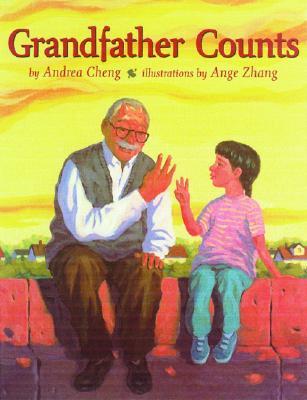 As simple as the language needs to be for a child to easily connect with the narrative, this story is dynamic in its attention to a child facing major changes in her home life when her grandfather arrives from China. Not only does Helen, our protagonist, have to give her up her bedroom and her view of the cargo train that runs outside of her room but, her mother becomes a perfectionist, and her grandfather’s is nearly mute in the household because he doesn’t speak English. But Helen, a little lost in her relationship with her grandfather, is persistent in observing him and trying to connect with him. Ultimately, she makes the connection by mistake in a sentimental manner that I felt was “sweet”. Like her, her grandfather likes watching the trains; together they count the cars and teach each other English and Chinese. Towards the end of the story, the family commits to privately learning Chinese through a computer program her Euro-American father has purchased; one gets the feeling that Helen and her grandfather are going to feel “at home” again. I was gratified to see this book give attention to the American Chinese children who don’t know Chinese and didn’t “fit in” at Chinese language school because the dominant narrative of Asian life still seems to be the immigrant story and first generation story of children who are fluent in the Chinese language. Helen and her siblings are first generation American children of mixed Euro and Chinese heritage who, despite her parents attempts to integrate Chinese culture into their lives, are not immersed in Chinese culture. Any child of immigrant parents whose lives make them consider themselves American descendents of their parents’ culture instead of members of the non-United States culture, will identify with Helen and see something of themselves in Helen’s story. All others will enjoy observing Helen’s lived identity and the multigenerational bonding experience in this simply told, complex story.
Recommendation: Highly Recommended; ages 4-8
Reviewer: Omilaju Miranda
A Wild Cowboy by Dana Kessimalis Smith
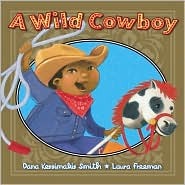 From the opening line of this book, “I am a boy, a wild cowboy,” the reader enters the imaginary world of a city boy who sees his entire world as the ranch that he runs. His parents (Asian Mom/ black dad) take him and his brother to his grandmother’s house. His brother is the protagonist’s “pardner”, his grandmother’s brownstone and it’s small backyard become the ranch; the pets and stuffed animals become the cattle that the grandmother and grandsons must “drive.” They are the “frontier’s best” smack dab in the middle of the city; his mom is a horse, his grandma’s puppies are coyotes and the reader is along for a fun adventure of the mind. You and your child will love the world created in the protagonists mind, the exciting pace of which is set with rhythmical rhyme. I smiled all the way through.

Happy Birthday, Lulu! by Caroline Uff
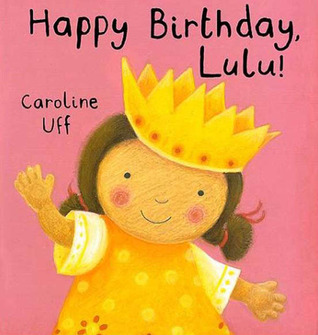 A perfect first picture book, this is about little girl’s birthday morning ritual and enjoyment of her birthday party. The color pencil drawings make all the characters look like dolls—a comforting approach to illustration for the small child. Lulu—the protagonist—happens to be a child of mixed heritage (white mom/black dad); she has an older sister and a very diverse set of friends. This is a great book to engage your child in the discussion of birthday parties. Uff has several more in the Lulu series.
Recommendation: Highly Recommended.
Reviewer: Omilaju Miranda for Ages 0-4

That’s My Mum by Henriette Barkow

Inside page–Kai with his mom and Amelia with her mom
That’s My Mum is a book that will have obvious significance for many in the Mixed-Heritage communities. One of the things I like about this book is that while the protagonist and first person narrator is Amelia who is brown with a white mother, her best friend whose family gets just as much space on the page is Kai, a biracial white boy whose mom is brown-skinned.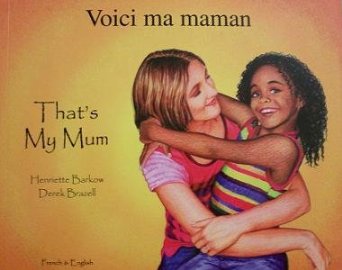
This is only the second picture book I’ve come across that gives attention to the fair-skinned, straight-haired children of brown mothers and the only picture book with a full story arc that does so. The author smartly pairs Amelia and Kai to show that their emotional responses to the mother mix-up are the same. Together, Kai and Amelia face the emotionally and pragmatically challenging issue of people questioning their relationships with their mothers. Though these two friends find the mother mix-up frustrating and saddening, the language of the book remains
light while giving realistic attention to the children’s feelings and communications with people outside of their family. In a humorous twist to their story, the two friends collaborate to create a solution to their shared issue. Many of their ideas are silly, one of which they reject out of self-love and appreciation for what they look like. Ultimately, they decide to make buttons with photos of their mothers– a solution that if noticed by others would completely clarify their relationship with their parents and will put a smile on the adult reader’s face as it represents the innocence and innovation of children’s minds. Child readers may still be confused.
The author’s effort in the middle of the book to demonstrate through the narrative language, the confusion other people face when interacting with them, actually results in confusing the reader as the illustration and the wording are not entirely clear. Due to this, I’d place reading age at no younger than 6-years-old.
Published by the London based Educational Company Mantra Lingua, the book ships from England and is published in dual languages. My copy is in English with Urdu translation, pictured is an English-French copy but the book cover states that it is available in English with 22 other languages. The one drawback to this book for those outside of England –the four weeks it takes to receive the book when ordering through Amazon.com. Enjoy.
Recommendation: Highly Recommended especially for families with brown or yellow parents of white appearing children since this is only the second picture book that I’ve found which acknowledges these parents and children.
Book Review by Omilaju Miranda.
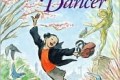
Dream Dancer by Jill Newsome and Claudio Munoz
 A ten-year-old dance prodigy who happens to be of mixed heritage (Latina and white) breaks her foot and goes through the emotional and physical process of recovery until she can dance again. I say “happens to be” because her ethnic heritage is never discussed in the book; we just see her parents and grandmother are of different races. Easy language and an enchanting storyline tell of Lily’s transference of her emotional attachment to dancing to dancing doll. Breezy, evocative writing and illustrationcarries the reader through Lily and her doll’s experience in this story that portrays a child literally falling and getting back up again on a grand scale and rebuilding her dreams.

The Adventures of Harmony by Edward Rea
 Get this book if you want your child to see two characters in a book who are multiracial people of color as are the protagonist and the mother in The Adventures of Harmony. The book is not about their ethnicity or the family’s interracial composition. There’s only one line in the book about her parents “looking different” which isn’t even clearly about their race/ethnicity. The line is so vague that it could be a book about the fact that men and women look different. The blurb on the back cover promised a “round the world adventure” and there are four pages that reference Harmony in relation to the broader world. The illustration was very realistic which I find appealing.
Recommendation: Unenthusiastically recommended only for the purpose of showing your child reader diverse characters.
Reviewer: Omilaju Miranda
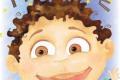
Mixed Like Me by Gina Galliday-Cabell
 The number of times the kid in this book says he doesn’t want to be mixed and the emotion with which the author writes it hit me so hard I was hurt, angry and turned off. I thought, “I can tell why she had to self-publish!” which isn’t really fair because there are some well written books that are self published. I imagine she wrote this book by putting her child’s actual feelings and a real conversation with her kid on the page but for me it kicks so hard, I wouldn’t read it to my 3-year-old; maybe a five and older kid who actually feels this way or needs guidance in peer counseling to help a mixed friend feel better about him/herself. The way the kid learns to feel better about himself is also challenging because way too much of the language that should come from the mother comes from the boy a la, “I know this is what you think of me mom” but there’s no continuity because he is not repeating or restating anything his mother has said. I would show this book to my daughter while not reading it just so my daughter could see an mixed child and his mom. The father is absent although he is referred to in the text. This is valuable for those single mother households. I will either make up my own words or just talk about the pictures and let my daughter make up a story. To me, the kid looks scary or zany looking in half the illustrations which some parents and kids may enjoy. That’s not my thing though.
Recommendation: Not Recommended; Ages 4+
Reviewer: Omilaju Miranda
 Diverse Kids Books--Reviews