
Home » Posts tagged 'multiracial' (Page 2)
Tag Archives: multiracial

All the Colors of the Earth by Sheila Hamanaka
 Poetically, the children of this book become the natural bounty of the earth, their skin color and hair textures compared to the beautiful colors of nature and hair compared to the textures of other living creatures.
With typical sentences/stanzas like,
“Children come in all the colors of the earth—
The roaring browns of bears and soaring eagles,
The whispering golds of late summer grasses,
And crackling russets of fallen leaves,”
a child is able to glean a confidence-inspiring insight into their physical look. This is a beautifully illustrated book that lives up to the lyrical poetry of its narrative. The illustrations go far beyond the normal representation of the human rainbow and, with very detailed rendering of facial characteristics, skin complexions and hair textures, the reader sees real differences in many, many different ethnic types. On the pages of this book, children of every ethnic heritage will find reflections of themselves enjoying life and the world around them. While every physical type of child is represented in ‘All the Colors of the Earth,’ only interracial families are represented, which I think is an exceptional and novel choice however disappointingly inconsistent with the universal inclusiveness of the other illustrations.
Recommendation: Highly Recommended; Ages 3+
Book Review by Omilaju Miranda.

Shades of Black by Sandra L. Pinkney
 This seems to be one of the most celebrated books of the early 21st century for speaking to children about color, race and having pride in one’s Black identity. When I asked people for help in the face of my daughter having trouble from other kids regarding the difference in my and her skin complexions, everywhere I asked, several people suggested this book. It is a photo essay, that on an elementary school level, displays and discusses, in lyrical, free verse poetry nearly the full range of phenotypes of African Diaspora children from white as Vanilla Ice Cream to Blue Midnight. Unlike the children we see on t.v. and featured on many Natural Hair, Black Beauty, and Mixed Heritage websites who are breathtakingly beautiful, the children in Shades of Black are average-looking kids with whom many kids can relate. Although it is not a story book, Shades of Black also stands out amongst children’s books featuring children of the African Diaspora because, unlike most story books that choose medium brown skinned characters as protagonists whether the family is monoracial or interracial, Shades of Black also gives attention to the lightest and darkest of the African Diaspora Spectrum of complexion. While many children of monoracial Black Heritage, Mixed Heritage black and white, or Mestizo Latino and black, will find someone in this book who reflects them or comes close to it, there is only one child who may represent those whose heritage is also South Asian, and none who look like they are also of East Asian Heritage. There are plenty of braided hair styles and one child with dreadlocks featured in this book but no girls wearing afros. What is not here sharpens the focus on what is present: this book is effectively dedicated specifically to the different colors of skin and eyes found amongst children of African Descent.
Because of that contradiction between skin colors of white, brown, gold, orange, etc. and their categorization as “Black,” which can seem illogical to the young child (like my own 3-year-old) who has learned their colors but doesn’t understand the intricacies and inconsistences of racial labels, this book is appropriate as is for the child who has already been introduced to the concept of “Black” as an ethnic/racial group or as a way to introduce your child to “Black” as an ethnic/racial group. For the pre-literate child who doesn’t understand “black” as a race/ethnicity, you can change the words to “I have African Ancestors” and still share the book with them.
I find it challenging that this book presents children who I suspect are either biracial or Multigenerational Mixed Kids as “black” without acknowledging their mixed heritage. Although I don’t agree with this choice from the editor it is an opportunity for parents to discuss with their child how being of African Descent gives one a place in the Black community even when of Mixed Heritage. On the two pages whose statements are “I am Black. I am Unique,” the author chose to feature,” light-skinned children with light eyes as if being black is only unique when “black” manifests in an obviously mixed phenotype. I feel that on one of these pages, a brown or dark-skinned child with brown eyes should have been featured. Pinkney (the author) also features children with hazel green eyes on two different pages, giving two different descriptions for the same color eyes. I cannot find any logical reason behind this choice because the two children featured are also nearly the same complexion; this focus on the same color eyes would have been more effective if the children were different complexions.
However, and whenever you read this book to your child, it is a valuable celebration of the full spectrum of skin colors and many physical traits found amongst children of African Descent.
Recommendation: Highly Recommended
Age Group: As is–after the child knows that “Black” is a racial category; If changing the words to “I have African Ancestors” –age 3+
Reviewer: Omilaju Miranda

PBS Kids’ “Superwhy!”
 If you have not yet discovered the PBSKids show “SuperWhy,” discover it. The main characters—Whyatt/SuperWhy, PrincessPea/ Princess Presto, Red/Wonder Red, Alpha Pig, and Webster are children and pet superheroes living in storybook village whose special powers are related to literacy i.e spelling, phonics, writing and reading. In each episode they help solve a child’s problems by flying into a classic fairy tale in which the child’s problem parallels that of the fairytale protagonist. Then, the SuperReaders save the day by changing the story so that the child in trouble and fairytale protagonist triumph over their issue. This show helps the toddler and preschooler engage in a fun adventure that builds their valuation of reading and helps the early reader learn reading concepts. They cover a full range of reading comprehension and word construction concepts. This is definitely ELA enrichment in the form of entertainment.
The lead character, Whyatt, as described by the SuperWhy wikis and obvious when you watch the show, is definitively olive skinned as is his family. While their ethnicity is not discussed, he has an appearance that many in the mixed and multiracial communities would see as a reflection of themselves. Princess Pea, a green-eyed, brown-skinned girl with waste length wavy hair is actually mixed. In the second episode of the first season, the team flies into the story of Princess Pea’s mother who is the original Princess of “The Princess and the Pea” where we meet her mother who is of African Descent and father who is Caucasian. We rarely see the families of the Super Readers but every episode is going to be a fun, learning episode.
Recommendation: Highly Recommended
Reviewer: Omilaju Miranda

Nina Bonita by Ana Maria Machado
 This book was originally written in Spanish and I read the English translation. Set in Brazil, with a spotlight on that country’s African Diaspora population, the magical friendship between a child and a rabbit whose speech every human can understand, grounds the narrative in levity and fantasy from the first page. Creating a balanced contrast with the text that likens the child to princesses of Africa and fairies from the moon, the straightforward discussion of family likeness and illustration of a full range of Brazilian phenotypes and ethnicities gave me goosebumps as I read this story. Nina Bonita is a girl whose dynamic dark beauty includes “hair curly and pitch black as if made of unwoven threads of night; skin dark and glossy just like a panther in the rain,” who has captured the heart and adoration of a white bunny who wants so much to have a daughter like her. He thinks he must be black himself to have such a daughter and asks Nina “what makes your skin so dark and pretty?” Nina has no idea how she got to be black especially since her mother is brown and her father is white but she makes up stories of how she may have gotten her color. Although the narrative is funny, Nina’s stories are a testimony to the sad fact that white or light is considered normal in her life so she comes up with extreme reasons for “becoming” dark instead of seeing herself as a reflection of her family. The bunny rabbit’s misfortunes in trying to become black like her by following her stories –mainly ending up sick and with diarrhea from drinking coffee and eating blackberries—also demonstrate the pitfalls of not discussing a child’s heritage with him/her. Ultimately, Nina Bonita’s mother overhears the conversation between the girl and the rabbit and tells them that Nina looks just like her grandmother. “Of course!” declares the rabbit who immediately ventures out to find a beautiful “night black” rabbit wife with whom he can make a daughter.
I don’t know if this is because of the translation or if the original had this wording but I’m disappointed in the language that makes it “natural” that Nina Bonita would become the godmother of the jet black bunny that is born to the bunny couple and the assertion that the bunnies have lots of babies “because when rabbits start having babies they never seem to stop” – I’m aware that I’m made uncomfortable by my own experience with racist stereotypes in the U.S. –an issue a few of you may or may not have as well. Other than those little blips, this story contains lyrical language and spirited drawings that bring to life the beautiful diversity of a Brazilian family, elevating the beauty of the least celebrated phenotype in most societies without any negative controversy over her belonging or her natural beauty. It will take you three weeks to receive the book when you order it from Amazon.com but it is well worth it and if you can read it in Spanish, you should get it in the original or maybe both versions. Enjoy.
Recommendation: Highly Recommended; Age 5+
Reviewer: Omilaju Miranda

The Adventures of Harmony by Edward Rea
 Get this book if you want your child to see two characters in a book who are multiracial people of color as are the protagonist and the mother in The Adventures of Harmony. The book is not about their ethnicity or the family’s interracial composition. There’s only one line in the book about her parents “looking different” which isn’t even clearly about their race/ethnicity. The line is so vague that it could be a book about the fact that men and women look different. The blurb on the back cover promised a “round the world adventure” and there are four pages that reference Harmony in relation to the broader world. The illustration was very realistic which I find appealing.
Recommendation: Unenthusiastically recommended only for the purpose of showing your child reader diverse characters.
Reviewer: Omilaju Miranda
What A Family! By Rachel Isadora
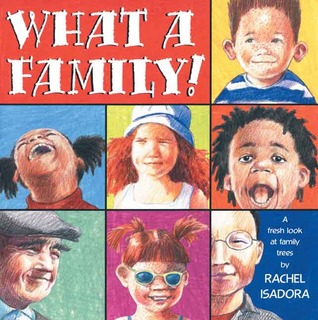 From hair to toes, cousins share similar features even when those cousins appear to be of different racial heritages. In this book, lively illustrations and funny descriptions of common and rarely thought of characteristics are an alternative way to read a family tree. The book shows several generations of the family highlighting the physical links across generations of cousins.
Recommendation: Highly Recommended; Ages 2-10
Reviewer: Omilaju Miranda

An African Princess by Lyra Edmonds
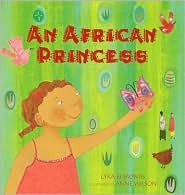 This is a lovely, simple story that deals with some complex identity issues without allowing any of those issues to feel heavy. A Mixed Heritage girl goes on a journey that affirms all the parts of her identity—Caribbean African Princess and United States acculturated, freckle-faced, city girl. At the center of this story is Lyra—a freckle-faced brown girl who lives on the tenth floor of an apartment building in the city but her mom tells her she is an African Princess. Starting with the light mentioning of Lyra’s African Princess ancestor captured from Africa and taken to the Caribbean, the story then moves to showing Lyra’s life as a city princess in the United States. Illustrated with collages, that make the reader feel like they are in the middle of an African Diaspora quilt world, the story of African quilts and robes that have traveled around the world as physical surviving representations of African heritage is shown without being told.
When the kids make fun of her for claiming to be an African Princess, Lyra’s family plans a visit to see her mother’s kin in the Caribbean. Daddy, from whom Lyra has presumably inherited the reddish hair and freckles, helps Lyra count down the days to the trip. In the Caribbean, Lyra’s great aunt, shows her quilts made by hand which they use as Lyra’s royal robes. Lyra’s aunt also explains that from the original African princess in their family who had many children—there are now African Princesses all over the world and Lyra is one of them. After the visit to the Caribbean, Lyra is stronger in her identity as an African Princess. I like the fact that she doesn’t have to give up any part of her heritage to be the African Princess descended from a long line of African Princesses.
Recommendation: Highly Recommended;Age: 5+
Reviewed by: Omilaju Miranda

Mixed: Portraits of Multiracial Kids by Kip Fulbeck
 From featuring Russian/Korean children who love soccer to Black/Indian children who like talking and drawing with their younger brothers, Kip Fulbeck’s highly acclaimed photo essay, which has traveled life sized as an art exhibition around the country presents photos of Mixed Kids with a description of their racial/ethnic backgrounds and a short essay from the parents or the child on their lives. Despite the photo of the child of multiracial African descent on the front cover, the book has more photos of children of multiracial Asian Descent (Hapa) than any other ethnicities. One of the most comprehensive sources celebrating mixed kids this reviewer has ever seen, a child with racial/ethnic heritages from all parts of the world will find several or more children with whom to physically identify, as well as get to know beyond the surface level, when reading this book.
Recommendation:Highly Recommended for all; Ages 0-Adult
Book Review by: Omilaju Miranda

Bluish by Virginia Hamiliton
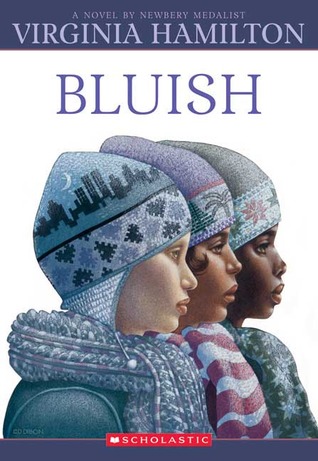 Most of the time I pick books for my children based on their experiences so they know they are not the only ones. Many times, I pick books to introduce adventures we plan to do or places we plan to go. Often I pick books that reinforce our family’s values or our ways of being. But sometimes I come across a book with a new character—a character with a life story we have not encountered yet, but I know we will.
The image on the cover of the book shows three girls in knit hats with varying skin tones and facial features. Natalie is identified as Jewish and Black and her mom bristles at the idea of kids calling her “Blewish”, not realizing her nickname “Bluish” has more to do with blue tint of her skin tone because of her illness. Dreenie and the third girl on the cover are never labeled with a particular heritage although Dreenie calls herself a “sorta sweet chocolate color” and calls Tuli “more honey color.” At one point, Dreenie’s little sister taunts her by saying, “I know who your mama ain’t, Drain. Because you sure ain’t one of us Anneva and Gerald Browns!” causing me to wonder if Dreenie was adopted but there is no more mention of this leaving me confused. But I am not the only one confused– honey-colored Tuli is right there with me. Tulifoolie pretends to speak Spanish singing out phrases, “chica-chica, do the mambo” and calling folks “muchcha” but is told by a Spanish speaking girl that she “gives Spanish kids a bad name.” Tuli lives with her grandmom in a not-so-good part of town. Tuli’s aunt is mentioned but never a mention of a mother or father–and no mention to confirm if she is indeed Latina. Your young reader might not have the need to know the exact heritage of Dreenie and Tuli and therefore might escape the confusion I experienced. All three girls play a major role in the story and present very different individuals who come together as friends. And that is a theme with which many readers can relate.
Recommendation: This book is appropriate for readers ages 9-14.
Reviewer: Amanda Setty
 Diverse Kids Books--Reviews