
Home » Posts tagged 'single parent' (Page 2)
Tag Archives: single parent
Mama, I’ll Give You the World by Roni Schotter
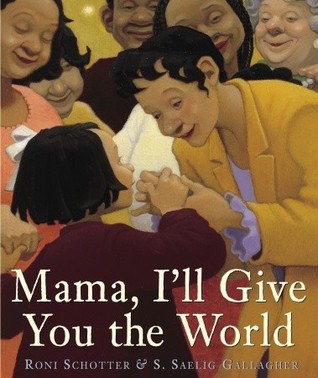 “When Papa was around, Mama loved to dance, but Mama doesn’t dance anymore,” is the first line of Mama I’ll Give You the World and that semi-vague statement is all that is ever said about the absent Papa that lives in the subtext of this children’s story. Perhaps he has passed away, maybe he has abandoned the family; either way, children being raised by single mothers with no father in their lives will feel like their family construct is reflected in Luisa and her mother’s family. Luisa’s mother wants to give Luisa the world that is “so big. So much more for you to know. So much more for you to see.” And that starts every day with Luisa doing her homework beneath a palm tree in the beauty salon and Luisa’s mother saving for Luisa’s college tuition. Doing homework looks exotic, Luisa’s working class world looks like a holiday getaway.
The text is accessible prose that brings the reader smoothly and easily into Luisa’s daily life with her mother in Walter’s World of Beauty– the beauty salon where her mother works. As is so often the case in real life, the salon where Luisa’s mother works is a community gathering place where Luisa’s extended family bonds. The story is a narrative of Luisa communicating with all the adults (hairdressers and clients in her mother’s hair salon) to organize a special gift for her mama—a secret gift that even surprises the reader. Luisa’s dedication to her mother culminates in a climax that made me cry as her daughter celebrates her mother’s birthday by connecting her mother to the past. In the midst of the celebration, the story subtlety introduces a new suitor who has been a trusted friend throughout the book.
Luisa is an observant, sensitive, intelligent character who loves her mom, communicates impressively, and with the realistic precociousness of a child, who while protected by many adults in her life, also lives with the worry about her mother’s happiness and past that overshadows their lives. The illustration is fanciful and engaging, telling the story of the loving community to which Luisa belongs.
Luisa’s world is diverse, filled with people of all races and may ethnicities. Although there are no Spanish words spoken, several of the characters bear Spanish names and the full range of physical features found amongst white, tan and moreno Latinos. Children whose families are from many parts of Latin America—whether the Spanish Caribbean, Central, or South America will feel reflected in the characters represented. Additionally, there are two male hair dressers working with Luisa’s mother—one of whom seems to be slightly effeminate so that without saying it directly, we see that Luisa lives in a diverse and all inclusive world.
Recommendation: Highly Recommended
Reviewer: Omilaju Miranda
If I Were Your Father by Margaret Park Bridges
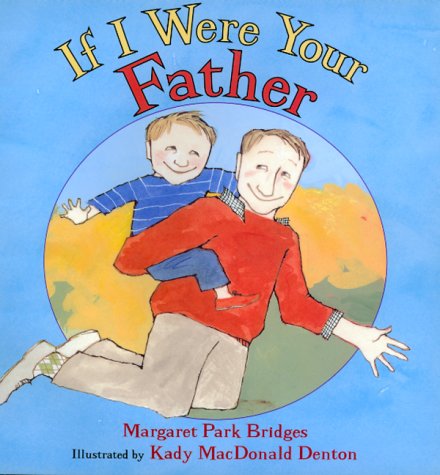 This book is a feel good conversation between father and son as the son shares his unrealistic imagination of what an ideal father should be and his father entertains the son’s musings as they move through the mundane activities of their day. The illustrations do not always coincide with the dialogue which may be a little confusing for children under five but red print for the son and blue print for the father’s words make it incredibly easy to know who is speaking through out. No matter what your family construct, you’re going to love the repartee between parent and child in this book but with no mother present, this is definitely a book with which children, especially sons of single fathers will be able to connect and of course is a good way to introduce the idea that some families are led by a single father to the children in your life.
Recommendation: Recommended; Ages 4+
Reviewer: Omilaju Miranda

Adventure Annie goes to Kindergarten’ by Toni Buzeo
 Annie Grace starts her day with her mom who helps her get ready and takes her to her first day of Kindergarten where Annie tries to create adventures for herself because, after all, Annie Grace is Adventure Annie. She gets into all sorts of trouble around the classroom and school as she single-mindedly tries to find an “adventure”. Eventually, the two quiet, obedient students who her teacher sends to get the milk for snack time get lost and Annie gets her adventure. Mr. Todd charges her with the task of going to find the “milk getters” who are lost. And sure enough, with the help of the walkie talkies that she packed in her adventure toolkit, she finds her classmates and the milk, and brings the wagon of milk back to the class. So, Annie the Adventurer gets to be a super heroine and in the end she is in her mom’s arms with a hug and a smile. Although the story was a little banal and repetitive, Adventure Annie is clearly being raised by a single mom and she’s having a rip-roaring time being herself.
Recommendation: Unenthusiastically Recommended; Ages: 4+
Book Reviewer: Omilaju Miranda
A Father Like That by Charlotte Zolotow
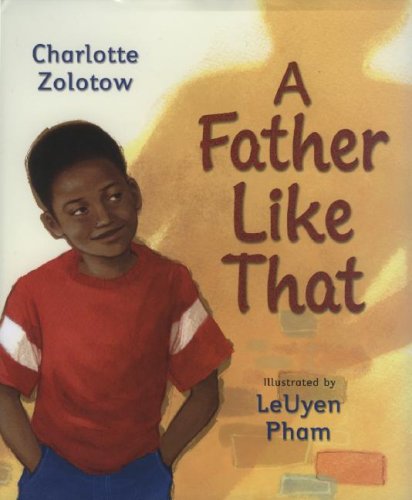 So just bowl me over and break my heart. This narrative comes from celebrated author Charlotte Zolotow who recently passed away. Books like this of hers make us thankful for the stories she gave us before moving to the next life, while we feel the void left in the future children’s literary canon. With the direct, “I wish I had a father,” Zolotow opens up this first person narrative with the painful yearning of her protagonist’s existence. In the conversation with his mother that follows, we see how a child missing a parent imagines a full and complex icon of love for himself and his mother. His pining for a father has moved him to think of every aspect of how a father would treat him and communicate with him, including the way that father would smooth things over with mom and speak in a low voice when angry. An insightful rendering of the depth and breadth of a child’s understanding of the nuances of human relationships, the book gives all single parents a role model in the mother who is just as powerfully evocative. In her one line, she responds with sensitivity to her son’s description of a father, embracing that that type of father sounds wonderful and offers the empowering suggestion that if that father never comes, the protagonist can be that type of father himself one day. Blow me away—this picture book has delivered the best response to a child wanting an absent parent that I’ve heard in a long time. LeUyen Pham’s illustrations pull us in and hold us close to the family of this child’s imagination and secure our emotional connection with mother and son at the end. The narrative is very intimate and feels targeted to the community it specifically represents.
Recommendation: Highly Recommended; ages 6+
Reviewer: Omilaju Miranda

More More More Said the Baby—Three Love Stories by Vera B. Williams
 I didn’t really enjoy this book but I seem to be the only one. It was a Caldecott Honor Book in 1990 and my 3-year-old daughter got in to touching her own belly button during the part where “Little Guy’s” father is kissing his belly button. I may have found this book more engaging if I’d discovered it for my child when she was an infant or early toddler. This is one of Vera B. Williams’ books that exists for the illustrations and not the written narrative. There are three short stories in this book—stories that illustrate three different children receiving affection from their caretakers. The copyright page explains that the book is based on the gouache paintings and as I read it, the narrative was so thin, in my opinion, that I felt the words were just put on the page to justify putting a multicultural children’s book on the shelf but that was 23 years ago and one of the first, if not only Caldecott honor books with interracial families.
So what exists that is multiculturally relevant? There is a lone father caretaker of a child, there is a Caucasian grandmother caretaker of a child of multiracial African descent, and there is a brown-skinned mother of a light-skinned Asian child. The challenge with the Gouache paintings is a lack of defined detail. My daughter thought that “Little Guy” was a girl who didn’t like her father and, while we suspected that the grandmother was Caucasian, my grandmother upon reading it wasn’t sure—the way the features are drawn, she could just as easily have been a light-skinned woman of color. Similarly, I do not know whether the mother with daughter is supposed to be a brown-skinned Asian sharing her daughter’s ethnicity or a woman of a different ethnicity or race. In an interview I can’t find right now, Williams says that she wrote the book to fill the void of in the children’s books market with interracial families so having read that interview, I’m certain the grandmother is Caucasian. You may find the last painting uncomfortable as a child is splayed in a way that is a little exposing—my daughter asked if the girl had on shorts under her dress. What is clear is that readers can definitely see that families are composed of a rainbow of people. Since this is a book about relationships between familial adults and children, without couples or references to two parents, this is a book that can definitely reflect and validate single parent and alternative guardian families.
Recommendation: Valuable to have in your book collection; Ages 0-4
Reviewer: Omilaju Miranda

Molly Bannaky by Alice McGill
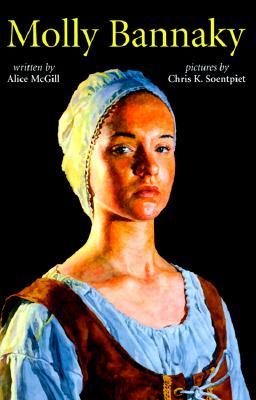 With an awe-inspiring light touch that manages to impart the oppressive colonial history of indentured servants and African slaves without sugar coating or overwhelming the young reader with the harsh realities of this period of history, Alice McGill writes the love and family story of former indentured servant, Molly Walsh and her formerly enslaved husband Bannaky—the grandparents of Benjamin Banneker. Chris Soentpiet’s water color paintings provide an evocative illustration for a story whose complexity holds the reader’s emotional commitment from the first to last page. You feel the griot that is author Alice McGill as you read Molly Bannaky. Every classroom should have a copy of this mini-biography of one of history’s women of strength and every household with or without children should have a copy of this book on its shelves. Not a bedtime story but a story to be read and discussed.
Recommendation: Highly Recommended; Ages 6-10
Reviewer: Omilaju Miranda

Becoming Naomi Leon by Pam Munoz Ryan
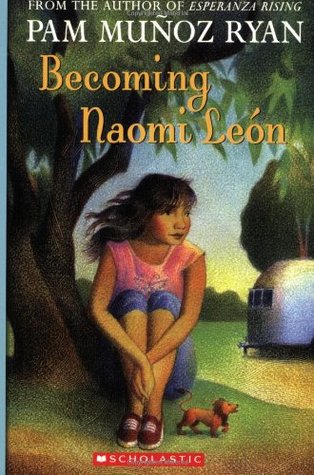 Naomi Soledad Leon Outlaw is a ten year old girl who lives with her great-grandmother and disabled brother in Avocado Acres Trailer Rancho in Lemon Tree, California. She hasn’t seen her mother in seven years, and her father is in Mexico. Naomi is an avid reader, list maker and soap carver who is devoted to her family and loves works. Her world transforms one afternoon when her glamorous looking mother, who has changed her name from Terri Lynn to Skyla, shows up unannounced with armfuls of gifts. Although Naomi is thrilled to meet her mother, she feels overwhelmed. When it emerges that Skyla is an alcoholic who has been in and out of rehab and that she not interested in Owen, Naomi’s brother, because has a disability, Naomi becomes quickly disillusioned.
The novel follows Naomi’s coming of age story and her development into a young woman. Her unconventional family is made up of her great-grandmother and brother, but also includes her neighbors from Mexico, and her estranged father. In an effort to reconnect with the children’s father – and to thwart Skyla’s attempts to take Naomi from her home – their great-grandmother takes them on an impromptu road trip to Mexico in their airstream trailer, named Baby Beluga. They arrive in the country right before La Noche de los Rabanos, The Night Of The Radishes, a Mexican festival where carvers create elaborate artwork out of radishes. The Leons, they find out, are renowned as carvers, and Naomi experiences a deep cultural immersion in discovering her Mexican roots, wearing a traditional Mexican Village woman’s blouse and huraches, and carving radishes with her friends.
‘Becoming Naomi Leon’ is a poetic, poignant novel with excellent character development and gentle treatment of difficult subject matter. It’s a classic coming of age story that incorporates the positive aspects of cultural mixing, and handles this complex family structure with grace and insight. The discovery of the long lost Mexican father is the highlight of the narrative.
Recommendation: Any advanced reader will enjoy this book, which could also be a good book to read to a child who is ready for chapter books to read aloud.
Book Reviewer: Jill Moffett
 Diverse Kids Books--Reviews