

Shades of Black by Sandra L. Pinkney
 This seems to be one of the most celebrated books of the early 21st century for speaking to children about color, race and having pride in one’s Black identity. When I asked people for help in the face of my daughter having trouble from other kids regarding the difference in my and her skin complexions, everywhere I asked, several people suggested this book. It is a photo essay, that on an elementary school level, displays and discusses, in lyrical, free verse poetry nearly the full range of phenotypes of African Diaspora children from white as Vanilla Ice Cream to Blue Midnight. Unlike the children we see on t.v. and featured on many Natural Hair, Black Beauty, and Mixed Heritage websites who are breathtakingly beautiful, the children in Shades of Black are average-looking kids with whom many kids can relate. Although it is not a story book, Shades of Black also stands out amongst children’s books featuring children of the African Diaspora because, unlike most story books that choose medium brown skinned characters as protagonists whether the family is monoracial or interracial, Shades of Black also gives attention to the lightest and darkest of the African Diaspora Spectrum of complexion. While many children of monoracial Black Heritage, Mixed Heritage black and white, or Mestizo Latino and black, will find someone in this book who reflects them or comes close to it, there is only one child who may represent those whose heritage is also South Asian, and none who look like they are also of East Asian Heritage. There are plenty of braided hair styles and one child with dreadlocks featured in this book but no girls wearing afros. What is not here sharpens the focus on what is present: this book is effectively dedicated specifically to the different colors of skin and eyes found amongst children of African Descent.
Because of that contradiction between skin colors of white, brown, gold, orange, etc. and their categorization as “Black,” which can seem illogical to the young child (like my own 3-year-old) who has learned their colors but doesn’t understand the intricacies and inconsistences of racial labels, this book is appropriate as is for the child who has already been introduced to the concept of “Black” as an ethnic/racial group or as a way to introduce your child to “Black” as an ethnic/racial group. For the pre-literate child who doesn’t understand “black” as a race/ethnicity, you can change the words to “I have African Ancestors” and still share the book with them.
I find it challenging that this book presents children who I suspect are either biracial or Multigenerational Mixed Kids as “black” without acknowledging their mixed heritage. Although I don’t agree with this choice from the editor it is an opportunity for parents to discuss with their child how being of African Descent gives one a place in the Black community even when of Mixed Heritage. On the two pages whose statements are “I am Black. I am Unique,” the author chose to feature,” light-skinned children with light eyes as if being black is only unique when “black” manifests in an obviously mixed phenotype. I feel that on one of these pages, a brown or dark-skinned child with brown eyes should have been featured. Pinkney (the author) also features children with hazel green eyes on two different pages, giving two different descriptions for the same color eyes. I cannot find any logical reason behind this choice because the two children featured are also nearly the same complexion; this focus on the same color eyes would have been more effective if the children were different complexions.
However, and whenever you read this book to your child, it is a valuable celebration of the full spectrum of skin colors and many physical traits found amongst children of African Descent.
Recommendation: Highly Recommended
Age Group: As is–after the child knows that “Black” is a racial category; If changing the words to “I have African Ancestors” –age 3+
Reviewer: Omilaju Miranda

Let Freedom Sing by Vanessa Newton
 With stylistic, cartoon-like illustrations and a focus on the children’s gospel song, “This Little Light of Mine,” Vanessa Newton tells the story of the Civil Rights Movement from the 1950s until the 21st century in a way that is accessible for children as young as three years old. Filled with illustrations of people of all racial, ethnic, and lifestyle backgrounds working together for freedom, this book is a fun, inviting representation of the United States’ Civil Rights Movement. If you buy this book for your three-year-old, it can grow with them up to the age of ten. Every reader will sing the song that appears, at least in part, on every page. The illustrations tell the non-violent conflict aspect of major moments in the Civil Rights movement, however the language accompanying the illustrations in the foreground typically just names the historical figure saying that they let their light shine. A typical example is an illustration of Rosa Parks on the bus and the words:
“Rosa Parks refused to move,
She let her light shine.”
If your child asks questions, you can fill in the gaps with history at the depth and detailed level that your child can handle. On the inset of some of the pages, there is a more detailed history that you can read to older children. The one exception to what I’ve described above is the image of protestors holding rocks ready to throw them at Ruby Bridges. You may want to turn past that page for younger readers. I am also bothered by the author/ illustrator’s choice to draw Barack Obama as a dark-skinned man more reminiscent of the King children than himself. Other than an inexplicable choice on the illustrator’s part to mis-represent Barack Obama, I like this book for all children.
Age Range: 3-10
Recommendation: Highly Recommended
Reviewer: Omilaju Miranda

Everywhere Babies by Susan Meyers
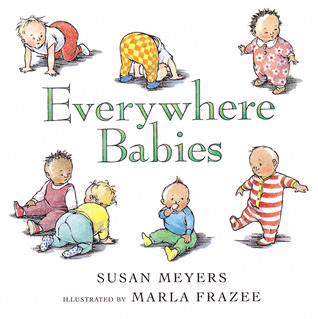 This sweet board book is a like a buffet of babies charming both children and adult readers. The author, Susan Meyers, and the illustrator, Marla Frazee, celebrate baby’s first year of life beginning with swaddled newborns, through all the late night rocking and feeding, into the crawling and playing, exploring life all the while and ending with a cake-covered baby on the first birthday. It is very clear Meyers and Frazee spent a lot of time just watching babies and families. It is also unmistakable they had a message when writing this book—diversity is joyful. We see light-skinned hands lifting a dark-skinned baby and a light-skinned baby reaching out for dark-skinned hands. We hear that babies can be fed “by bottle, by breast, with cups and with spoons.” We see two moms, single parents, two dads, twins, a variety of body shapes and sizes, grandmas and grandpas, and many combinations of skin tone. This book really is the I Spy of family diversity, so the reader will have no problem finding a picture that resembles himself and his family.
The one criticism I have for this book is we do not see any persons with physical disabilities. There is one grandmother holding a baby on her knee while her cane rests beside her, but no obvious example of a child or parent with a disability. We see babies crawling and one baby learning to walk, but it would have been lovely to have seen a child with a walker or braces on her legs. Beyond that, I have nothing but glowing remarks for this book. It is an old favorite of ours and my go-to present for 1-year olds, given that it ends with a birthday party. The closing of the book also speaks to me personally as the mother of an internationally adopted child. “Every day, everywhere, babies are loved—for trying so hard, for traveling so far, for being so wonderful… just as they are!” This simple inclusion of “traveling so far” always made me and my child feel as if the story was hers.
Recommendation: I highly recommend this book for ages 9 months to 3 years. It deserves a place on every book shelf in every home and every place of learning.
Book Reviewer: Amanda Setty
Willow by Denise Brennan-Nelson
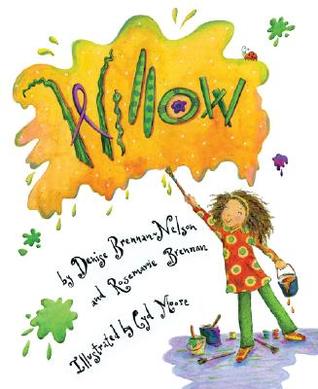 Willow, the protagonist of this book has a personality reminiscent of Eloise and Madeline. Her stubborn determination to be imaginative and artistic even as her art teacher, Miss Hawthorne tries to break the spirit of creativity with rigid rules eventually transforms her teacher. Willow’s open, loving spirit is innocent and generous and the story is an inspiring example of adult-child interaction. The illustrations are energetic, riveting paintings that transport the reader into a parallel universe of creativeWorld. I’ve already gifted this book to one of my daughter’s friends. I bet you’ll find it just as infectious and worthy of sharing.
When one reads Willow, it is easy to believe that you are reading about a child of color, however I bought the second book in the series, Willow and the Snow Day Dance and the character’s parents are both white with no explanation of adoption so I’m thinking that I’m wrong about her being a child of color. In addition, when I read A Fire Engine for Ruthie, I noticed, with the illustrations of Ruthie that it is Cyd Moore’s style to draw her girl protagonists with wavy krinkly hair (although that doesn’t negate Willow’s brown skin). I emailed the illustrator, Cyd Moore and the publisher, Sleeping Bear Press asking if Willow is a child of color and have not yet received an answer. Despite that, I’m including Willow on this site because sometimes children just need to see their likeness on the page in a book with a real story and a child with a dynamic personality, and there are plenty of children of color who can look at Willow and see themselves in her light brown skin and wavy hair that grows out instead of down.
Recommendation: Highly Recommended; Ages 5+
Reviewer: Omilaju Miranda
A Father Like That by Charlotte Zolotow
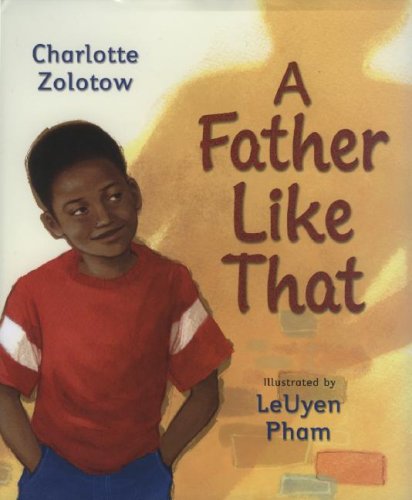 So just bowl me over and break my heart. This narrative comes from celebrated author Charlotte Zolotow who recently passed away. Books like this of hers make us thankful for the stories she gave us before moving to the next life, while we feel the void left in the future children’s literary canon. With the direct, “I wish I had a father,” Zolotow opens up this first person narrative with the painful yearning of her protagonist’s existence. In the conversation with his mother that follows, we see how a child missing a parent imagines a full and complex icon of love for himself and his mother. His pining for a father has moved him to think of every aspect of how a father would treat him and communicate with him, including the way that father would smooth things over with mom and speak in a low voice when angry. An insightful rendering of the depth and breadth of a child’s understanding of the nuances of human relationships, the book gives all single parents a role model in the mother who is just as powerfully evocative. In her one line, she responds with sensitivity to her son’s description of a father, embracing that that type of father sounds wonderful and offers the empowering suggestion that if that father never comes, the protagonist can be that type of father himself one day. Blow me away—this picture book has delivered the best response to a child wanting an absent parent that I’ve heard in a long time. LeUyen Pham’s illustrations pull us in and hold us close to the family of this child’s imagination and secure our emotional connection with mother and son at the end. The narrative is very intimate and feels targeted to the community it specifically represents.
Recommendation: Highly Recommended; ages 6+
Reviewer: Omilaju Miranda
I Love Saturdays y domingos by Alma Flor Ada
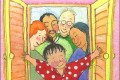
 This is a valuable book to show the bilingual and bicultural immersion of a girl who is multiracial Mexican and Caucasian USAmerican. On every alternate page the protagonist speaks Spanish with her Mexican grandparents. On the surface, the grandparents are different—in addition to their race/ethnicity, the USAmerican grandparents live in the city or suburbs, the Mexican grandparents live on a farm near a fishing pier. The illustrations are lively and evocative. It is a formulaic story of comparisons: My grandpa buys me balloons: my abuelo buys me a kite; my grandma makes pancakes; my abuela makes me huevos rancheros…fourteen pages in, I drifted from boredom. Despite the fact that the comparisons went on for too long in my opinion, the parallel lifestyles and interests of the grandparents makes a powerful impression on the reader of the similarities of people who seem very different. Although the details of their lives are very different, both sets of grandparents love their pets, enjoy the circus, like making things by hand, create exceptional ways to make the protagonist happy and, of course, love their granddaughter.
The plot turn which is actually fun should have come earlier in the book—the protagonist has a party at her house that both sets of grandparents attend during which the grandparents help out with the children. The Pinata and the traditional Mexican birthday song are fun. You and your child may actually want to learn the song as I did.
Recommendation: Mildly recommended
Reviewer: Omilaju Miranda

Documentary Film –“Off and Running: An American Coming of Age Story” by Avery Klein-Cloud and Nicole Opper
 Spanning two years in the life of high school track star, Avery Klein-Cloud, this is the documentary of her journey to reconnect with her birth mother. New Yorker Avery Klein-Cloud is the African American daughter of two white Jewish mothers and sister to two brothers –one Korean and the other African American and Puerto Rican. The documentary opens with Avery reaching out to her birth mother and in a heart wrenching, emotional journey of attempting to balance living a high performer’s daily life with hoping to fill in the voids of her identity, we watch Avery struggle with both of her families, school, and a new found Black awareness as part of her personal self-knowing. At the risk of spoiling, this film is a testimony to the power that love and raising a child with all possible social, familial, and educational advantages have to make sure that those who lose their way make it back home.
I highly recommend this film for everyone and definitely for transracial families and soon-to-be transracial adoptive parents.
Available on Netflix , Shop PBS, and Amazon.
–Transracial Adopted Child (African American/Jewish)
Recommendation: Highly Recommended
Reviewer: Omilaju Miranda

You’re Not My Real Mother by Molly Friedrich
 Molly Friedrich writes a spirited conversation between adoptive mother and child initiated by the Vietnamese daughter declaring “You’re not my real mother” to her mother. What follows is mother and daughter agreeing and laughing their way through an illustrated list of all the things that mothers and daughters do together. When the daughter revisits the issue of not understanding why her mother doesn’t look like her, the mother explains adoption to her daughter. I love the fact that this book deals with the issue of transracial adoption’s most obvious issue for the young child—that they don’t look racially like their parents— head on. By tackling that issue from the beginning of the book, this story respects children for their observation and insight. My three year old lost interest mid-book right after the mother and daughter hugged exalting kisses and parental gobbling of the child. I think she’s used to that sort of scene being the end of a story so an older child should voluntarily keep focus. The author says this is a story of the answer that poured out of her heart when she was faced with this challenge by her daughter. As such, accompanied by lively illustrations it feels incredibly sincere.
Recommendation: Recommended; ages for 4+
Book Reviewer: Omilaju Miranda
Felicia’s Favorite Story by Leslea Newman
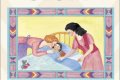
 This is a simple story that demonstrates a girl’s self-knowledge and love of her own familial history. It’s Felicia’s bedtime and before she goes to sleep she wants a story but not one from a book—in classic, creative recognition of a young child’s vanity, Newman has Felicia ask her mom to tell her a story instead of reading her a story—the story of her adoption. Felicia and her moms become a family through an at-birth adoption in which New York native Mama Nessa and Puerto Rican native Mama Linda travel to Guatemala to bring Felicia home .
As her Mama Linda tells her the story, Felicia interrupts, often inserting her humor and her own retelling of the story into her mother’s narrative. Felicia isn’t the only one with humor as her mothers join in with humor of their own which includes ponderings of why they didn’t adopt certain animals instead of a child and stories of how they chose Felicia’s name. If you have an expressive child, you and your child will see their quick wit and self-indulgence in the character of Felicia and you and your significant other in the bargaining, nurturing ways of Mama Linda and Mama Nessa. Adriana Romo’s illustrations look like paintings; Romo even frames them in borders that refer to Latin American cultural art, pulling the reader in as admiring observer as well as reader.
Recommendation: Highly Recommended; Ages 4+
Reviewer: Omilaju Miranda
Families Are Different by Nina Pellegrini
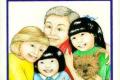
 Nico, the protagonist, is the first person narrator who addresses the reader directly with an opening salutation before moving into the story of her adoption and six years of life. The language feels forced as if Nico is putting her life on display and she is the tour guide. The good thing about Nico’s “museum guide” voice is that even when she speaks of her confusion and sad feelings, she speaks with authority and knowledge which makes her trustworthy for the young child who may be trying to work their way through parallel experiences. I think Nico’s authority can be very empowering in the end when she discovers that although she is different from her parents, she is the same as everyone in her class because everyone has a different family composition. A child reading this may be encouraged to look at the families of her or his classmates and friends and see that there are many different family structures amongst them.
Recommendation: Unenthusiastically recommended for the message not the story; age 5+
Reviewer: Omilaju Miranda
 Diverse Kids Books--Reviews