
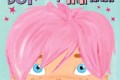
The Boy with Pink Hair by Perez Hilton
 Perez Hilton has written a delectable children’s book about a little boy who is different from everybody else in the world. He is born with bright Pink hair. He is not like his mom or dad. Everywhere the boy with the pink hair goes, people stare and make fun of him. His family loves him and is a happy family and his parents tell him that one day his difference will make a difference. For a while he doesn’t have any close friends but then his parents build him a tree house with a kitchen, giving him a space of his own to cook and he is a food making prodigy. On his first day of school, he encounters a bully but also makes a friend who he invites into his cooking sanctuary. The school faces a crisis and the boy with pink hair solves the problem with his food preparation, bringing everyone together as a community of food preparing teachers and students. Even the bully pitches in to help and eventually they become friends as well. Then, the bully’s father franchises the food creations of the boy with the Pink Hair and he is internationally celebrated and popular. The moral of the story is that even though the boy with the pink hair is different, his difference isn’t what makes his contribution to the world special. He happens to have pink hair and happens to be a cooking prodigy.
Colorfully and engagingly illustrated, this is a book that children of all ages who like vibrant colors and don’t mind several kind of obvious messages or idealistic diversity clichés turned into a story will enjoy. The narrative of overcoming obstacles to relationships and overcoming bullying with collaboration are all positive.
I take umbrage with book’s message that your difference doesn’t matter if you become wildly acclaimed and fix things for all the people who are not considered different. Despite the fact the majority population often only accepts those considered different when they are famous or saviors, this is not what I think young children should be taught. Although the diversity language of “He was born that way” and “His parents didn’t pester him to play games that didn’t interest him,” is familiar language for accepting people in the lgbt community, any child who is in a physical or cultural minority can connect on many levels with the idea of being accepted by their parents.
The protagonist’s difference is an impossible, fun, silly difference that allows all to comfortably discuss diversity and acceptance. Because the book chooses to avoid a direct practical difference or present a complex protagonist, I think it is most valuable when read with an adult and discussing issues of diversity afterwards.Without that discussion, the book is overly PC, vague, and cliche, not really teaching any children how to truly accept difference in themselves or others just because they are human.
Recommendation: Slightly Recommended; ages 5+ with adult to discuss; without adult, leave on shelf
Book Review by Omilaju Miranda

I Love You Like Crazy Cakes by Rose Lewis
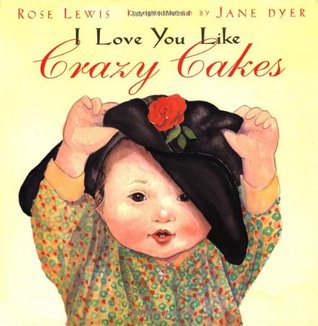 A sincere letter from a Euro-American adoptive mother to her adopted Chinese daughter, this is the first person story of the transcontinental infant/toddler adoption from the mother’s perspective. The language is sensitive and sincere as the mother tells her daughter about their lives before they lived together and their first few days together. Children will enjoy reading about a plane ride, feeling as if they traveled to a mysterious orphanage in China where every baby has a friend in their crib, and a magical connection between mother and child from the first moment they met. My heart warmed at the conscientious, emotional connection the adoptive mother voices, “I held you…and cried. The tears were for your Chinese mother, who could not keep you.” I believe many adoptive parents must feel a connection to the loss birth parents feel or may feel at releasing their child for adoption but this is the first time I’ve seen it on the page in a picture book. For many parents who have trouble expressing that dimension of their feelings to their child, the mother in this book can be their voice. Overall, I am impressed by way the delicate, watercolor illustrations show the adoptive mother’s dedication to integrating China into her daughter’s life. A joy to read.
Recommendation: Recommended; Ages 2+
Book Reviewer: Omilaju Miranda
In Our Mothers’ House by Patricia Polacco
 This is one of the best first person narrative children’s books I’ve ever read. The voice is so authentic I thought it was a children’s nonfiction story until I read the back bookflap. An African descendant woman tells the story of her life with her two mothers, Asian brother and carrot-top sister from their at-birth adoptions until their parents pass away, leaving the family home to the protagonist’s brother. Polacco’s narrative style is one of such candor and fluidity that as the protagonist shares with us the milestones of her life from becoming a big sister to seeing her mothers in dresses for the first time to finding emotional comfort in the home after her parents pass away , the reader is increasingly emotionally invested in their ever expanding world of friends, family and tradition. Polacco also includes the conflict of an anti-gay neighbor in the book, who turns the dial up on that confrontational anti-gay anger pretty high without actually saying “lesbian, gay, or homosexual.” The mothers handle the confrontation in a protective and reassuring manner that gives parents reading this book with children the freedom to explain as little or as much about sexual orientation as parents wish, including saying nothing about sexual orientation and just explaining that sometimes people don’t like others who are different. Illustrated with engaging animation and expressiveness, readers will see and feel a full spate of emotions as we do in real life. While the mothers demonstrate friendly touch affection towards each other and familial touch affection toward the children, for some, it will be important to see that the three children enter heterosexual marriages, framed in family portraits near the end of the book. The choice to show the oldest daughter and the son married to people within their “own” racial groups, demonstrates to me a silent acknowledgement of efforts made by the Italian and English-Irish mothers to encourage, support and preserve their children’s unique cultural identities. Complete with three children who grow up to become successful professionals with happy families of their own, In Our Mothers’ House is the multi-dimensional All American LGBT-parent family story.
Recommendation: Highly Recommended; ages 6+
Reviewer: Omilaju Miranda
I Don’t Have Your Eyes by Carrie A Kitze
 Written with transracial adoptee children in mind, this book, with a series of lyrical statements, contrasting the differences in the physical appearances of children’s and parents’ body parts to the emotions, attitudes , and life perspectives associated metaphorically with the physical, sensorial, or functional purpose of the body part, communicates the conscientious and humane value system that parents teach and transfer to their children with such fluidity and beauty that you feel the text bringing you and your child closer and helping your child see the best in themselves and their depthful connection to you. In no cheesy, but a substantial, poetic, non-didactic prose, the book really conveys that who we are and who we help each other grow to be inside is what is valuable and what makes us family. The illustration is beautiful, realistic and includes illustrations of many different parent-child racial pairings including parents and children who share the same race but obviously different features so it doesn’t have to read as a book about “all of us racially different kids”; a child walks away from this book understanding that no one looks exactly like their parents but the loving way we navigate in the world is the offspring of our parents way of raising us.
Recommendation: Highly Recommended; Ages 4-12
Book Reviewer: Omilaju Miranda

Maniac Magee by Jerry Spinelli
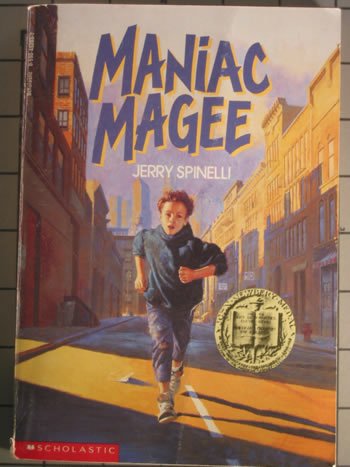 Maniac Magee was first published in 1990, and received the prestigious Newbery Medal in 1991. The National Education Association named Maniac one of its “Teachers’ Top 100 Books for Children” in 2007, the School Library Journal placed it among the “Top 100 Chapter Books” in 2012.
That’s pretty high praise, suggesting the book’s endurance and strength over 20 years. Reading it for the first time in 2014, I wished I had read it when my children were in elementary and middle school. We could have talked about the magic realism that works well in the novel: Maniac’s powers to run, to hit homeruns, and to untie huge tangled knots. Those powers seem to serve Maniac (real name Jeffrey Lionel Magee) well after his parents die in a tragic accident when he’s 3 years old. He runs away after 8 years with his angry aunt and uncle, and ends up in Two Mills, Pennsylvania. He doesn’t realize, at first, how racially divided the town is. Maniac is white, and one of his first and best friends is Amanda Beale, a black girl who treasures books, and whose family takes him in for a short time. His football interceptions and his fearlessness entering a scary backyard build him a reputation among both black and white children as a “maniac.”
Much of the book is about Maniac’s search for a sense of home, as racial and other incidents cause him to keep moving, and make him wonder if he is causing problems for people he cares about. He becomes friends with a washed up minor league baseball player. Maniac teaches Grayson to read and celebrates a sweet Christmas with him. He tries to help a couple of rowdy little brothers stay in school. He eventually ends up homeless again, living in the buffalo pen at the zoo. After one more challenging adventure, Maniac finds his way back to the Beale family.
The themes of racism, illiteracy, and homelessness, plus the blend of an orphan’s magical talents (including his ability to travel long distances and not attend school) provide lots to talk and think about. The 46 (short) chapters are appropriate for third to ninth graders. Social media and electronic devices may have changed a lot in the last two decades, but this story of a child figuring out his way in the world remains compelling.
Recommendation: Highly Recommended; ages 8-14
Reviewer: Maureen McCauley Evans

Kimchi and Calamari
 Joseph Calderaro turns fourteen at the beginning of this engaging, humorous story of a Korean born Italian American kid who is thrown into a quagmire of emotions when, on the heels of his social studies teacher giving him ancestry project that makes him feel that he has no history or ancestral connections because he is adopted, his father gives him a corno for his birthday, as is the Italian cultural tradition in their family
While the major plot of the novel is Joseph’s search for his Korean mother and family, he also has a crush on a girl and teenage awkwardness to overcome. In this story that offers no dreamy endings, Rose Kent writes such a convincing and vulnerable narrative through Joseph’s first person voice that readers will laugh and cry growing close to Joseph and the people in his close circle. Readers will feel agitated with Joseph’s whining, tattle-tale younger twin sisters—the biological daughters of his parents, laugh with Joseph’s best friend who pushes him to do the search for his birth mother and hold their breath in empathy with his father whose fear of rejection and discomfort with the issue of Joseph being of Korean ancestry keeps him from even talking about Joseph’s birth nationality. Kent seamlessly weaves into the story the many ways in which Joseph feels inadequate as a Korean and rootless as an Italian. In addition to the disappointment of finding the “wrong” birth family, he also meets a Korean immigrant family who stereotypically own the Dry Cleaners and have a daughter who is an academic prodigy whose Korean language and cultural traditions exacerbate Joseph’s sense of being “un-Korean”.
At the center of the novel is the drastic and desperate action Joseph takes to hide the fact that he doesn’t know his Korean ancestry and the drama that unfolds and upturns Joseph’s life in the wake of his tortured decision. Ultimately, Joseph’s father breaks his silence, Joseph works to repair the relationships he has broken and his family strategizes an approach to integrating Joseph’s Korean roots into his Italian-American/Korean life. Anyone who likes to read will read ‘Kimchi and Calamari’ twice and love it. Others will read this book and find a powerful story of defining identity, being lost and found as a transracially, internationally adopted child.
Recommendation: Highest Recommendation; ages 9-14
Reviewer: Omilaju Miranda
The Sissy Duckling by Harvey Fierstein
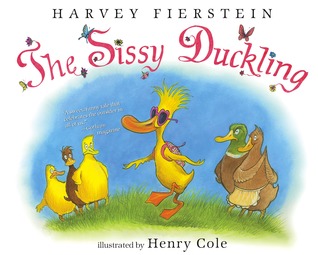 Harvey Fierstein hits it out of the ball park with this fun, colorful, funny, snappy, semi-sarcastic book. I laughed throughout this book. From the opening, I loved, “Elmer was the happiest duckling in the whole forest.” Now, Elmer is a boy duckling who loves doing “girly” things including cheerleading, lots of pink accessorizing, and cooking pretty food, which makes him different from all the boy ducks but he is the happiest. He is so self-assured and comfortable with himself that when his father makes him participate in sports, he’s cavalier and dismissive of those preferred “boy” activities in which his father wants him to participate. That impressed me just as his experience of being bullied and rejected by other ducks, including his father broke my heart. I easily moved along through Elmer’s life, recognizing, although the parallel wasn’t forced—how strongly Elmer’s life parallels the lives of so many gay men—effeminate and masculine—who are emotional throwaways from their family and decide to run away.
But there’s a turn in Elmer’s life that men don’t usually get— he gets to be the hero and save his prejudiced father’s life after he is shot by a hunter’s rifle. Even though the duck community all rally around Elmer accepting him and celebrating him as a hero, Elmer declares, “I am the same duck I have always been. I have not changed. I am a BIG SISSY and PROUD of it!” Elmer’s mother and the third person objective narrator tell Elmer and the reader that Elmer is special not because of his difference but just because he exists. There is a universal message here of Elmer being special because of his strength to be himself when isolated, jeered, and accepted; he never bends to try to conform to what the other ducks consider normative duck behavior. This models so well for all children the special status of being comfortable enough to be oneself in all circumstances. I want to kiss Harvey Fierstein for writing this book. What a winner!!
Recommendation: Highly Recommended; Ages 5+
Reviewer: Omilaju Miranda

The Purim Superhero by Elisabeth Kushner
 This is the coolest story book, exceptional in that dialogue is plentiful—it is full of the realistic conversation that goes on between children and their peers as well as the adults in their lives. Nate has to decide what to be for the Purim Celebration at his synagogue but more importantly, he has to decide whether to be himself—a boy who wants to dress up as an alien— or a follower of the crowd. The crowd in this case is the group of boys in his Hebrew class who are dressing as superheroes. His fathers encourage him to be strong enough to be himself and he comes up with a surprise costume that makes him feel like he is true to himself and will be welcome with the boys in his class. I thought we would get through this entire story without discussing the way in which Nate’s family is different but ultimately as a part of the conversation encouraging Nate to be himself, he and his fathers make a reference to his fathers’ dedication to being their true self. However, conversation over his fathers being two dads instead of a mom and dad does not take up much space in this lovely story about an elementary child’s apprehension over being different from the group and the imaginative solution he finds to restore his confidence. A lovely story for every child who at some point will want to resist peer pressure to express him/herself.
Recommendation: Recommended; ages 4-7
Reviewer: Omilaju Miranda
Molly’s Family by Nancy Garden
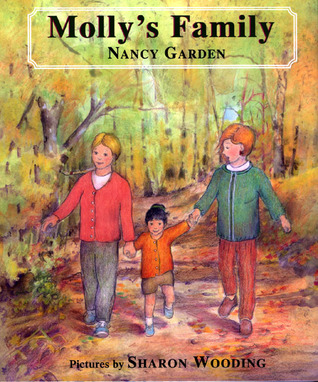 Kids don’t bite their tongue and with the blunt challenge of a six-year-old, Nancy Garden starts this story in which the protagonist, Molly responds verbally and emotionally to her classmate telling her that she can’t have the two mothers that she has drawn as part of her family make up. Molly’s mothers are her birth mother and adoptive mother (which is an important distinction in this category of books that have a strong representation of families made through adoption instead of one of the partners giving birth) but Molly doesn’t know those facts until later in the story when her mothers explain that to her . The teacher and a couple of Molly’s classmates are sympathetic to her hurt feelings and discomfort. Following the incident in the classroom, the teacher and then both of Molly’s mothers explain to her that the family you have is the family that is both possible and real. But the issue is not solved for Molly with these affirmations; she is still unsure of the validity of her two mother family, she is aware of her difference and has lost her confidence which is demonstrated by her leaving the drawing of her family at home on the 2nd day of the story. In a believable parallel with the process children whose home culture is significantly different from the societal norm go through to move from shame and insecurity to validation and acceptance of their families, it is only when the teacher tells Molly again that a child can have two mothers that Molly finally opens up to observing the ways that others are different and her family is real. Realistic illustrations and believable dialogue strengthen this story that gives a child of gay parents an understanding of their validity and other children an understanding of how families differ and live in harmony.
Recommendation: Highly Recommended; ages 5+
Reviewer: Omilaju Miranda

And Tango Makes Three by Justin Richardson
 So, did you know that there was a true story of two male penguins partnering for life, adopting a penguin chick and raising her? Neither did I until I reached the end of And Tango Makes Three, but this all happened at the Central Park Zoo and what a wonderful way for us to see that family takes all constructs in the animal world as in the human world. I think that the fact that this is a true story should have come earlier in the story, to make it more universally appealing as the wonder of it all is that the way the penguins manage their life as a couple and family is very similar to the way that humans find their way, emulating their hetero-normative parents and fellow citizens. Until I knew that this was a true story, I kind of felt like the book was agenda driven which was uncomfortable; once I knew it was a true story I was in awe at the universality of relationship experiences that may very well cross all species. Roy and Silo (the protagonist penguins) are good sitters to the egg given to them by the zookeeper, and when Tango emerges from the egg, they are good parents to her. Because of the straightforward comparative writing, I would say that this book is like a National Geographic story for preschoolers and elementary students with appealing illustration that makes entertaining use of the page. The story is one that everybody of all ages should know to increase awareness and acceptance in society. I tend to like stories that are strong in plot and character internally and independently whereas And Tango Makes Three depends a little too much on comparing the same-gender couple to opposite gender couples and penguin families for my tastes but there is value in informational picture books as well as those grounded solely in good story.
Recommendation: Recommended; ages 3+
Reviewer: Omilaju Miranda
 Diverse Kids Books--Reviews