
Home » Posts tagged 'mixed biracial' (Page 2)
Tag Archives: mixed biracial
Marisol McDonald and the Clash Bash/ Marisol McDonald y la fiesta sin igual by/por Monica Brown
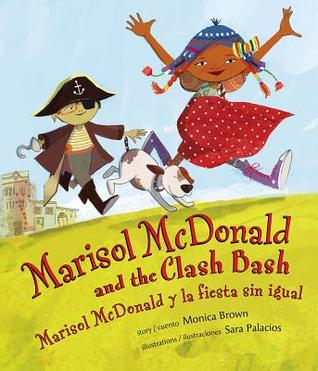 Monica Brown once again delivers a captivating protagonist in the character of Marisol McDonald whose bilinguality, red-headed, brown-skinned physical traits, and mixed Peruvian-Scottish-U.S.American ethnic heritage are significant influences on her daily life. Marisol McDonald became one of my favorite children’s literature characters in the first book in this series, Marisol McDonald Doesn’t Match. This time around, Marisol is days away from her eighth birthday. While she doesn’t want to choose clothes or a party theme that match, she does want to see her abuelita (grandmother) for her birthday. However, Marisol must deal with the disappointing reality that, despite the fact that she has been doing chores and saving money for two years to pay for her abuelita to visit, a visa for her grandmother to visit the U.S. takes too much time for abuelita to arrive before Marisol’s birthday. With the strategic use of hand made, individualized party invitations to her diverse, multicultural group of friends, Marisol is able to get her mismatched costume birthday party and her abuelita finds a special, and realistic way to make an appearance. The story is told in a rich, first person point of view, which includes a sprinkling of Spanish in the English version and a sprinkling of English in the Spanish version so the reader always feels as if they are living in Marisol’s authentic bilingual world. Palacios’ painted illustrations add to the overall cheer of enjoying this book. And the dual language, English/Spanish telling of the story allow the reader to read the story in both languages in one sitting or read it in English one day and Spanish the next day.
My four-year-old who is rather good at decoding and following a good story didn’t follow all the detailed nuances that go along with Marisol choosing not to match and wasn’t as excited about this story as I was so I put target audience at just slightly older and a better fit for the child who can already read. The quality of the story should make it a favorite for children beyond the age of ten even though they will have already moved on to higher reading levels. For the 5-8 year old reader, new vocabulary is emphasized that will make them excitedly run to the dictionary so they can understand every single word and emotion of this spunky, energetic protagonist. I want to see so much more of Marisol McDonald. Once again, think Madeleine, think Eloise, think Olivia the Pig, think Orphan Annie all updated and in a Peruvian-Scottish U.S.American girl. l I love this character; you and your kids will as well. (buy
Recommendations: Highly Recommended Ages 5-8+
Reviewer: Omilaju Miranda

Mommy, Why’s Your Skin So Brown by Maria Leonard Olsen
 The brown skinned, multiracial mixed heritage mother of two children who are lighter than her discusses with her children why she is darker than both of them and much darker than the son who has fair skin, silky blond hair, and blue eyes. The book reads as if the author simply transcribed a conversation that she had with her children. Her anger or annoyance with people who were asking the author if she was the nanny (according to interviews she has given) comes through evocatively in the tone of the narrative as well as on the book’s back cover blurb, which both address the necessity to admonish people to not allow their “curiosity to overwhelm their manners”.
That is a salient point that many parents of interracial families would like to communicate to those who rudely ask questions like “Are you the nanny?” “Is she adopted?” “Is that child yours?”, which confuse and sometimes sadden our children. However, in a children’s book, the tone of the mother’s frustration doesn’t communicate as a part of the children’s characterization and reads as the words of an angry author. It just doesn’t feel like it is from the children, and there’s nothing in the narrative to balance it off.
Points of the narrative that could have been the basis for beautiful illustrations of the entire family are missed. This conversation between the mother and her children is boring as a book read to a child and there are points that actually get confusing where the mother narrator is discussing where everybody got their different features (i.e. the mother speaks of getting her own dark skin from her grandmother, herself being a color in between both her parents, and her son getting blue eyes from his father and the mother’s grandfather) yet there are no images of the relatives to accompany this monologue.
This lack of illustration accompanied by no mention of the mother’s actual ethnicity (research into the author reveals she is biracial Filipina and this story is from her personal life) seems like a strong commitment to being vague. I’m sure the author doesn’t mention the ethnic heritages of her family so that the book could be used universally by the many parents of color of all ethnicities and races who face this scenario but because this book’s only story line is this family, the absence of a discussion of the family’s ethnicity and actual heritage leaves a palpable void. With no characterization for any of the characters in the book and a narration primarily from the mother’s perspective, sadly there is no story here. This is such a loss in part because this is the only picture book I’ve read that focuses primarily on the biracial child with almost exclusively Caucasian features. The other books which even present these children, present them as part of a duo led by brown biracial children or as part of an ensemble cast.
While I do not see this as an enjoyable read for children of any age as a standalone book, this book could easily serve as an interesting guide for adults on how to discuss this matter with their children and the points that can be covered regarding family features. If used in that matter, I would definitely suggest incorporating photos of the referenced family members into the conversation. (buy)
Recommendation: If your family is similar to the one in this book then, couple this book with your own family photos and exploration of your family tree or, for people with all types of family constructs and teachers, couple this book with either That’s My Mum by Henriette Barkow or My Mom is a Foreigner but Not to Me by Julianne Moore and this book can lead off the discussion of the serious aspects of a family dealing with people’s reactions to a mother (or father) looking racially different from her children.
Recommendations: For Adults to lead discussions on interracial families and phenotype differences.
Reviewer: Omilaju Miranda
You Be Me and I’ll Be You by Pili Mandelbaum
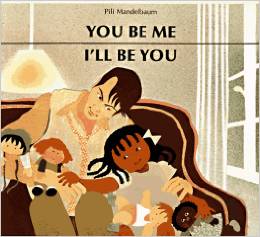 A well intentioned father tries to help his brown-skinned biracial daughter feel comfortable with her skin color by plaiting his straight hair, donning black face and having her don white face. I was almost too insulted to continue reading but out of duty, I finished the book. The narrative attempts to redeem itself by showing people laying out on the beach tanning, using rollers to make their hair curly, and pointing out that every one wants features they can’t have. I don’t know if this did well in Belgium where it was originally published but as a U.S.American, I would never read this to my child.
Recommendation: Not Recommended.
Reviewer: Omilaju Miranda
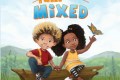
I am Mixed by Garcelle Beauvais and Sebastian A. Jones
 Layers of Love for I Am Mixed
From the first page of I Am Mixed, we enter the magical world of the twins, Nia and Jay—one where the frogs have top hats and butterflies land on little girls’ fingers; straws are made of licorice, grasshoppers are students alongside humans and of course, there are twins—boy and girl twins which in itself is magical—automatic friends who are the same (Mixed) while different (girl/boy, chocolate/vanilla) but have each other and you, the reader can be like them too! You are walking into a mystical fantasy land of wonder and amazement and all this sweet wonder is what makes up the mixed twins.

Book Review for How My Parents Learned to Eat by Ina R. Friedman
 A Caucasian USAmerican sailor and Japanese student fall in love after dating for a year but they’ve never eaten together! In a suspenseful, delightful story we learn how they overcame their anxieties over how to eat “Japanese” (with chopsticks) and “Western” (with knife and fork) and got engaged. The narration is sweet and this is a simply told, dynamic story that you and your children will enjoy.
Recommendation: Highly Recommended; Age: 5+
Book Reviewer: Omilaju Miranda
 Diverse Kids Books--Reviews