
Blog


Book Review for We Adopted You, Benjamin Koo by Linda Walvoord Girard
 This is a first person narrative from the perspective of the adopted child, Benjamin Koo Andrews. In it he tells his life history from birth to his current age—nine-years-old. His story discusses everything from being left at the doorstep of an orphanage when he was approximately 10 days old through his toddler years, early childhood, discovery of his racial difference from his parents and rebelling because he was adopted, adopting his sister and dealing with taunts at school. The book feels like a documentary but it is very informative and acknowledges a wide range of life experiences and feelings that a child who doesn’t share the race or country of his parents may face. The illustrations make the heaviness of the narrative approach a little lighter and this definitely is a book that I feel is a powerful tool for a parent to use to discuss adoption with their child; the text feels like it was written for that purpose moreso than anything.
Recommendation: Recomended; Age 6+
Book Reviewer: Omilaju Miranda

Book Review for Marisol McDonald Doesn’t Match/Marisol McDonald No Combina by Monica Brown
 Just looking at the cover image of this book—a little red-head with toasty brown complexion and Punky Brewster clothing hanging upside down, pink and blue polka dot wrapped pig-tails flapping against her arms, I couldn’t wait to read it. With the title written in English and Spanish, I knew it was going to be a fun read. And, it didn’t disappoint. Once finished, I was so excited, I had to take a few minutes to calm down before writing this review. Marisol embodies and off-beat charm: think Pippi Longstocking, think Eloise, think Madeline; except, Marisol is a Mixed Heritage, Peruvian-Scottish-American and her story is written in English and Spanish with some dialogue in both languages as well. But she is just as confident, plucky, and determined as the other children’s stories’ heroines. Just as her friends and family say she doesn’t match because of her freckled brown skin and red hair (“the color of carrots” says her cousin; “the color of fire”, says Marisol), they say she doesn’t match because she puts peanut butter and jelly on tortillas, they say she doesn’t match because she paints stars in the same sky as the sun, Marisol says all these are good and tasty and unique. Then a friend says she couldn’t match if she wanted to. In true scrappy style, Marisol responds to this comment as if it is a challenge and tries to “match”. Matching is woefully, sad-faced boring until her teacher gives her a note encouraging her to be her mixed up, non-matching self because that is mismatching is true to her. So Marisol in the end is dressed in her Peruvian hat with pink ballet tutu, polka dot skirt and striped leg warmers. She likes herself not matching in every single way. You and your kid will like her too.
Recommendation: Highly Recommended; Age range: 4-8
Book Review by Omilaju Miranda

Book Review for How My Parents Learned to Eat by Ina R. Friedman
 A Caucasian USAmerican sailor and Japanese student fall in love after dating for a year but they’ve never eaten together! In a suspenseful, delightful story we learn how they overcame their anxieties over how to eat “Japanese” (with chopsticks) and “Western” (with knife and fork) and got engaged. The narration is sweet and this is a simply told, dynamic story that you and your children will enjoy.
Recommendation: Highly Recommended; Age: 5+
Book Reviewer: Omilaju Miranda
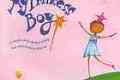
Book Review for My Princess Boy by Cheryl Kilodavis (Ages 3+)
 Heartwarmingly sentimental, a plea for compassion and acceptance of a child who is different and an illustration of a child’s unique life all at once, the reader can feel that this story poured out from a mother’s heart on to the page. Princess Boy loves girl’s clothes and toys. His family loves him and supports him even as others outside the family laugh at him and them. The faceless illustrations make Princess Boy and his family universal. Will you, reader, accept and love Princess Boy?
In addition to being moved by the direct sensitivity of the narrative, the author’s message on the back cover and rear back flap are ones we all need to hear. Written by a mother to educate the children, parents, and teachers who may otherwise have bullied her four-year-old son, My Princess Boy enters your heart and expands it if it’s open and softens it if you were resistant to difference. At the preschool age children are adamantly trying to figure out the details of gender segregation, My Princess Boy involves a child’s senses in the lesson that pink is for boys, too and anybody can like dresses—values that I keep trying to teach my daughter. Whether you borrow it or buy it, it will definitely earn it’s place in your reading space and heart
Book Review for Black, White, Just Right by Marguerite Davol
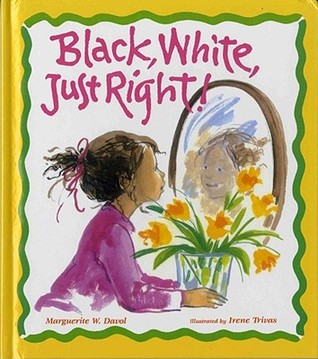 This book does a good job of presenting a full life of a multiracial family including answers to a child’s questions about how she is different from her parents without her ever having to state the questions. They do everything–a true “week in the life…” Downfall is that the text and illustration overtries to eliminate stereotypes by having the white father do a bunch of things that are stereotypically attributed to African Americans. The writing is set up so that only the last two couplets of the quatrains rhyme so that takes a minute to get used to but once you get use to the writing style, it flows. Also, the vocabulary is advanced enough that you can start reading it to your pre-schooler and keep it as a bedtime story until 3rd grade. 4 out of 5.
Book Review for Over the Moon—An Adoption Tale by Karen Katz (transracial adoption)
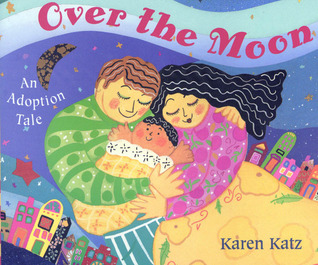
A fairy tale story of the at-birth adoption of a Central American daughter by her parents from the United States. Through magical, mosaic illustrations and mythical language, we learn of a family connected in dreams before the child is even born. The flight the parents take to get their daughter when she is born is on an airplane but the illustrations show the parents flying freely through a multicolored night sky seemingly flying on the fulfillment of their wish to be parents instead of on an airplane. The baby’s first night is chronicled, including the fact that she grew in another mother’s stomach who couldn’t afford to take care of her so mommy and daddy came to take care of her as the fulfillment of their life’s wishes. Then, baby girl goes home where the people who were excited to meet her even before she was born are the family and friends cartwheeling through the streets in celebration of her arrival. Parents and children will be carried away by the magic of this story.
Recommended.
Reviewer: Omilaju Miranda
The Literary Litmus Test: Your First Page

Employers spend an average of just 30 seconds scanning each job resumé. If you don’t make an immediate positive impression, you won’t get called in for an interview.
The same half-minute scan holds true for your fiction. One page is all you have to hook an agent or editor and entice them to keep reading. Without a strong voice, a compelling hook and sharp writing, you’re doomed for a swim with the slushies.
It therefore makes sense to attend a first page critique. The neighborhood kids may giggle over your tale, your friends might deem it wonderful, and your critique partners may even bless it as ready for submission. But a professional opinion is your best literary litmus test.
A professional first page critique can answer these questions:
- Is your writing appropriate for the genre? Does the voice match the target age range? Is your picture book too wordy; is your…
View original post 211 more words
How to Become a Children’s Author
If you want to publish a book for children, the first thing you must do is ask yourself why.
Is your motivation to publish a kid’s book one of the following?
- Your kids/grandkids/nieces/nephews/neighbors/students love a story you’ve written.
- It would be fun to see your name in print.
- You want to sign autographs.
- You want to make money, quickly.
- You want your artist cousin/sister/friend to illustrate it.
If you answered “yes” to any of the above, please read this post. I write this to save you a lot of time and frustration. Because it’s not an easy business. NOT. EASY. AT. ALL.
New writers often believe they can pen one story in an hour or two, never revise it, yet somehow land an agent and a publishing deal—-as if the simple act of writing begets publication.
 Hitting one baseball does not mean the Yankees will draft you. Likewise, writing…
View original post 754 more words
 Diverse Kids Books--Reviews